
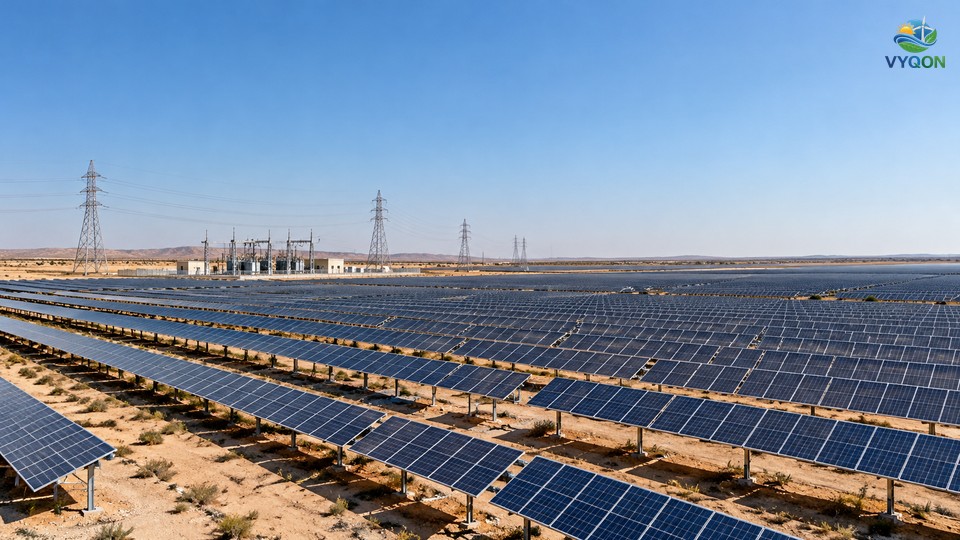
ENGIE has fully commissioned two solar projects in India with a combined capacity of 450 MW: the 250 MW Khaba project in Barmer, Rajasthan, and the 200 MW Khavda project in the Khavda Renewable Energy Park in the Rann of Kutch, Gujarat. The French energy group announced the commissioning in a press release published on 29 October 2026. With the two plants, ENGIE adds 450 MW of operational solar capacity to its Indian portfolio, which the company now puts at about 2 GW in operation or under construction.
The two projects
The Khaba project is a 250 MW solar plant located in Barmer, Rajasthan. It was developed by Khaba Renewable Energy Private Limited, a wholly owned subsidiary of ENGIE. According to the company, the plant will generate about 650 GWh of renewable electricity every year and will avoid the emission of nearly 180,000 tonnes of carbon dioxide annually.
The Khavda project is a 200 MW solar photovoltaic park inside the Khavda Renewable Energy Park, in the Rann of Kutch in Gujarat. It was developed by Enren II Energy Private Limited. The plant will supply electricity to Gujarat Urja Vikas Nigam Limited (GUVNL) under a 25-year power purchase agreement and is expected to produce about 350 GWh of electricity a year. ENGIE has not disclosed, in the release, the tariff of the agreement or the exact dates on which each plant reached full commissioning, so this article does not state them.
ENGIE said that about 80 per cent of the workforce mobilised for the construction of the two plants was recruited locally.
How the projects reached this point
Earlier announcements show how the two projects were financed. In the case of Khaba, ENGIE announced financial closure in the summer of 2026. Reports at that time said the project had arranged a rupee term loan of about Rs 982 crore from the Indian branches of MUFG Bank, Crédit Agricole Corporate and Investment Bank and BNP Paribas, and that construction was expected to be completed by the third quarter of 2026. The release does not say when commissioning was completed, so it cannot be compared directly with that target.
The Khavda plant had reached financial closure earlier, in May 2025, with MUFG Bank and Crédit Agricole Corporate and Investment Bank as lenders, and it was implemented through Enren II Energy, the same subsidiary named in the commissioning release. Gujarat Urja Vikas Nigam, the state utility that buys the power, is also the counterparty of ENGIE’s first battery storage award in India.
ENGIE’s growing Indian portfolio
ENGIE says the commissioning confirms the growth of its business in India, which now combines renewable generation with flexibility solutions. The company recalled two recent awards that mark its entry into battery storage in the country. The first is a 280 MW / 560 MWh battery energy storage system, awarded in November 2025. The second is a hybrid project that combines 200 MW of solar with 100 MW / 600 MWh of battery storage, awarded in January 2026.
The 280 MW / 560 MWh system is a standalone storage project for GUVNL. A power purchase agreement for it was announced in early 2026 at a discovered tariff of Rs 1.87 lakh per MW per month, under a Gujarat initiative to procure 2 GW / 4 GWh of standalone storage.
With about 2 GW of capacity in operation or under construction, India is one of the markets where the group is investing to grow, and the release says ENGIE wants to meet rising demand for reliable, low-carbon electricity there. The 450 MW now commissioned moves a significant part of that pipeline from construction to operation.
What the management said
Pedro Vasconcelos, Deputy CEO of ENGIE in charge of Renewable & Flexible Power, said that India is a key growth market for the group, where it continues to scale up and strengthen its presence while contributing to one of the most important energy transitions in the world. He added that the rapid evolution of the market opens new opportunities, in particular in corporate renewable power purchase agreements (cPPAs) and in combining renewable generation with energy management and flexibility solutions. ENGIE’s ambition, he said, is to build on this momentum and its expertise to create more value for its customers and for the group.
What it means for India’s clean-energy sector
The commissioning matters for several reasons. First, it shows that large utility-scale solar projects are reaching operation. The two plants are in Rajasthan and Gujarat, two states where much of India’s utility-scale solar capacity is being built.
Second, the Khavda plant is backed by a 25-year agreement with a state utility, a tenor that gives lenders and the offtaker long-term certainty on the price of power. Long-tenor contracts of this kind have been a central feature of India’s solar build-out, and the successful commissioning of such plants supports the case for further procurement of solar capacity.
The interest in corporate power purchase agreements suggests that private buyers, and not only distribution companies, are expected to become a larger source of demand, while the focus on flexibility fits the shift towards storage-backed projects.
Official references
- ENGIE Newsroom, “ENGIE met en service 450 MW de capacité solaire en Inde” (press release, 29 October 2026): https://newsroom.engie.com/actualites/engie-met-en-service-450-mw-de-capacite-solaire-en-inde-33ae1-ff316.html
Leave a Comment