
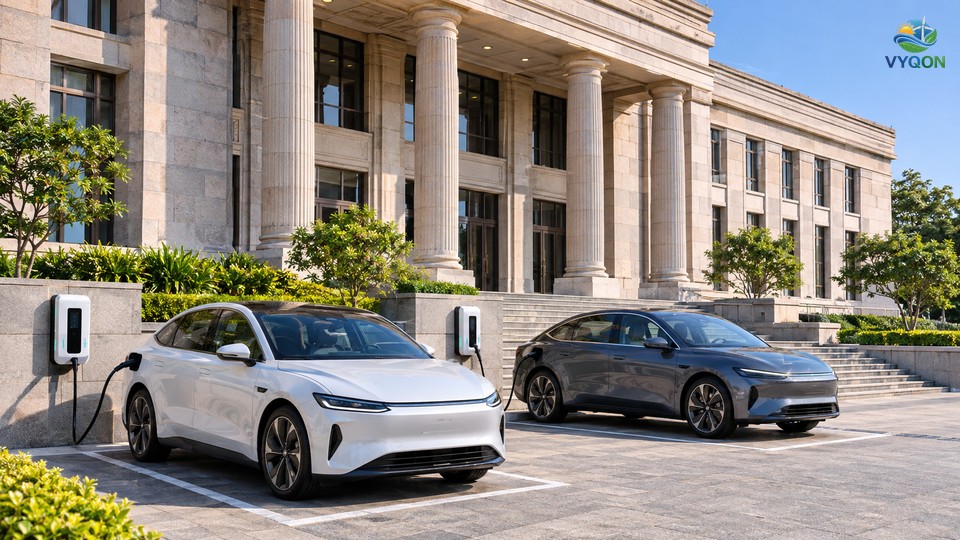
The Finance Ministry has made electric vehicles (EVs) the “default and preferred choice” for the purchase of staff cars by central government ministries and departments. In an office memorandum dated 10 November 2026, the Department of Expenditure set the net dealer price (NDP) ceiling for EVs at Rs 20 lakh, double the Rs 10 lakh ceiling for internal combustion engine (ICE) vehicles, which covers petrol, diesel and hybrid cars. The order came into force with immediate effect.
What the Finance Ministry order says
The Department of Expenditure issued the instructions under the title “Instructions regarding procurement and hiring of staff cars by Ministries/Departments of the Government of India – Revision of Net Dealer Price (NDP) ceiling and promotion of Electric Vehicles (EVs)”. It is listed on the department’s website under its latest notifications.
The key points of the order are:
- EVs first: Ministries and departments shall ordinarily procure EVs when they condemn or replace their existing ICE staff cars. The order says EVs “shall be the default and preferred choice for procurement”.
- New price ceilings: The NDP ceiling is Rs 20 lakh for EVs and Rs 10 lakh for ICE vehicles (petrol, diesel and hybrid).
- Earlier limit: The 2022 instructions on procurement and hiring of cars had fixed the NDP ceiling at Rs 6 lakh.
- Reasons given: The order says the changes are meant to promote electric mobility, reduce dependence on fossil fuels, and reflect prevailing market prices and vehicle lifecycle costs.
When a ministry can still buy an ICE car
The order does not ban ICE cars. If a ministry or department considers that buying or deploying an EV is not practical, it can propose to buy an ICE vehicle. Such a proposal must be justified and sent to the Department of Expenditure, which will decide on a relaxation case by case. The proposal may be sent with the approval of the Secretary of the administrative ministry or department and the concurrence of its Financial Adviser.
Hiring of cars
The order also covers hired vehicles. All ministries and departments must continue to follow the Department of Expenditure’s instructions of 1 September 2022, which mandate the hiring of EVs. Where hiring an ICE vehicle is considered necessary, a justified proposal must again be sent to the Department of Expenditure for relaxation on a case-by-case basis, with the same approval and concurrence.
What stays the same
All other terms and conditions on entitlement, procurement and hiring of cars, as set out in the office memorandum of 1 September 2022 and later instructions, remain unchanged. Procurement continues to follow the General Financial Rules (GFR), 2017, as amended from time to time.
Why the price ceiling matters
The ceiling applies to the net dealer price, not the on-road price. A ceiling that was Rs 6 lakh in 2022 is now Rs 10 lakh for petrol, diesel and hybrid cars and Rs 20 lakh for EVs. The order says the revision accounts for market prices and lifecycle costs. By setting the EV ceiling at twice the ICE ceiling, the order lets ministries consider a wider range of electric models than the older limit would have allowed.
No target for the number of staff cars to be replaced has been announced. Because EVs are to be bought at the time of condemnation or replacement of existing cars, the shift will follow each department’s replacement cycle rather than happen at once.
What it means for India’s clean-energy sector
Central government fleets are a visible part of public procurement. A rule that puts EVs first for staff cars sends a demand signal to electric car makers and charging providers, even if the volumes are modest compared with the retail market. It also gives ministries a reason to plan charging points at their offices, which links the order to power supply and charging infrastructure.
For the power sector, each additional EV adds to electricity demand, and charging at government offices can be matched with rooftop solar where buildings have it. Any such planning would be left to each ministry.
The order fits a wider policy push for clean mobility, energy security and lower emissions. What to watch next is how many ministries use the relaxation route for ICE vehicles, and whether state governments adopt similar rules for their own fleets.
Official references
1. Department of Expenditure, Ministry of Finance, “Instructions regarding procurement and hiring of staff cars by Ministries/Departments of the Government of India – Revision of Net Dealer Price (NDP) ceiling and promotion of Electric Vehicles (EVs)”, office memorandum dated 10 November 2026: https://doe.gov.in/en/instructions-regarding-procurement-and-hiring-staff-cars-ministriesdepartments-government-india
Leave a Comment