
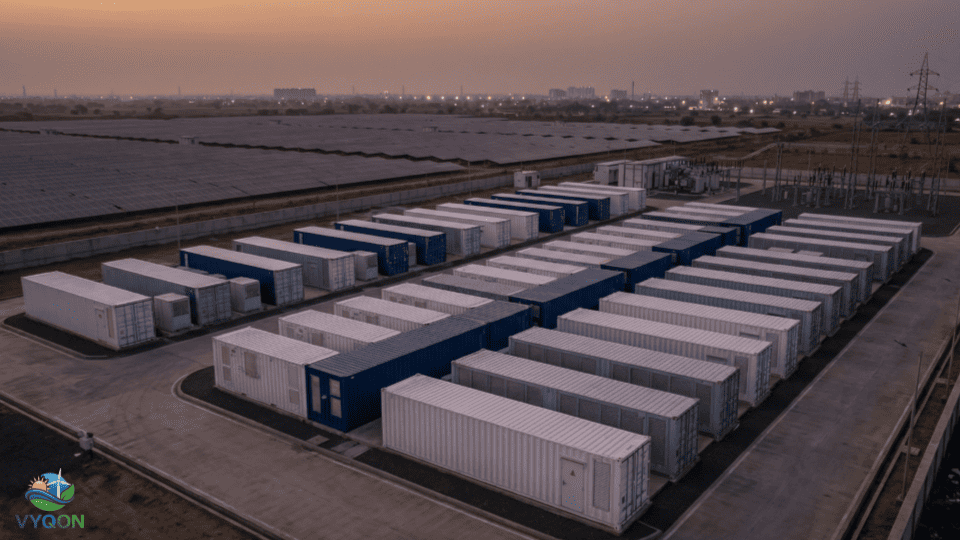
ENGIE India has finalized a Power Purchase Agreement (PPA) with Gujarat Urja Vikas Nigam Limited (GUVNL) for a 280 MW / 560 MWh standalone Battery Energy Storage System (BESS) project. Announced in March 2026, the deal marks ENGIE’s first move into the Indian standalone battery market, representing a strategic diversification beyond the company’s established wind and solar focus. The project is situated in Gujarat and is designed to provide critical grid services, supporting the region’s increasing reliance on renewable energy.
Technical Project Overview
The project is engineered to function as an independent asset, allowing for flexible deployment to maintain grid reliability. Key specifications include:
- Capacity: 280 MW / 560 MWh.
- Storage Duration: Two-hour storage duration.
- Technology Type: Standalone Battery Energy Storage System (BESS).
- Location: Gujarat, India.
- Operational Role: Focused on grid balancing, peak shaving, and managing the acceleration of renewable capacity to ensure the delivery of round-the-clock clean energy.
Financial and Tender Context
ENGIE India secured the capacity through a competitive bidding process at GUVNL’s auction held in November 2025. This tender was part of a larger state-level standalone BESS initiative aimed at establishing 2 GW / 4 GWh of storage capacity to bolster Gujarat’s power infrastructure. The project was awarded at a discovered tariff of INR 1.87 lakh/MW/month. Unlike VRE-paired storage, which is constrained by specific generation assets, this standalone project functions as an independent grid-scale asset to provide flexible peak power management.
Official Commentary on Grid Integration
In an official statement, ENGIE India described the PPA as a milestone reflecting a “critical shift” in the nation’s energy landscape. As the acceleration of renewable capacity continues to introduce variability into the network, the company noted that large-scale storage is emerging as the “backbone of the power system.”
The project is intended to provide the “flexible and firm power solutions” necessary for a modern, resilient power system. By integrating standalone storage, the utility can manage peak demand periods effectively, ensuring that clean energy remains available on a consistent basis regardless of generation intermittency.
Company Profile and 2030 Targets
ENGIE India currently manages a substantial renewable energy portfolio of approximately 2.75 GW, with operational assets spanning seven states. This project marks a significant technological evolution for the company in the Indian market, complementing its existing fleet of variable renewable energy assets with high-response storage capabilities.
The agreement aligns with ENGIE’s stated long-term strategic growth plans for the region. The company has set an ambitious objective to expand its renewable energy portfolio to 7 GW by 2030, underscoring its commitment to scaling clean energy infrastructure and storage capacity to meet India’s 2032 energy storage projections.
Leave a Comment