
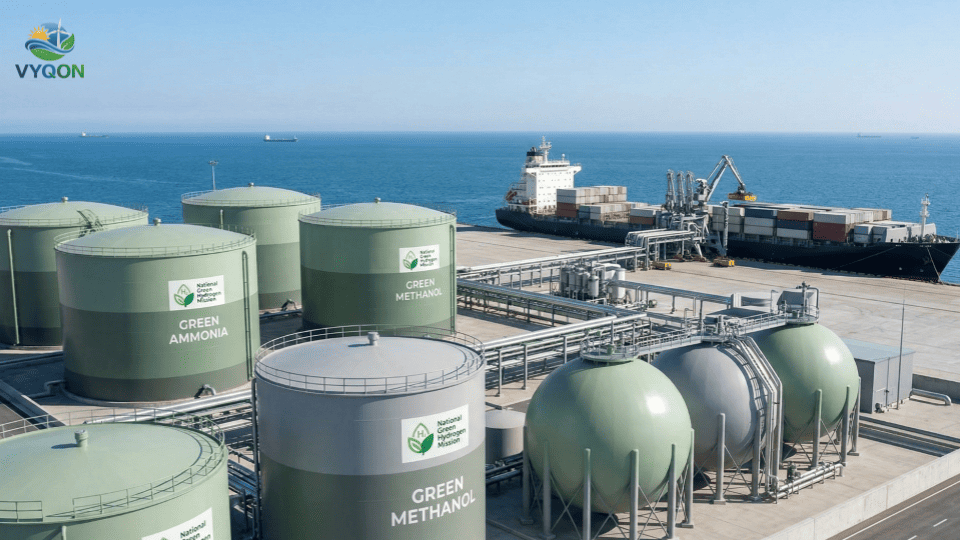
The Ministry of New and Renewable Energy (MNRE) issued a formal notification on February 27, 2026, establishing national standards for Green Ammonia and Green Methanol. This regulatory framework defines the technical criteria required to classify these hydrogen derivatives as “green” within the Indian market. The standards are a key component of the National Green Hydrogen Mission (NGHM), which seeks to position India as a global hub for the production, utilization, and export of green hydrogen and its derivatives.
Technical Specifications for Green Ammonia
Under the new standards, Green Ammonia (NH₃) is defined as ammonia produced using green hydrogen derived from renewable energy. To qualify for this classification, the production process must meet a specific threshold for total non-biogenic greenhouse gas emissions, set at 0.38 kg of carbon dioxide equivalent per kilogram of ammonia (kgCO₂e/kg NH₃).
Compliance with this limit is determined based on a 12-month rolling average. This threshold is mathematically aligned with India’s Green Hydrogen Standard, which allows for 2.0 kgCO₂e/kg H₂. Because the synthesis of one kilogram of ammonia typically requires 0.176 to 0.178 kilograms of hydrogen, the hydrogen production phase accounts for approximately 0.352 to 0.356 kgCO₂e of the final footprint. This leaves a narrow margin of 0.024 to 0.028 kgCO₂e for auxiliary processes, requiring nearly 100% renewable or low-carbon energy for the entire facility.
The system boundary for emission calculations includes the following processes:
- Green hydrogen production, encompassing water treatment and electrolysis.
- Ammonia synthesis, utilizing the Haber-Bosch process or alternative pathways.
- Purification and compression required for the handling of the gas.
- On-site storage at the production facility, including energy-intensive synthesis loop compression and refrigeration.
Technical Specifications for Green Methanol
Green Methanol (CH₃OH) is defined as methanol produced using green hydrogen and renewable energy. The standard accounts for the additional energy required for carbon capture and bond synthesis by setting a total non-biogenic greenhouse gas emission threshold of 0.44 kg of carbon dioxide equivalent per kilogram of methanol (kgCO₂e/kg CH₃OH). As with ammonia, compliance is verified over a 12-month rolling average.
Since methanol synthesis requires a carbon source, the MNRE notification specifies three eligible categories for CO₂ capture:
- Biogenic Sources: CO₂ captured from biomass gasification, fermentation (such as ethanol production), or anaerobic digestion.
- Direct Air Capture (DAC): CO₂ extracted directly from the atmosphere via physical or chemical processes.
- Existing Industrial Sources: CO₂ captured from point-source emissions in sectors such as cement, power, or steel plants, serving as a bridge for Carbon Capture and Utilization (CCU) technologies.
The lifecycle boundary for Green Methanol covers the entire well-to-gate process, including hydrogen production, methanol synthesis, purification, and on-site storage.
Monitoring, Verification, and Governance
The Bureau of Energy Efficiency (BEE), a statutory body under the Ministry of Power, is the designated Nodal Authority responsible for the implementation and monitoring of these standards. Governance is managed through the Green Hydrogen Certification Scheme of India (GHCI), which ensures the transparency and traceability of green fuels to prevent “greenwashing.”
The verification process involves multiple stakeholders:
- Accredited Carbon Verifiers (ACVs): Third-party agencies accredited by the BEE to perform physical on-site monitoring and technical audits.
- Certification Stages: The GHCI utilizes a tiered structure, including Concept Certificates (design phase), Facility-Level Certificates (post-construction), and Final Certificates (issued after annual on-site verification).
A certification fee of ₹5 per 100 kg of green hydrogen or equivalent derivative produced has been established to fund the administrative and monitoring activities of the GHCI. Final Certificates will include unique identification codes for every 100 kg unit to ensure full traceability in the carbon market.
Implementation Path
The BEE is responsible for developing detailed Measurement, Reporting, and Verification (MRV) methodologies tailored to various production pathways. These protocols will define the specific data points producers must record to secure national certification.
The Ministry of New and Renewable Energy may revise the list of eligible CO₂ sources for Green Methanol in the future to reflect technological and environmental shifts. However, any such revisions will include grandfathering provisions to protect the regulatory status of projects that have already reached financial closure.
The establishment of these national standards provides regulatory certainty for the fertilizer, maritime shipping, and chemical sectors. By setting clear, stringent benchmarks, the framework facilitates the transition of hard-to-abate industries toward sustainable feedstocks and supports India’s goal of achieving Net Zero emissions by 2070.
Leave a Comment