
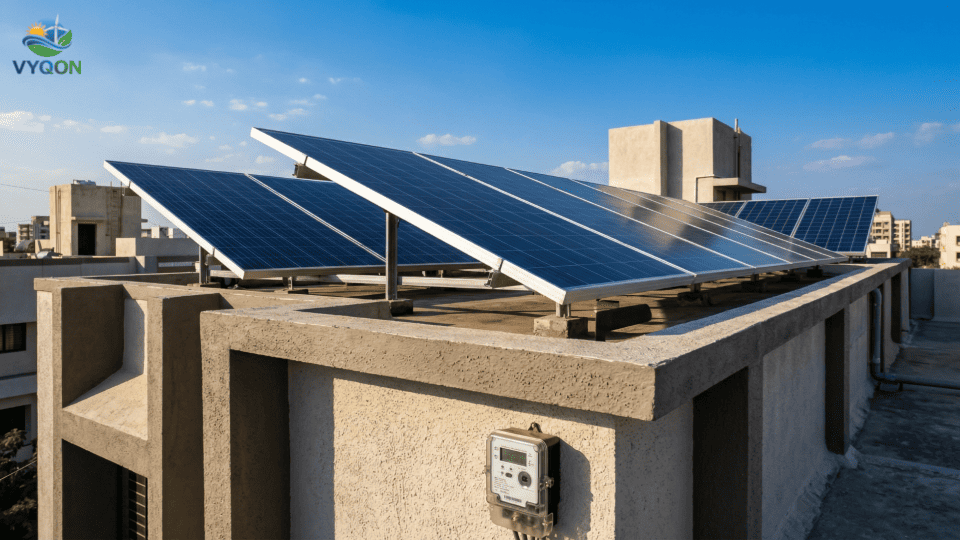
The Maharashtra Electricity Regulatory Commission (MERC), in a Suo-Motu order dated March 30, 2026, has finalized the surplus power purchase tariff for rooftop solar at ₹2.82/kWh for the 2026–27 financial year. Effective April 1, 2026, the rate applies to all unplanned excess electricity injected into the grid by consumers under net-metering and net-billing arrangements. The Commission’s determination reinforces a regulatory framework designed to prioritize self-consumption over revenue generation while maintaining the fiscal stability of the state’s distribution licensees.
Core Tariff Specifications and Effective Dates
The following table outlines the Commission-determined rates for the upcoming financial year:
| Category | Rate/Value | Effective Period |
| Rooftop Solar Surplus Tariff | ₹2.82/kWh | FY 2026–27 |
| Effective Date | April 1, 2026 | FY 2026–27 |
| Regulation Basis | Case No. 1/SM/2025 | FY 2026–27 |
Technical Framework and Applicability
The 2026–27 tariff order is binding for all primary Distribution Licensees (DISCOMs) operating within Maharashtra, including:
- MSEDCL: Maharashtra State Electricity Distribution Company Limited
- BEST: Brihanmumbai Electric Supply and Transport Undertaking
- TPC-D: Tata Power Company Limited (Distribution)
- AEML: Adani Electricity Mumbai Limited
A critical technical restriction effective since February 13, 2026, now governs system sizing. Under this consumption-linked capacity approval mechanism, specifically targeting residential applicants under the PM Surya Ghar Muft Bijli Yojana, system capacity is restricted based on the applicant’s actual electricity consumption over the preceding 12 months. This shifts the design philosophy from future load projection to demonstrated historical usage.
Benchmarking and Regulatory Rationale
The Commission derived the ₹2.82/kWh rate by benchmarking it against the lowest tariff discovered under the Mukhyamantri Saur Krishi Vahini Yojana (MSKVY) 2.0 (Case No. 7 of 2025). By selecting the lower end of the ₹2.82–₹3.10/kWh bidding range, the regulator aimed to align distributed solar compensation with utility-scale procurement costs.
In rejecting stakeholder petitions for higher rates aligned with retail tariffs or Average Power Purchase Costs (APPC), the Commission emphasized that rooftop solar’s primary intent is bill reduction through self-consumption. The ruling explicitly aims to prevent “cross-subsidy” imbalances, ensuring that the cost of purchasing surplus power does not result in a higher tariff burden for non-solar consumers.
Average Power Purchase Cost (APPC) for Gross Metering
For projects under Gross Metering arrangements, where the entire solar generation is exported to the grid, the purchase rate is tied to the DISCOM-specific APPC. These final Commission-determined rates remain constant for the entire term of the Energy Procurement Agreement (EPA) for projects commissioned in FY 2026–27:
- BEST: ₹6.65/kWh
- Tata Power: ₹6.01/kWh
- MSEDCL: ₹5.40/kWh
- Adani Electricity Mumbai: ₹5.11/kWh
- Adani Electricity SEEPZ: ₹2.85/kWh (The Commission invoked its power to remove difficulties by considering the full power purchase basket for this utility, as it sources nearly 100% of its requirements from renewable energy.)
Variable Charges for Ancillary Renewable Energy Sources
Under the RE Tariff Regulations, 2019, the Commission has determined variable charges for legacy renewable projects operating under existing PPAs. These rates incorporate a mandatory 5% annual fuel cost escalation factor.
Biomass-based Projects
The variable charge for biomass-based projects is set at ₹6.85/kWh for FY 2026–27. This reflects a technical correction from the earlier draft estimate of ₹6.87/kWh to ensure accurate fuel cost indexation.
Non-fossil Fuel-based Co-generation (Bagasse)
The variable charge for bagasse-based co-generation projects is determined at ₹5.29/kWh for the 2026–27 financial year.
Stakeholder Context and Policy Shifts
The Vidarbha Industries Association (VIA) and other industry stakeholders have labeled the current regulatory trajectory an “anti-industry tariff structure,” with some calling the latest order a “death blow” to the viability of rooftop solar for commercial and industrial (C&I) consumers.
Grid Support Charges (GSC): A major point of contention is the implementation of GSC, which will be levied on gross solar generation—penalizing power generated and consumed behind the meter. The GSC mechanism will be triggered once MSEDCL achieves a cumulative solar capacity of 5 MW (currently estimated at ~3.5 MW).
Revised Energy Banking Rules: The Commission has tightened banking provisions to align with the principle that energy can only be drawn within the same or lower tariff time slots:
- Normal Hours (00:00–09:00): Energy banked can be used during normal and solar hours, but not peak hours.
- Solar Hours (09:00–17:00): Energy banked is restricted to this specific time block and cannot offset peak-hour consumption.
- Peak Hours (17:00–24:00): Energy banked during this period can be utilized across all time slots.
Notably, residential consumers remain exempt from these Time-of-Day (ToD) slot-wise banking restrictions for rooftop renewable energy, providing a safeguard for the state’s largest consumer segment.
Leave a Comment