
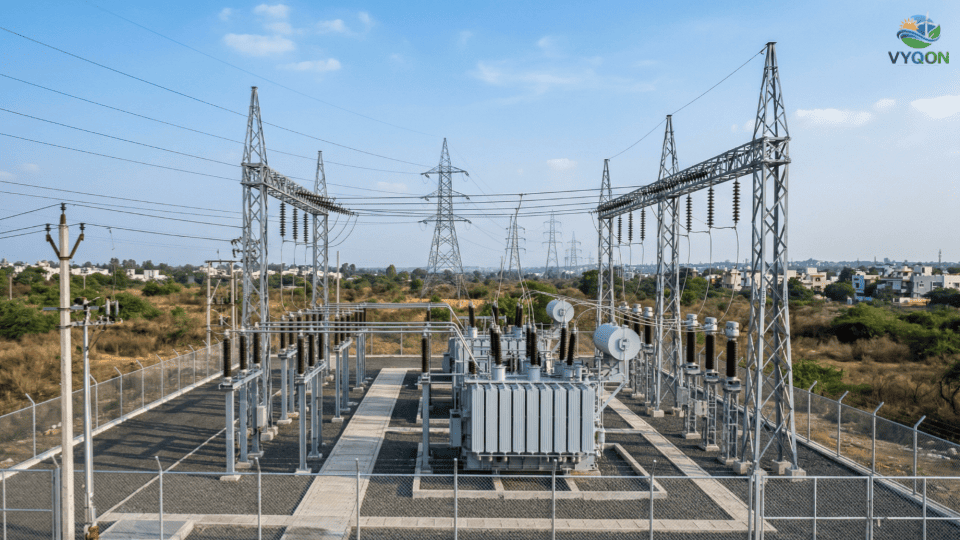
The Telangana Electricity Regulatory Commission (TGERC) has issued its comprehensive tariff order for the 2026-27 financial year, maintaining a freeze on base retail power tariffs across all consumer categories. The order, which takes effect on April 1, 2026, determined that existing energy and fixed charges will remain unchanged for domestic, industrial, and commercial users. While retail rates remain static, the Commission has notified significant revisions to the Cross-Subsidy Surcharge (CSS), Additional Surcharge (AS), and the Time-of-Day (ToD) tariff framework to reflect shifting grid demand patterns and the increasing integration of renewable energy.
Retail Tariff Structure and “Solar Hour” Revisions
In a move to shield consumers from rising costs, the Commission has retained the current energy charges for key categories. However, it has fundamentally restructured the Time-of-Day (ToD) framework to align with increased contracting of renewable energy (RE) sources.
Granular Retail Tariff Details:
- HT-I(A) Industry General: Energy charges are held at ₹7.65/kWh (11 kV), ₹7.15/kWh (33 kV), and ₹6.65/kWh (132 kV and above). Fixed charges remain at ₹500/kVA/month.
- HT-II(A) Commercial: Rates are maintained at ₹8.80/kWh (11 kV), ₹8.00/kWh (33 kV), and ₹7.80/kWh (132 kV and above). Fixed charges remain at ₹500/kVA/month.
- Domestic (LT-I): The Commission kept the tiered slab structure:
- 0-50 units: ₹1.95/kWh
- 51-100 units: ₹3.10/kWh
- 101-200 units: ₹3.40/kWh (for first 100) and ₹4.80/kWh (for 101-200)
- 201-800 units: Slabs ranging from ₹5.10 to ₹9.50/kWh
- Above 800 units: ₹10.00/kWh
- Domestic Fixed Charges: Remained at ₹10/month for consumption up to 800 units and ₹50/month above that threshold.
ToD Tariff and “Solar Hour Rebate”: To incentivize demand shifting to peak solar generation periods, the TGERC introduced a “Solar Hour Rebate” of ₹0.50/unit for consumption between 10:00 AM and 6:00 PM. Conversely, to manage grid stress, the Peak Hour Surcharge (6:00 AM – 10:00 AM and 6:00 PM – 10:00 PM) was increased from ₹1.00/unit to ₹1.50/unit. Normal tariffs continue to apply during the night slot (10:00 PM – 6:00 AM).
Revised Open Access Charges: CSS and Additional Surcharge
The Commission has notified increases in the Cross-Subsidy Surcharge (CSS) while approving a lower-than-requested Additional Surcharge, following a rigorous prudence check of the DISCOMs’ stranded cost claims.
Cross-Subsidy Surcharge (CSS) Adjustments:
- TGSPDCL: CSS for HT-I Industry increased to ₹1.98/kWh (11 kV), ₹1.73/kWh (33 kV), and ₹1.62/kWh (132 kV).
- TGNPDCL: CSS for HT-I Industry at 11 kV moved from ₹1.90/kWh to ₹1.99/kWh.
Additional Surcharge (AS) Rationale: For the first half of FY 2026-27 (April 1 to Sept 30, 2026), the Commission approved an Additional Surcharge of ₹0.13/kWh. Notably, the Commission rejected the DISCOMs’ request for ₹0.59/kWh after recalculating stranded charges and downwardly revising claimed transmission and fixed costs. This ₹0.13 rate is a reduction from the ₹1.45 seen in FY 2025-26 but an increase from the NIL surcharge applied in 2H FY 2025-26.
Other Regulatory Charges:
- Grid Support Charge: Increased to ₹19.77/kW/month.
- Green Tariff: Maintained at ₹0.66/kWh over normal energy charges for those opting for RE power.
Financial Framework: ARR “Pruning” and Revenue Gap
The TGERC demonstrated significant regulatory oversight by “pruning” the DISCOMs’ financial claims. The Commission approved a total Aggregate Revenue Requirement (ARR) of ₹64,950.72 crore, slashing nearly ₹8,000 crore from the DISCOMs’ initial claim of ₹72,996 crore.
- Revenue Deficit: The approved revenue gap was determined at ₹15,105.91 crore.
- State Support: The Government of Telangana has committed a subsidy of ₹14,000 crore.
- Regulatory Asset: The remaining gap of ₹1,105.91 crore has been allocated as a Regulatory Asset. In regulatory terms, this represents a deferred cost to be recovered from consumers in future years, a practice under increasing scrutiny by the Supreme Court.
- TGSPDCL Metrics: The Southern DISCOM’s ARR was estimated at ₹50,242 crore against a projected revenue of ₹40,659 crore at current tariffs.
Regulatory Directives and Administrative Provisions
The Commission issued several directives aimed at consumer protection and administrative transparency:
- Electrocution Ex-Gratia: Compensation for fatal accidents involving non-departmental persons was increased from ₹5 lakh to ₹8 lakh. The Commission directed that payments must be settled within two months of the accident, or DISCOMs must report reasons for the delay.
- Rooftop Solar Billing: Reversing a previous change, the TGERC instructed DISCOMs to determine tariff slabs based on net consumption (import minus export) for net-metered consumers. Any excess amounts collected under the old methodology must be adjusted against the next three billing cycles.
- Open Access Amendment: Under Regulation No. 2 of 2026, RE Generators are now entitled to RECs for unutilised banked energy, providing a new revenue stream for green energy projects.
Stakeholder Engagement and Technical Observations
During the public hearings, technical interventions from groups such as Prayas (Energy Group) highlighted critical areas for future planning.
- Resource Adequacy: DISCOMs must submit their first Long-Term Distribution Resource Adequacy Plan (LT DRAP) by October 30, 2026. Stakeholders urged the Commission to mandate the use of open-source software for these plans to ensure the models can be transparently audited.
- Agriculture Demand: Stakeholders raised concerns regarding the current 12-hour/day demand estimation. The Commission was urged to transition from the “ISI Methodology” to measured energy via feeder-based metering to improve accuracy.
- Historical Transparency: Stakeholders requested the Commission to make the 2017 ASCI study on agricultural consumption public to better inform future demand forecasting.
- Short-term Procurement: The TGERC flagged that proposed short-term power purchases appeared “on the higher side” and directed DISCOMs to strictly adhere to merit order dispatch, ensuring market purchases only occur when prices are lower than the variable costs of existing thermal stations.
Leave a Comment