
Extension of ALMM Framework
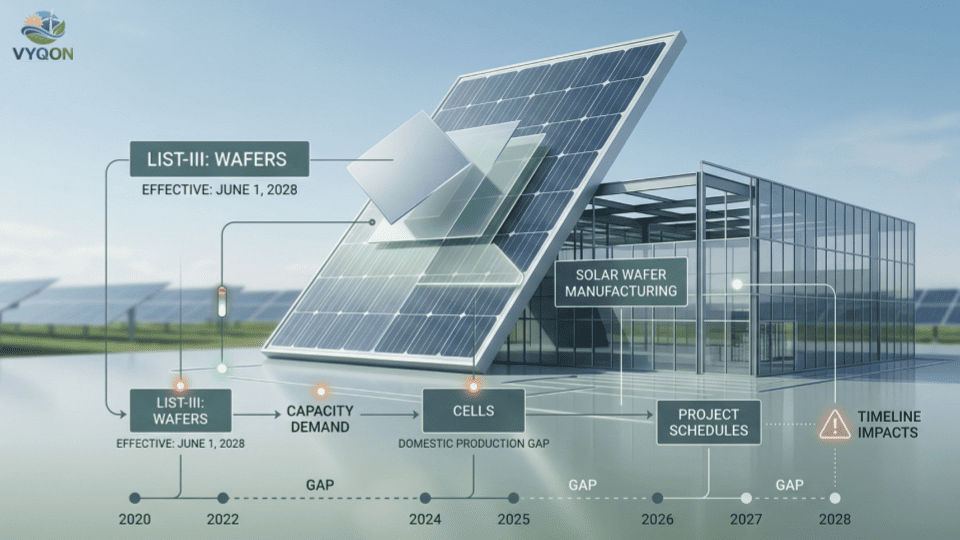
On March 17, 2026, the Ministry of New and Renewable Energy (MNRE) issued a directive amending the Approved Models and Manufacturers of Solar Photovoltaic Modules (ALMM) Order. This regulatory update expands the ALMM framework to include solar wafers under a newly established List-III. The mandate requires full wafer compliance for designated solar projects effective June 1, 2028. According to the MNRE, the policy objective is to facilitate end-to-end domestic integration of the solar manufacturing value chain, encompassing modules, cells, and wafers.
Activation Thresholds: The 15 GW Requirement
The notification of ALMM List-III is subject to specific industrial and legal prerequisites. The list will only be operationalized when the following cumulative conditions are met:
- The presence of at least 3 independently owned and operated wafer manufacturing units.
- The absence of common ownership or direct/indirect control among these units.
- A minimum aggregate domestic manufacturing capacity of 15 GW per annum.
Furthermore, the framework mandates an Ingot-Wafer Linkage. To be eligible for enlistment in List-III, manufacturers must possess commensurate ingot manufacturing capacity, ensuring that the domestic value addition represents upstream integration rather than the processing of imported ingots.
Project Timelines and Compliance Mechanisms
The policy utilizes a Cut-Off Date mechanism, defined as 7 days after the publication of the initial ALMM wafer list. The application of the mandate varies by project category and bidding timeline, as outlined in the following regulatory framework:
| Project Category | Compliance Requirement / Exemption Status |
| Bids submitted or PPAs signed on or before the Cut-Off Date | Exempt from ALMM wafers; mandatory modules and cells required |
| Bids submitted after the Cut-Off Date | Full ALMM compliance (Modules, Cells, Wafers) required |
| Net-Metering/Open Access (Commissioned < June 1, 2028) | Exempt from wafer compliance |
| Net-Metering/Open Access (Commissioned ≥ June 1, 2028) | Full ALMM compliance required |
| Govt-Owned Behind-the-Meter (Pre-June 1, 2026) | Modules only |
| Govt-Owned Behind-the-Meter (June 2026–May 2028) | Modules and Cells only |
Legal analysis from SKV Law Offices identifies an asymmetric transitional treatment within this framework. Government-owned behind-the-meter projects benefit from bid-date-linked grandfathering and a phased compliance pathway. Conversely, Open Access and Net-Metering projects are granted only a commissioning-date-linked exemption, which does not provide pipeline protection for projects already in the procurement or contracting stages.
Domestic Capacity Metrics and Sourcing Gaps
Industrial data indicates a structural imbalance between downstream assembly and upstream manufacturing. As of June 2025, India’s installed PV capacity reached 120 GW for modules and 29 GW for cells. However, CareEdge Ratings estimates effective operational capacity at only 80-85 GWp for modules and 11-13 GWp for cells, with the remaining capacity in stabilization phases. Operational wafer capacity remains limited to 2 GW.
Under the Production Linked Incentive (PLI) scheme, manufacturing achievement rates as of June 2025 were 59% for modules, 22% for cells, 10% for wafers, and 14% for polysilicon. The Karnataka Renewable Energy Systems Manufacturers Association (KRESMA) reports a supply gap of 25 GW for solar generation specifically requiring domestic cells. Total financial risk for PLI awardees is estimated by JMK Research and IEEFA at ₹41,834 crore (~$4.81 billion) through potential encashment of bank guarantees and foregone incentives.
Industrial Implementation Challenges
Industry stakeholders, including RenewSys and Loom Solar, have identified significant financial and technical barriers to upstream actualization:
- Capital Expenditure: RenewSys India estimates the investment required for integrated ingot and wafer facilities at ₹10 billion (~$108 million) per 1 GW. Upstream processes (ingot-wafer and cells) account for approximately 90% of total capital requirements in a wafer-to-module setup.
- Land and Utility Requirements: A 5 GW integrated facility requires 100–125 acres of contiguous land, alongside guaranteed high-capacity power and water access.
- Technical Constraints: Manufacturing remains dependent on Chinese machinery and proprietary know-how. While visa restrictions for Chinese technicians initially impacted commissioning—with only 2,000 visas issued in 2024 compared to 200,000 in 2019—the Ministry of Commerce launched a dedicated visa portal and expedited approval procedure in August 2024 to mitigate manpower constraints.
- Tariff Impacts: CareEdge Ratings projects that mandatory domestic sourcing will increase plain vanilla solar tariffs by 30-40 paise per unit from current levels of ₹2.5 per unit. The impact on hybrid or storage-based projects is expected to be lower due to the smaller proportional share of solar components.
Structural Categorization of ALMM Lists
The MNRE framework utilizes sub-lists to manage transitional exemptions: List-I(a) for modules using non-ALMM cells and wafers, List-I(b) for modules using ALMM cells but non-ALMM wafers, and List-II(a) for cells using non-ALMM wafers. These categories provide context for the phased transition toward the June 1, 2026, mandate for ALMM cells (List-II) and the June 1, 2028, mandate for wafers (List-III).
Technology adoption remains bifurcated among major manufacturers. Adani, Avaada, and ReNew are deploying TOPCon technology, while Reliance has adopted Heterojunction Technology (HJT). Thin-film and integrated manufacturing units currently enlisted under List-I are deemed compliant with both wafer and cell requirements. Manufacturers failing to achieve full value-chain integration within the specified timelines face potential delisting from primary ALMM lists.
Official Attribution
Regulatory mandates and policy directives are attributed to the Ministry of New and Renewable Energy (MNRE). Industrial capacity data and market projections are sourced from Mercom India, CareEdge Ratings, and joint reports by IEEFA and JMK Research. Technical and financial estimates are attributed to RenewSys India and KRESMA as noted.
Leave a Comment