
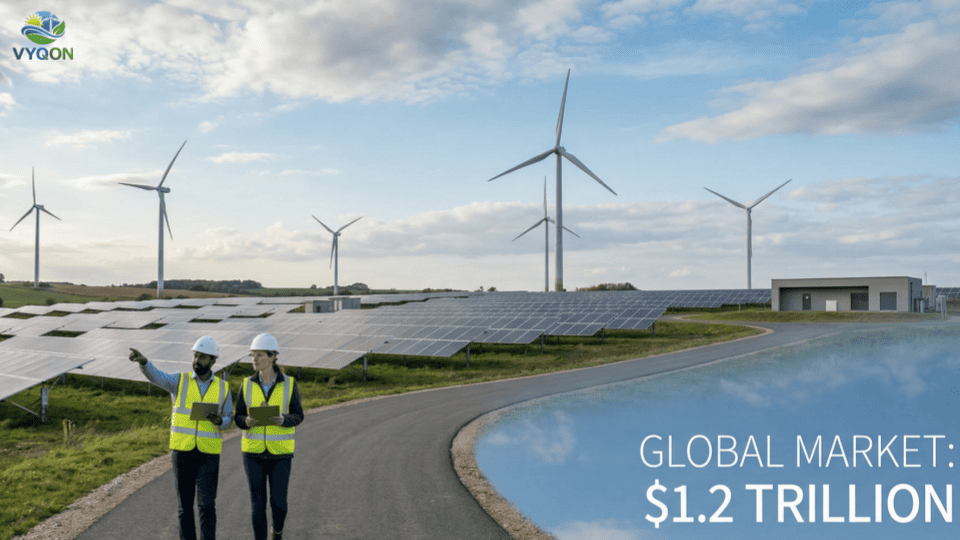
Global energy investment is projected to surge to a record $1.2 trillion in 2025, a milestone defined by clean energy spending now doubling the capital allocated to fossil fuels. According to the International Energy Agency’s (IEA) latest findings, $2.2 trillion is being funneled into clean technologies—including renewables, nuclear, grids, and storage—overshadowing the $1.1 trillion directed toward the fossil fuel supply chain. While total spending hits new heights, the market is increasingly characterized by a “wait-and-see” approach among investors regarding new project approvals (FIDs) as they navigate trade uncertainties and a shifting macroeconomic landscape.
Market Breakdown: Performance of Key Technologies
The 2025 technology landscape is dominated by the continued scaling of solar PV and a significant recovery in nuclear interest, even as the “Clean Energy Equipment Price Index” hits record lows—falling 60% over the last decade. This deflationary trend in equipment costs has allowed solar to become the largest single category in the IEA inventory despite tightening margins for manufacturers.
| Technology Segment | 2025 Estimated Investment | Key Market Driver/Stat |
| Solar PV | $450 Billion | Largest single category; equipment prices down 60% since 2015, driving massive utility and rooftop deployment. |
| EVs & Electrification | $800 Billion | Demand-side surge driven by EV sales and a pivot toward industrial electrification and heat pumps. |
| Nuclear Power | $75 Billion | Investment up 50% over 5 years; driven by large-scale builds in China and tech-sector interest in SMRs for data centers. |
| Battery Storage | $66 Billion | Critical for variable renewable integration; costs continue to plummet, following solar’s trajectory. |
| Wind Power | $160 Billion+ | Western OEMs recovering profit margins after 2024 restructuring; offshore faces persistent capex and policy headwinds. |
Sector Comparison: The “Age of Electricity” vs. Fossil Fuels
The transition from a fuel-intensive to an electricity-centric energy system is accelerating, fueled largely by the rise of Artificial Intelligence (AI) and data centers. Ten years ago, fossil fuel supply investment was 30% higher than electricity spending. Today, the roles have reversed: electricity sector investment is set to reach $1.5 trillion in 2025, now 50% higher than the total spent on oil, gas, and coal supply.
However, the “Age of Electricity” faces a stark reality check. Despite the clean energy narrative, global coal approvals reached their highest level since 2015, spearheaded by 100 GW of new capacity in China and 15 GW in India to ensure energy security. Conversely, the oil market is signaling a cooling period. Upstream oil investment is expected to fall by 6% in 2025—the first decline since the pandemic—with US tight oil serving as the bellwether through a projected 10% retraction in capital expenditure.
“Today’s investment trends clearly show a new Age of Electricity is drawing nearer… energy security is coming through as a key driver of the growth in global investment this year to a record $3.3 trillion as countries and companies seek to insulate themselves from a wide range of risks,” stated IEA Executive Director Fatih Birol.
Regional and Manufacturing Concentrations
Capital remains heavily concentrated in major economies, leaving a precarious investment gap in emerging markets, particularly within the African continent.
- China: Cements its status as the world’s energy powerhouse, spending nearly as much as the EU and US combined. Beyond domestic borders, Chinese firms have committed $80 billion to overseas EV and battery manufacturing in hubs like Indonesia, Brazil, and Türkiye.
- Africa: Represents the most severe investment disparity, accounting for just 2% of global clean energy spending. A primary inhibitor is the continent’s crippling financial burden; Africa’s debt servicing costs are equivalent to over 85% of its total energy investment in 2025.
- Southeast Asia: Emerging as the secondary global hub for solar manufacturing and a critical mineral linchpin, with Indonesia maintaining its position as the world’s largest nickel producer.
Future Projections and Global Targets
The IEA warns of a widening “grid bottleneck” that threatens global energy security. Currently, grid investment stands at $400 billion per year, significantly trailing the $1 trillion spent on generation. To meet COP28 targets, grid spending must reach parity with generation by the early 2030s.
Furthermore, current trajectories are insufficient to meet the COP28 goal of tripling renewable capacity; annual investment in renewable power must double by 2030. To bridge the divide in developing nations, the “Baku to Belem Roadmap” aims to mobilize $1.3 trillion for low-emissions projects by 2035, emphasizing the need for international public finance to de-risk private capital.
Implications: While the transition to electricity is structurally sound, the mismatch between generation spending and grid infrastructure, coupled with high capital costs in developing nations, remains a primary risk. Without a massive reallocation of capital toward emerging economies and transmission systems, the global energy transition will remain a two-speed phenomenon.
Source: International Energy Agency (IEA), World Energy Investment 2025.
Leave a Comment