
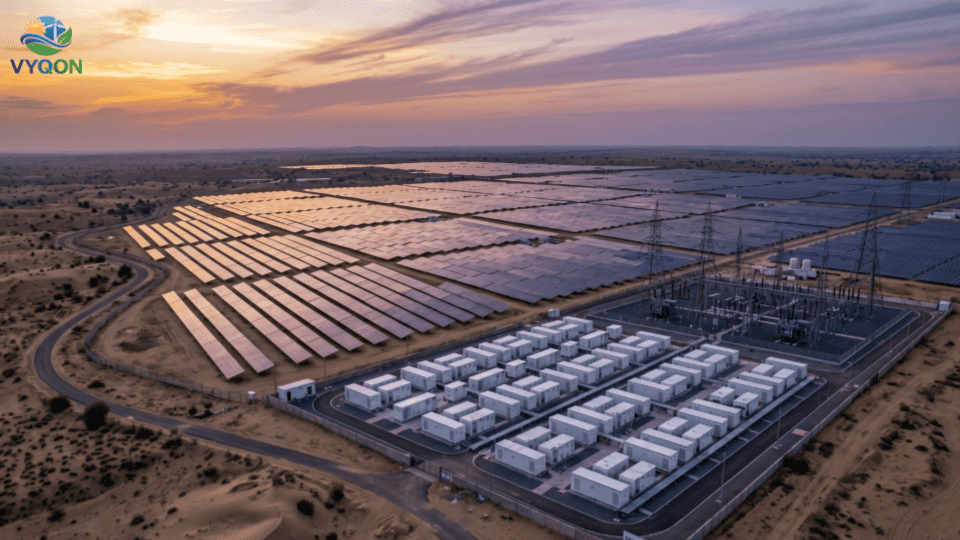
The Central Electricity Regulatory Commission (CERC) has granted tariff adoption for the Solar Energy Corporation of India’s (SECI) Tranche-XX tender, securing 2,000 MW of solar PV capacity integrated with 1,000 MW/4,000 MWh of Battery Energy Storage Systems (BESS). The Commission approved a competitive tariff range of ₹2.86/kWh to ₹2.87/kWh, a regulatory milestone that paves the way for firm and dispatchable renewable energy (FDRE) profiles at rates significantly lower than the ₹10/kWh price caps often seen in peak-hour spot markets. This approval enables the deployment of 4 GWh of grid-scale storage, a critical component for managing India’s evening peak demand.
Technical Background and Tender Evolution
The procurement process was initiated under RfS No. SECI/C&P/IPP/11/0011/24-25, originally dated July 31, 2024. The tender attracted robust market interest, with 27 bidders submitting quotes for an aggregate 7,220 MW, representing an oversubscription of more than 3.5 times. Following a rigorous evaluation, 25 bidders were shortlisted for the e-reverse auction (e-RA) conducted in October 2025.
To ensure grid stability and peak-load management, the CERC order reinforces several mandatory technical and connectivity parameters:
- Storage Configuration: Developers must maintain a storage ratio of 0.5 MW capacity and 2 MWh of energy for every 1 MW of contracted solar capacity.
- Grid Connectivity: Projects must be designed for interconnection with the Inter-State Transmission System (ISTS) at a minimum voltage level of 220 kV.
- PPA/PSA Structure: Power Purchase Agreements (PPAs) and Power Sale Agreements (PSAs) are set for a fixed 25-year duration.
- Project Commissioning: Full supply must commence within 24 months of the PPA’s effective date.
- Technology Standards: All solar cells and modules must comply with the Approved List of Models and Manufacturers (ALMM).
Successful Bidders and Capacity Allocation
The auction concluded with 11 successful developers. Notably, the final allocation for Navayuga Green Energy was determined via the “bucket filling” method, as the developer originally bid for 300 MW but was limited by the remaining capacity in the 2 GW tranche.
| Developer Name | Allocated Capacity (MW) | Tariff (₹/kWh) |
| Shivalaya Construction | 600 | ₹2.86 |
| Purvah Green Power | 300 | ₹2.86 |
| SAEL Industries | 300 | ₹2.87 |
| Welspun Renewable Energy | 200 | ₹2.86 |
| MB Power (Madhya Pradesh) | 150 | ₹2.86 |
| Navayuga Green Energy* | 120 | ₹2.87 |
| Banyan Insolation (Datta Infra) | 100 | ₹2.86 |
| Stockwell Solar Services | 80 | ₹2.86 |
| LC Infra Projects | 50 | ₹2.86 |
| Oswal Cables | 50 | ₹2.86 |
| GH2 Solar | 50 | ₹2.87 |
*Awarded via bucket filling method.
Operational Mandates and Dispatch Protocols
The CERC order specifies stringent operational requirements to transform intermittent solar generation into a reliable dispatchable asset. Developers are subject to the following supply obligations:
- Peak-Hour Dispatch: Developers must supply 2,000 kWh of energy per MW of contracted capacity during daily peak hours as specified by the Buying Entity. This four-hour peak supply mandate includes a technical constraint requiring a continuous discharge of at least one hour.
- CUF Requirements: While the allowable operating range is 19%–30%, developers must formally declare an annual Capacity Utilization Factor (CUF) between 25% and 27% at the time of submission.
- Shortfall Penalties: Failure to meet either the peak-hour obligations or the minimum non-peak CUF will attract penalties as prescribed in the PPA.
- Merchant Operations: Developers may utilize the BESS for third-party sales or power exchange transactions during off-peak hours, provided all primary PPA commitments are satisfied.
Financial Provisions and Regulatory Findings
The Commission concluded that the bidding process was transparent, competitive, and followed the standard guidelines issued by the Ministry of Power. The high level of participation was cited as evidence of the reasonableness of the discovered tariffs.
Key financial and incentive provisions include:
- Trading Margin: SECI is authorized to charge a trading margin of ₹0.07/kWh, provided escrow arrangements or letters of credit are established as security. In the absence of these mechanisms, the margin is capped at ₹0.02/kWh.
- Success Charges: Developers are required to pay success charges of ₹1,00,000/MW (plus applicable taxes).
- Payment Security: A discount of ₹0.02/kWh in the monthly tariff is applicable should the developer opt for coverage under the Payment Security Mechanism (PSM).
- ISTS Waiver: Co-located BESS projects benefit from a waiver of Inter-State Transmission System charges, provided they are commissioned by June 2028.
Leave a Comment