
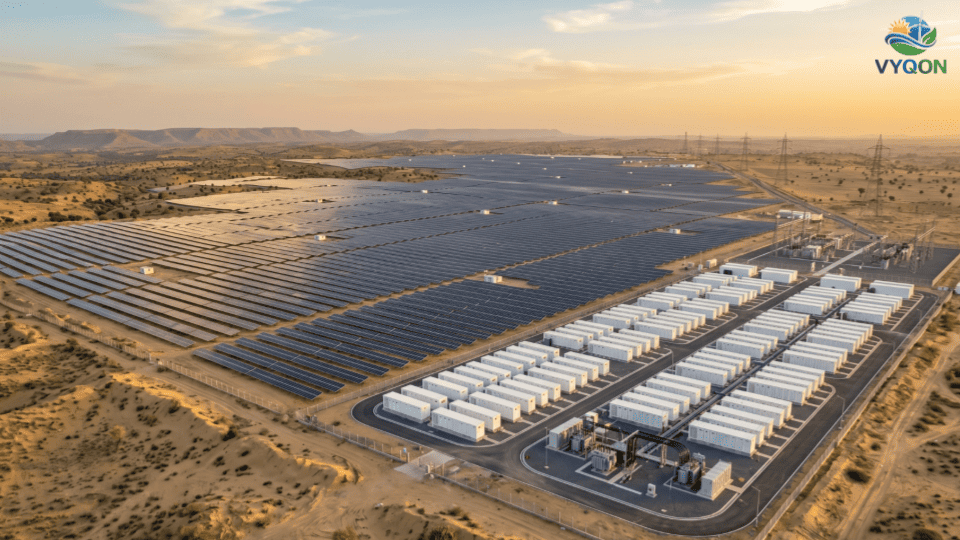
On April 15, 2026, the Central Electricity Regulatory Commission (CERC) issued an order adopting the discovered tariff of ₹3.13/kWh for the Inter-State Transmission System (ISTS)-connected solar-plus-storage projects tendered by NHPC Limited under Tranche-XI. While the initial tender sought 1,200 MW of solar capacity integrated with 600 MW/2,400 MWh of energy storage systems (ESS), the Commission ultimately adopted a total capacity of 1,560 MW following a partial approval of the “Greenshoe Option.” This procurement framework aligns with the Ministry of Power’s 2023 guidelines intended to promote firm and dispatchable renewable energy, assisting distribution companies in meeting their mandatory Storage Power Obligations (SPO).
NHPC submitted to the Commission that the discovered tariff of ₹3.13/kWh is highly competitive and well-aligned with current market trends. The petitioner noted that this rate falls below the range of other recent CERC-approved tariffs, which have typically spanned from ₹3.25/kWh to ₹3.49/kWh.
Successful Bidders and Capacity Allocation
The tariff was discovered through an e-reverse auction conducted on July 15, 2025, which saw participation from 15 bidders. Five entities emerged as successful bidders, each securing capacity at the L-1 tariff of ₹3.13/kWh. The following table details the base capacity and the corresponding storage components allocated to these entities:
| Successful Bidder | Solar Capacity (MW) | Storage Capacity (MW/MWh) |
| Reliance Infrastructure | 390 | 195 MW / 780 MWh |
| PNC Infratech | 300 | 150 MW / 600 MWh |
| SAEL Industries | 300 | 150 MW / 600 MWh |
| JBM Renewables | 150 | 75 MW / 300 MWh |
| Navayuga Engineering | 60 | 30 MW / 120 MWh |
Technical Specifications and Project Components
The tender requirements define the technical and operational parameters necessary to ensure grid stability and the delivery of dispatchable power. Key specifications include:
- Integrated Storage Requirement: Each project must include a mandatory storage component relative to its solar capacity, totaling 600 MW/2,400 MWh for the base 1,200 MW allocation.
- Dispatch Capability: Developers are required to maintain a four-hour daily storage capability to facilitate firm power delivery during peak demand periods.
- Project Locations: Projects are to be set up in Rajasthan, Telangana, Maharashtra, Karnataka, Gujarat, Madhya Pradesh, and Andhra Pradesh, with all units integrated with BESS to bolster regional grid stability.
The Greenshoe Option and Capacity Expansion
The NHPC Tranche-XI tender included a “Greenshoe Option,” allowing for the procurement of additional capacity at the same discovered tariff. Although NHPC awarded a total of 1,940 MW following the auction (comprising the 1,200 MW base and 740 MW in greenshoe capacity), the Commission restricted the adoption of the additional capacity.
Specifically, while SAEL Industries and Navayuga Engineering sought higher additional allocations, the CERC restricted the expansion to 300 MW for SAEL and 60 MW for Navayuga. The Commission observed that the greenshoe mechanism lacked explicit regulatory backing under existing bidding guidelines and moved to ensure the adoption remained strictly compliant with Section 63 of the Electricity Act, 2003. Consequently, the total capacity adopted by the CERC stands at 1,560 MW.
Regulatory Notes and Commercial Terms
The Commission’s order also outlines the financial and operational framework for the intermediary procurer and the generators.
Trading Margin The CERC approved a trading margin of ₹0.07/kWh for NHPC, the intermediary procurer. This margin is contingent upon NHPC providing generators with payment security through an escrow arrangement or an irrevocable, revolving letter of credit. In instances where these conditions are not satisfied, the trading margin is restricted to ₹0.02/kWh.
Project Timeline The Power Purchase Agreement (PPA) duration is fixed for 25 years. Projects are required to achieve commissioning within 24 months from the date the PPA is signed. Based on these regulatory timelines and standard development cycles, the projects are expected to reach the commissioning stage within the 2027-2028 window.
Leave a Comment