
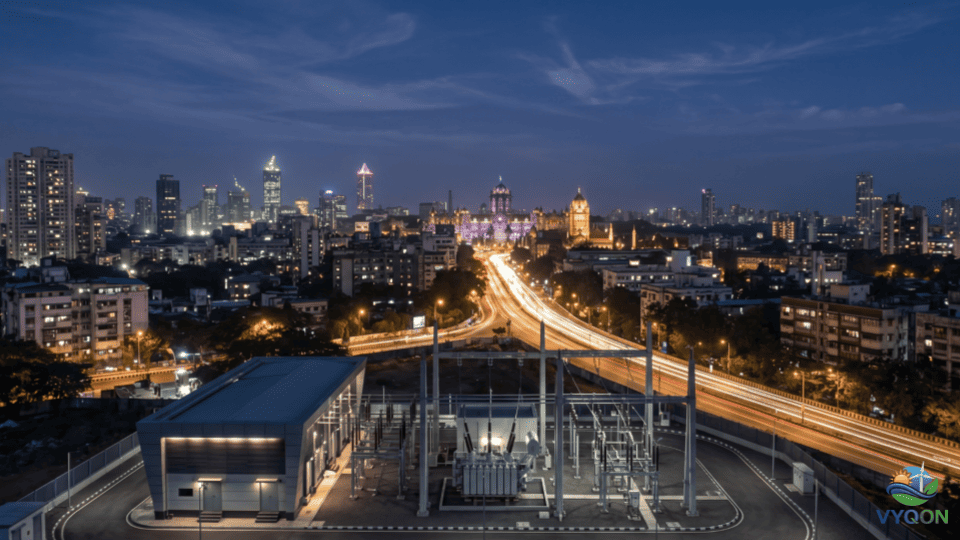
On April 14, 2026, Adani Electricity Mumbai Infrastructure Limited (AEMIL) commissioned a 1,000 megawatt (MW) High-Voltage Direct Current (HVDC) transmission link between Kudus and Aarey. This project represents the most significant grid upgrade for Mumbai in nearly 25 years, providing a 50% increase in the city’s external power supply capacity. The link is specifically engineered to facilitate the bulk injection of renewable energy into the Mumbai Metropolitan Region (MMR), strengthening energy security for more than 20 million residents.
Technical Specifications of the Kudus-Aarey Link
The infrastructure establishes a high-capacity interface between the 400 kV Maharashtra State Electricity Transmission Company Ltd. (MSETCL) Kudus EHV substation in Palghar and the 220 kV AEML Aarey EHV substation in Goregaon East. The link operates as a “virtual generator” with 100% capacity utilization.
Technical parameters include:
- Voltage Level: ±320kV.
- Total Capacity: 1,000 MW.
- Transmission Corridor: A total length of 80 km, comprising 30 km of overhead transmission lines and 50 km of underground XLPE (cross-linked polyethylene) HVDC cables.
- Technology Type: Voltage Source Converter (VSC) based technology with Modular Multilevel Converter (MMC). The VSC valves are self-commutated using Insulated Gate Bipolar Transistors (IGBT).
- Connection Points: The corridor runs from the MSETCL Kudus substation to the AEML Aarey substation, utilizing a Transition Station near Shirsad, located approximately 50 km from Aarey, to interconnect overhead and underground sections.
Operational Innovation: The World’s First Compact HVDC Substation
Due to extreme urban density and space constraints in Mumbai, the project features the world’s first compact HVDC substation at Aarey. This design significantly reduced the physical footprint of the infrastructure, freeing approximately 2 square kilometers of urban land—an area equivalent to roughly 280 football fields or 100 cricket fields. Industry analysts identify this installation as a scalable model for other global megacities facing similar land permitting and grid integration challenges.
The deployment of VSC technology provides the following operational attributes to the Mumbai grid:
- Dynamic Voltage Support: Precise and rapid control of power flows to maintain voltage stability.
- Black-start Capability: The ability to restore power following a grid disturbance without requiring an external power source.
- Independent Power Control: Continuous and independent control of active and reactive power at each terminal.
Grid Impact and Historical Rationale
The project was conceived following the October 2020 Mumbai blackout, which demonstrated the vulnerabilities of the city’s existing transmission corridors. As a core component of the Mumbai Climate Action Plan, the link decongests existing networks and enables the city to transition away from a heavy reliance on in-city generation.
The following data outlines the demand and capacity context for the Mumbai grid:
Mumbai Grid Capacity and Demand Projections
| Metric | Data Point |
| Current Peak Demand | 4,000 MW |
| Projected Demand (FY25) | 5,000 MW |
| Projected Demand (2027) | 8,000 MW |
| Embedded Generation Capacity | 1,800 MW |
| Aarey Converter Station Import Capacity | Increase from 250 MW to 1,000 MW |
The project is essential for Adani Electricity Mumbai Ltd (AEML) to achieve its target of a 60% renewable energy share in its power mix by 2027.
Executive Perspectives
Kandarp Patel, CEO of Adani Energy Solutions Ltd., stated that the commissioning provides Mumbai with a modern power corridor capable of integrating large-scale renewable energy while strengthening the city’s energy security. Patel noted that the project is among the fastest HVDC systems ever commissioned and serves to decongest the existing network.
Niklas Persson, Managing Director of Hitachi Energy’s Grid Integration business, noted that the project demonstrates the capability of delivering technically complex transmission infrastructure within tight urban constraints. Persson highlighted that the link provides a reliable electricity supply to support the city’s fast-growing digital infrastructure and rising data center demand.
Corporate Structure and Technical Partnership
Adani Electricity Mumbai Infrastructure Limited (AEMIL) is a 100% subsidiary of Adani Energy Solutions Limited (AESL). The project was executed on a Regulated Tariff Mechanism (RTM) basis, following the grant of a transmission license by the Maharashtra Electricity Regulatory Commission (MERC) on March 21, 2021. Hitachi Energy served as the primary technical partner, providing the VSC technology and managing the commissioning of the link.
Financial Overview
The project involved a total investment of approximately INR 7,000 crore ($1 billion). Financial closure included a $100 million revolving project finance facility established in October 2021. A consortium of nine international banks participated in the financing:
- DBS Bank Ltd.
- Intesa Sanpaolo S.p.A.
- Mizuho Bank Ltd.
- MUFG Bank Ltd.
- Siemens Bank GmbH
- Société Générale
- Standard Chartered Bank
- Sumitomo Mitsui Banking Corp.
- The Hong Kong Mortgage Corp.
Leave a Comment