
Executive Summary of Regulatory Filing
In a strategic move to bolster the state’s renewable energy portfolio, Gujarat Urja Vikas Nigam Limited (GUVNL) has moved the Gujarat Electricity Regulatory Commission (GERC) via Petition No. 2013 of 2021. The filing seeks formal approval for the procurement of power and the execution of Power Purchase Agreements (PPAs) for solar projects developed by the Gujarat State Electricity Corporation Limited (GSECL). This regulatory hurdle is the latest step in a massive state initiative aimed at converting government wasteland into productive solar assets. Acting as the petitioner, GUVNL is requesting that the Commission validate the procurement framework to ensure the long-term viability of these low-tariff installations.
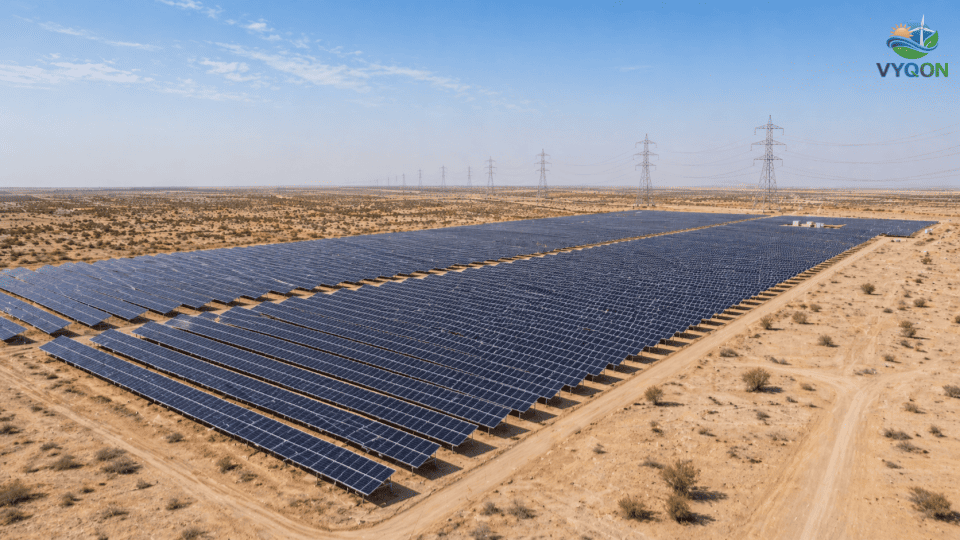
Project Profile: 34 MW Chhadavada Solar Project
The Chhadavada project, situated in the Kutch district, represents a vital test case for GSECL‘s site-selection and development strategy. The project is currently in an active phase of procurement and engineering.
- Capacity: 34 MW.
- Location: Chhadavada, Kutch district.
- Project Status: EPC (Engineering, Procurement, and Construction) tenders have been invited and are currently “live.”
- Site Selection Parameters: The site was shortlisted following a preliminary survey by GSECL and GETCO, evaluating critical factors such as land pattern, evacuation feasibility, and distance from existing infrastructure.
- Infrastructure: The project is strategically positioned to utilize spare evacuation capacity at nearby Gujarat Energy Transmission Corporation Limited (GETCO) sub-stations.
The 2,500 MW Wasteland Solar Programme Framework
The project is authorized under a dual-departmental framework designed to optimize underutilized state assets. The program’s foundation rests on two primary policy instruments:
- Revenue Department G.R. No: JMN-3919-259-A1 (dated 07.03.2019): This resolution facilitates the allocation of government wasteland to Power Sector Undertakings (PSUs) at a token lease rate of Rs. 1 per hectare for a 30-year term.
- Energy and Petrochemicals Department G.R. No. SLR/11/2019/675/B1 (dated 16.08.2019): This directive specifically authorized GSECL to develop 2,500 MW of solar capacity under the wasteland scheme.
The overarching goal is to leverage GETCO‘s spare transmission capacity to deliver significant volumes of renewable energy without the typical overhead costs associated with land acquisition.
Financial Structure and State Subsidies
The financial viability of the Wasteland Solar Programme is predicated on a “cost-plus basis” model, where GUVNL has provided in-principle approval for power purchase contingent on GERC‘s oversight.
Financial Highlights:
- Estimated Project Cost: Rs. 4 Crores per MW.
- Capital Subsidy: The State Government has extended a 50% capital subsidy to GSECL, significantly reducing the debt burden on these projects.
- Tariff Projections: By utilizing the 50% subsidy and token land rates, and factoring in a 12% Return on Equity (RoE), GSECL targets a resultant tariff of less than Rs. 1.50 per unit—nearly half the current market rate for solar power.
- EPC Selection and e-RA: GSECL employs a transparent bidding process via the nprocure portal. This process includes e-Reverse Auctions (e-RA) to ensure the discovery of the most competitive EPC prices from technically qualified bidders.
Regulatory Deviations and PPA Provisions
A key point of contention in Petition 2013/2021 is a requested deviation from the standard PPA terms regarding “Change in Law” protections. GSECL argues that its role as a developer hiring EPC contractors requires a shift in when legal risk is accounted for, moving away from the standard bid deadline trigger used in commercial competitive bidding.
| Provision Source | Trigger Point for Change in Law |
| Standard GUVNL Competitive Bidding PPA | Events notified after the Bid Deadline. |
| GSECL Wasteland Scheme PPA (Draft) | Events notified after the date of issuance of letter (notice to proceed) by GSECL to their EPC Contractor. |
Program Implementation Challenges
Despite the aggressive policy support, the rollout has faced significant field-level obstacles. Regulatory filings indicate that GSECL has encountered:
- Land Acquisition & Topography: Much of the designated wasteland is characterized by “nallas” (natural drainage channels) and low-lying areas prone to water accumulation, complicating technical feasibility.
- Local Resistance: Implementation has faced opposition from local villagers. A notable precedent is the Haripara project, which faced such intense resistance that GSECL was forced to seek police protection through the local Collector and Mamlatdar offices to continue work.
- Non-Contiguous Land: Many sites consist of fragmented land parcels, necessitating separate approach roads and equipment, which prevents the economies of scale seen in large-scale solar parks.
Current Status
As of the July 2022 hearings before the Commission, the 2,500 MW programme’s progress is as follows:
- Commissioned: Approximately 120 MW of solar capacity is fully operational.
- Awarded: EPC contracts have been formally executed for 711 MW of capacity.
- Tendering: Approximately 116 MW remains in the active tendering phase.
GSECL has signaled that once this petition is approved, it will file separate petitions under Section 62 of the Electricity Act 2003 for the formal determination of tariffs for each individual project.
Leave a Comment