
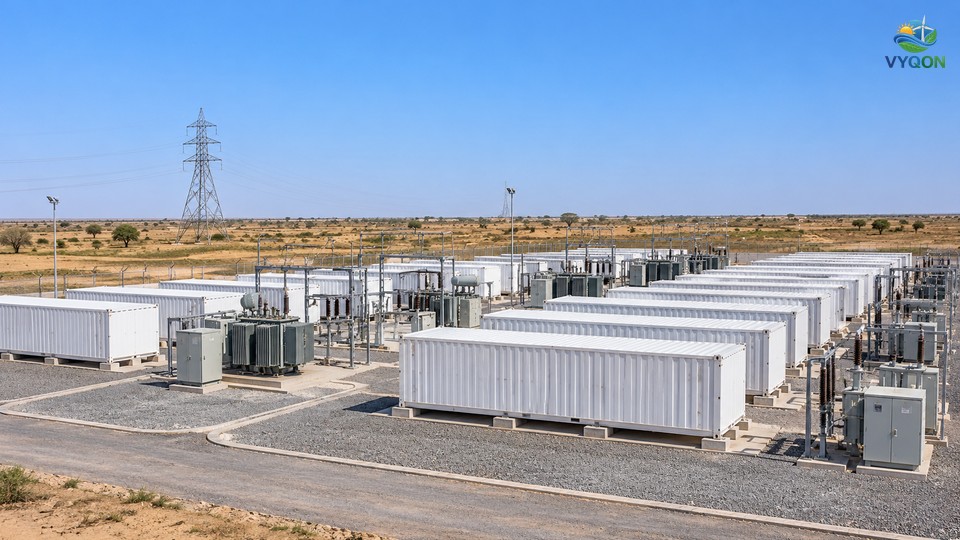
ACME Solar Holdings Limited has commissioned a further 88.02 MW / 366.969 MWh of battery energy storage system (BESS) capacity at its Firm and Dispatchable Renewable Energy (FDRE) project in Chittorgarh district, Rajasthan. In a filing to the stock exchanges dated 31 October 2026, the company said the capacity was commissioned on 30 October 2026 through its wholly owned subsidiary, ACME Sigma Urja Private Limited, and that the commercial operation date (COD) for it is 1 November 2026.
The new block is part of a BESS component of 250 MW / 1,069 MWh (discharge capacity) planned for the project. With this addition, ACME Sigma Urja has commissioned a cumulative 159.660 MW / 664.261 MWh of discharge capacity. That is about 64 per cent of the planned power rating and about 62 per cent of the planned energy capacity, by VYQON’s arithmetic from the figures in the filing.
What the filing says
The disclosure was made under Regulation 30 of the SEBI Listing Obligations and Disclosure Requirements Regulations, 2015. It was addressed to BSE Limited (scrip code 544283) and the National Stock Exchange of India (symbol ACMESOLAR), and it was issued in continuation of the company’s earlier intimation dated 23 October 2026. It carries the subject line “Update on commissioning of Battery Energy Storage System (BESS) Project”.
The project is located at Village Neemri, Tehsil Rawatbhata, District Chittorgarh, Rajasthan. The filing gives the capacity as discharge capacity, in two figures: 88.02 MW for power and 366.969 MWh for energy. The energy figure divided by the power figure works out to a little over four hours of discharge at full power, a duration well suited to covering the evening peak.
The filing does not name the buyer of the power, the tariff, the project cost, or the planned dates for the remaining storage capacity. It also does not give the size or the commissioning status of the solar and wind generation that would sit alongside the batteries. Those details were not disclosed and are therefore not covered here.
How the project has been commissioned so far
The Chittorgarh storage is being brought into service in stages, and the latest block is the largest so far. The first phase of 53.73 MW / 222.969 MWh was commissioned on 30 September 2026, with a COD of 2 October 2026. A second step of 17.91 MW / 74.323 MWh was commissioned on 23 October 2026, with a COD of 25 October 2026, taking the cumulative total to 71.640 MW / 297.292 MWh.
The newest block of 88.02 MW / 366.969 MWh is larger than the first two steps combined. Adding the three steps together gives 159.660 MW (53.73 plus 17.91 plus 88.02) and 664.261 MWh (222.969 plus 74.323 plus 366.969), which matches the cumulative figures in the latest filing. The newest block therefore more than doubled the capacity that was in service a week earlier.
Based on the figures disclosed, about 90.34 MW and roughly 404.7 MWh of the planned 250 MW / 1,069 MWh remain to be commissioned. This is VYQON’s own subtraction and is not a number given by the company. The company has not given a date for it, and none is assumed here.
Why storage is built in blocks
Commissioning batteries in stages can look unusual, but it is a practical way to manage a large hybrid build. Battery systems are modular, so containers can be installed, tested and energised in blocks while other parts of the project continue. Each block that is commissioned gets a COD of its own, which lets the developer start operations on part of the asset instead of waiting for the full 250 MW / 1,069 MWh to be ready.
What FDRE means
FDRE stands for Firm and Dispatchable Renewable Energy. In an FDRE project, solar and wind generation is combined with a battery system so that the plant can supply power at a committed, steady level over the day instead of only when the sun shines or the wind blows. Such projects are meant to cover the evening peak that solar alone cannot serve.
What it means for India’s clean-energy sector
India’s electricity demand peaks in the evening, after solar output has fallen, and grid operators have been looking to batteries to cover that gap. Storage that is already commissioned adds real capacity that a buyer can schedule, and it gives developers operating data on how large lithium-ion systems perform over time.
For ACME Solar, the latest filing shows steady delivery on a project that is being commissioned in blocks. With about 64 per cent of the planned power rating now in service, the Chittorgarh BESS has moved from the early phase to the later stage of its build, though a part of it is still ahead.
What to watch next
Commissioning of the remaining storage capacity at Neemri, the status of the solar and wind component, and the power sale arrangement are the points to watch in the company’s coming disclosures. None of them is covered by this filing.
Official references
- ACME Solar Holdings Limited, Regulation 30 intimation to BSE Limited and National Stock Exchange of India Ltd, “Update on commissioning of Battery Energy Storage System (BESS) Project”, dated 31 October 2026: https://www.bseindia.com/xml-data/corpfiling/AttachLive/72267106-33ba-48c5-bfbd-339cd5542cd8.pdf
- ACME Solar Holdings Limited, Regulation 30 intimation to BSE Limited and National Stock Exchange of India Ltd, “Update on commissioning of Battery Energy Storage System (BESS) Project”, dated 23 October 2026: https://www.bseindia.com/xml-data/corpfiling/AttachLive/1e6e9e79-b281-4635-8144-42e789d2f7fb.pdf
Leave a Comment