
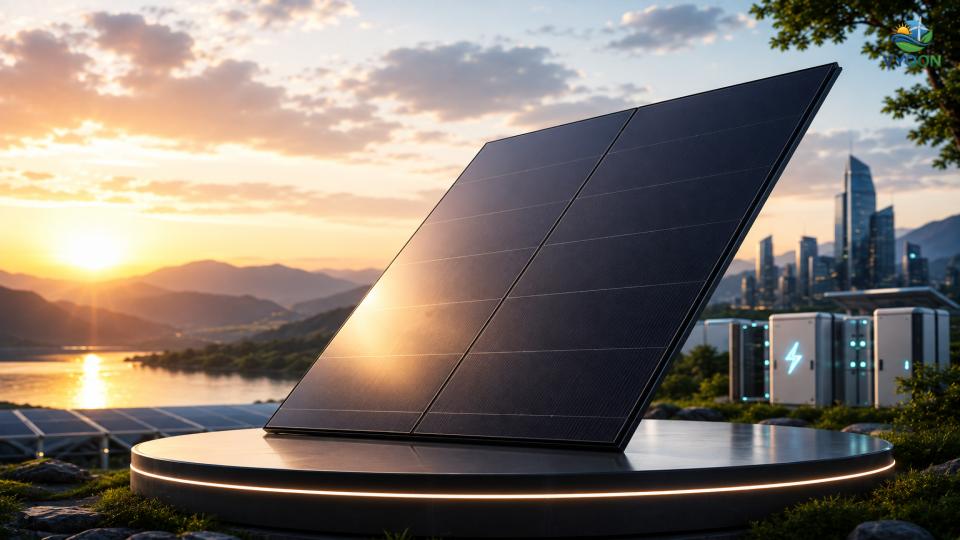
The global photovoltaic market is currently undergoing a massive structural shift. While traditional PERC and standard TOPCon architectures have driven the industry for years, 2026 marks the definitive rise of Back Contact BC Solar Modules. By completely rethinking how electrical current is captured and transported across the silicon cell, manufacturers have eliminated the front-side gridlines entirely.
This gridless design is not just an aesthetic upgrade; it represents a fundamental leap in energy yield and thermal stability. Today, top-tier manufacturers are scaling this technology to unprecedented commercial volumes. Here are the five critical reasons why this architecture is dominating the 2026 solar landscape.
The Core Architecture of Back Contact Technology
In standard solar cells, metallic gridlines on the front surface collect the generated electricity, but these lines physically block a portion of the incoming sunlight. Back Contact BC Solar Modules solve this by placing both the positive and negative electrodes entirely on the rear side of the cell.
By eliminating the front-side gridline shading, the module maximizes its light-absorbing surface area. This allows for significantly higher energy generation under real-world operating conditions. For project developers, this translates to optimal land utilization and a maximized return on investment. Furthermore, without the visual obstruction of metal lines, these modules offer a sleek, all-black aesthetic that commands a significant premium in residential and commercial distributed scenarios.
Pushing Efficiency Past the 28% Barrier
The technical ceiling for silicon solar has been shattered this year. In early 2026, Hybrid Interdigitated-Back-Contact (HIBC) solar cells achieved a massive breakthrough when the Institute for Solar Energy Research Hamelin (ISFH) certified a photoelectric conversion efficiency of 28.13%.
This laboratory success has rapidly translated into commercial dominance. Modules fabricated using these advanced HIBC cells were recently certified by the U.S. National Laboratory of the Rockies (NLR) at an impressive 26.4% efficiency. In real-world mass production, top-tier EcoLife series modules have firmly claimed the top spot in the TaiyangNews global rankings with a mass production efficiency of 25%.
The 60GW Commercial Milestone
Historically, Back Contact BC Solar Modules were viewed as a premium, niche technology due to complex manufacturing processes. However, 2026 has proven that this technology is fully scalable. In June 2026, industry leader LONGi announced that its BC technology platform had surpassed a cumulative 60GW in commercial sales and shipments.
Driven by strong market performance, including 8.34GW shipped in the first quarter of 2026 alone, BC technology has officially transitioned into the global mainstream. Manufacturers anticipate that cumulative BC module shipments will skyrocket past the 100GW milestone by the end of the year.
Superior High-Temperature Performance
Beyond pure efficiency, Back Contact BC Solar Modules offer distinct advantages in harsh climates. A critical metric for any solar panel is its temperature coefficient, which measures how much power is lost as the ambient temperature rises.
Standard TOPCon modules typically feature a temperature coefficient around -0.33 to -0.35%/°C. In contrast, advanced BC modules operate with a significantly better temperature coefficient ranging from -0.30 to -0.32%/°C. This means that in high-temperature environments during the peak summer months, BC modules maintain better power generation stability and suffer far less thermal degradation.
Rapidly Expanding Market Landscape
The massive market demand for higher efficiency and premium aesthetics has catalyzed intense industry competition. Currently, roughly 20 global photovoltaic giants—including LONGi, Aiko, Tongwei, Trina, and JinkoSolar—have fully entered the BC technology track.
Because Back Contact BC Solar Modules deliver 5-8% more power generation per unit area than standard TOPCon modules, they are increasingly becoming the core growth point of the industry. As we move through the rest of 2026, the speed of technological iteration and cost control capabilities in the BC sector will become the defining competitive barriers for manufacturers worldwide.
Official Source References
- LONGi Press Release (June 2026): LONGi surpasses 60GW BC commercial milestone, energizing global leadership in Back Contact innovation. Read the official release on LONGi’s website.
- LONGi Efficiency Records (April 2026): 28.13%, 26.4%! LONGi Sets New World Records for Crystalline Silicon Solar Cell and Module Efficiency. Read the official announcement here.
- TaiyangNews (2026): LONGi EcoLife Series Module Top TaiyangNews Global Ranking, Ushering in the “25%+” Era of Photovoltaic Efficiency. Read the TOP SOLAR MODULES report here.
- JINGSUN Industry Reports: Insights on navigating the current solar landscape, including “TOPCon, BC, or HJT solar panel– which should I choose?”. Read their industry reports here.
Leave a Comment