
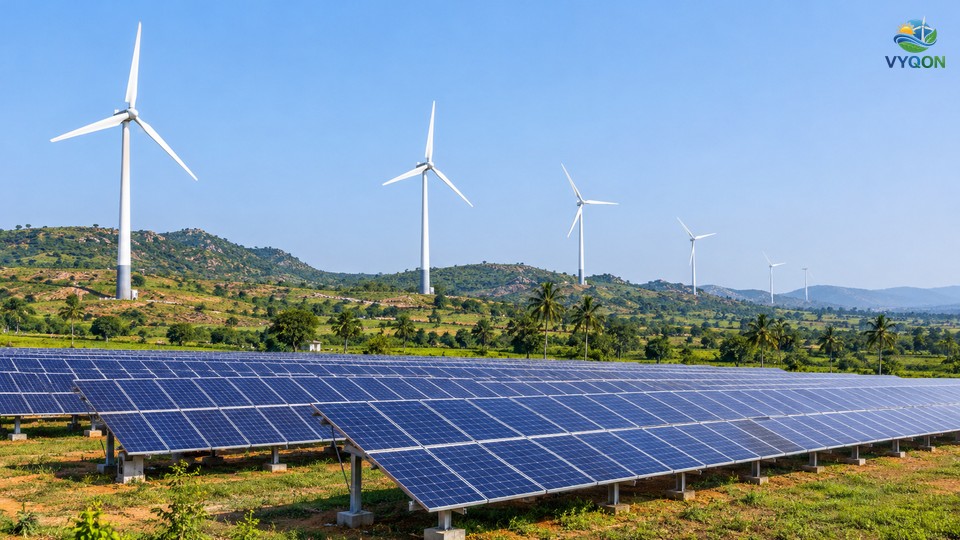
CleanMax hyperscalers are beginning to prefer grid-connected wind-solar hybrid projects in South India over regions such as Kutch and Rajasthan, because of perceived curtailment risk, according to the management of CleanMax Enviro Energy Solutions Limited. The comment came on the company’s Q2 FY27 earnings conference call held on 4 November 2026, the transcript of which was filed on BSE on 6 November 2026. The company also said curtailment at its Bikaner plant cost it about 5 per cent of its first-half FY27 EBITDA.
What CleanMax hyperscalers want from a project
Answering an analyst’s question on how customers view projects connected to the Central Transmission Utility (CTU) network, management said hyperscaler clients look for three things.
- CTU connectivity. Hyperscaler clients prefer CTU-connected projects.
- Wind-solar hybrids. They want a better match between supply and demand across the time of day and through the year, so they do not want solar alone.
- South India location. They are beginning to prefer CTU-connected wind-solar hybrids in South India, to address the curtailment risk perceived in regions like Kutch and Rajasthan, and because many hyperscalers are setting up their own data centres in South India.
Curtailment means a grid operator asks a generator to reduce output, usually because the grid cannot take all the power on offer. For a renewable plant, it directly cuts the energy sold.
Hyperscalers are over a quarter of contracted capacity
Management said that out of 6,200 MW of contracted capacity, roughly 27-28 per cent is with hyperscaler clients, which it described as the likes of Amazon, Google and Meta. These are typically large deals, and the company does not expect more than one such announcement a year. It said it also works with colocation data centre operators such as NTT, STT, Equinix and Iron Mountain.
CleanMax said it holds about 35 per cent of the aggregate volume of hyperscaler energy deals contracted in India so far. Management added that demand and the volume of conversations with both hyperscalers and colocation data centres are higher than ever before.
CTU capacity sold out and more applied for
Because hyperscalers want CTU-connected projects, the company said all of its CTU-connected capacity until September 2028 is already sold out. It has been applying for more connectivity, including a further 2 GW after 30 September 2026.
Management said it took a business call to reserve its limited CTU capacity mainly for hyperscaler clients, even though other customers ask for it. Its view is that the aggregate hyperscaler requirement is much larger than the open-access CTU capacity available to them.
Flexible contracts, same tariffs
On contract terms, management said hyperscalers want the flexibility to decide, at their own discretion, whether to take the power directly into a data centre or use it for green attributes. Under both models CleanMax receives the same tariffs, locked in for 20-25 years, so the company is indifferent to which route the customer chooses.
Bikaner curtailment and the EBITDA impact
Analysts asked about grid curtailment at the Bikaner plant in Rajasthan. Management said curtailment was 70 per cent in the first quarter after the plant was commissioned, nearly 50 per cent in July and August, 44 per cent after that, and 26 per cent as of October, after the grid operator upgraded parts of the network.
In the first half of FY27, curtailment cost the company about 5 per cent of its EBITDA. EBITDA grew 56 per cent in the half; management said that without curtailment it could have grown 61 per cent. It added that it has no update on when the grid will finish building the relevant substation and lines, as that is outside its control.
What it means for India’s clean-energy sector
The comments suggest that corporate buyers with large data-centre plans are weighing grid reliability as well as tariffs when choosing where renewable capacity is built. If the preference for South India holds, developers may see more demand for hybrids with CTU connectivity in that region, while projects in resource-rich but congested areas could face closer scrutiny of evacuation timelines.
These are statements by company management on an earnings call, not independent data. Management said it does not give guidance on when customers will sign new contracts.
Leave a Comment