
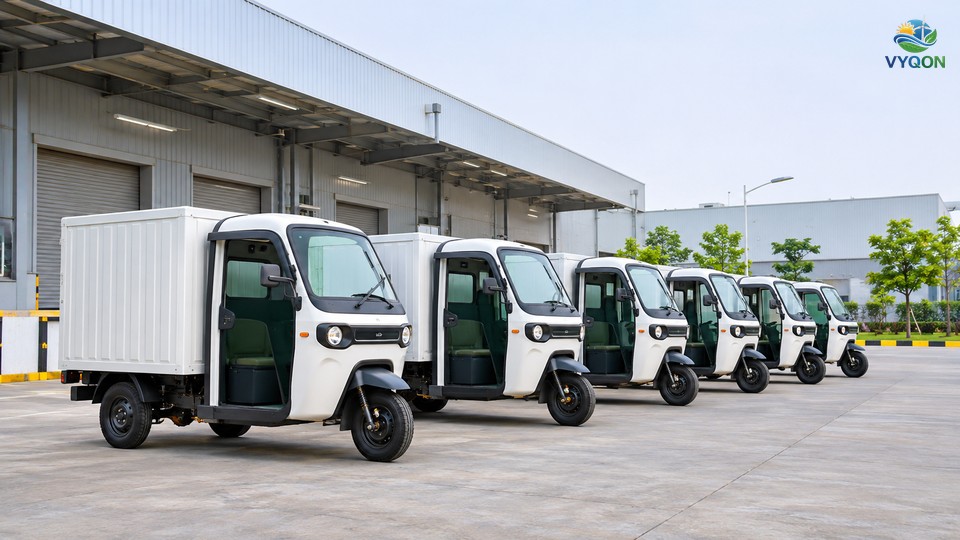
Mahindra Last Mile Mobility, the electric three- and four-wheeler business of Mahindra & Mahindra, plans to double its manufacturing capacity by FY29 and has a pipeline of eight new products, according to the company’s Q2 FY27 press and analyst meet presentation filed on BSE on 5 November 2026. The presentation says current capacity is fully utilised and that expansion is being planned. Domestic sales of the business rose 36.7% to 52,869 units in the July-September 2026 quarter (Q2 FY27), up from 38,684 units a year earlier.
Mahindra Last Mile Mobility sales in Q2 FY27
Electric three- and four-wheelers made up most of the volume. The company’s slide shows 45,287 electric units in Q2 FY27, against 32,024 in Q2 FY26, a rise of 41.4%. Sales of internal combustion engine (ICE) three- and four-wheelers were 7,582 units, compared with 6,660 a year earlier. Electric vehicles therefore accounted for about 86% of the business’s domestic volumes, up from about 83% a year ago.
Sales were also higher than in the previous quarter, when the business sold 42,276 units. That is a sequential rise of 25.1%, and it takes volumes for the first half of FY27 (April-September 2026) to 95,145 units. The presentation states that electric three-wheeler volume grew 57.5% in H1 FY27 and that more than 26,000 Udo vehicles were delivered in the half.
On market position, the deck puts the company’s electric three-wheeler market share at 36.2% in Q2 FY27, citing data from the Society of Indian Automobile Manufacturers (SIAM). A separate slide gives the share for H1 FY27 as 37.6%. The business says it is growing at twice the industry rate.
Capacity doubling and eight new products
The company says it is “doubling capacity by F29” and has a “launch pipeline of 8 products”. It did not disclose how much capacity will be added, how much will be invested, when the extra capacity will start production, or the launch dates of the eight products. None of these details was given in the presentation or at the company’s media briefing.
The stated aspiration of the business is “to electrify India’s last mile and be the #1 e-CV company”. Its growth targets for FY30 include 6x revenue growth and electric three-wheeler volumes 25 times the FY20 level. The chart in the presentation shows an FY20 base of about 14,000 units and shows FY26 at about 7.5 times that base. On those figures, 25 times the base works out to roughly 3.5 lakh electric units a year by FY30, and FY26 volumes to roughly 1.05 lakh units. These are calculations from the chart labels, not separate company guidance.
Electrification of three-wheelers and the unicorn valuation
The presentation says electrification of the L5 three-wheeler category, measured as per the Central Motor Vehicles Rules (CMVR) classification, stood at 41.4% in Q2 FY27. The company has set a target of 50% electrification of the segment by FY30, and it describes the 41% already achieved as progress towards that goal.
Mahindra also states that the last mile mobility business has achieved unicorn status and is now valued at Rs 10,822 crore. The deck does not say how the valuation was arrived at.
How the business fits within Mahindra & Mahindra
In the group’s segment reporting, the last mile mobility business sits in the “Auto others” line, which also covers trucks and buses and the manufacturing arrangement for two-wheelers and electric three-wheelers. The group’s H1 FY27 cash flow slide shows an outflow of Rs 155 crore under capex and operating cash for the electric vehicle businesses of MEAL and the last mile mobility company taken together.
The parent company’s electric SUV business is covered separately in VYQON’s report on Mahindra’s battery electric vehicle volumes in Q2 FY27.
What it means for India’s clean-energy sector
In the L5 three-wheeler category, electric models already account for 41.4% of sales by the company’s figures. Mahindra’s figures show a business in which electric vehicles are now about 86% of domestic units sold, and where, by the company’s own statement, current factory capacity is fully used. A supply limit of this kind means that new capacity can matter as much as new demand for the pace of electrification in the segment.
The planned doubling of capacity by FY29, together with eight new products, would widen the product range open to fleet operators and small businesses, although the company has not said which segments the new models will serve. A bigger base of electric vehicles in daily commercial use also adds to demand for charging and for the power that charging draws from the grid, a link that connects last-mile transport to the wider clean-energy build-out.
The figures to watch next are the ones the company has not yet given: the amount of capacity to be added, the timing of each product launch and the investment behind them. Until those are disclosed, the FY29 capacity target and the 50% electrification goal for FY30 remain stated intentions, not scheduled projects.
Official references
- Mahindra & Mahindra Limited, Q2 F27 Press / Analyst Meet presentation, filed on BSE on 5 November 2026 (scrip code 500520): https://www.bseindia.com/xml-data/corpfiling/AttachLive/c491a92c-9904-49dc-b140-66f46139a565.pdf
Leave a Comment