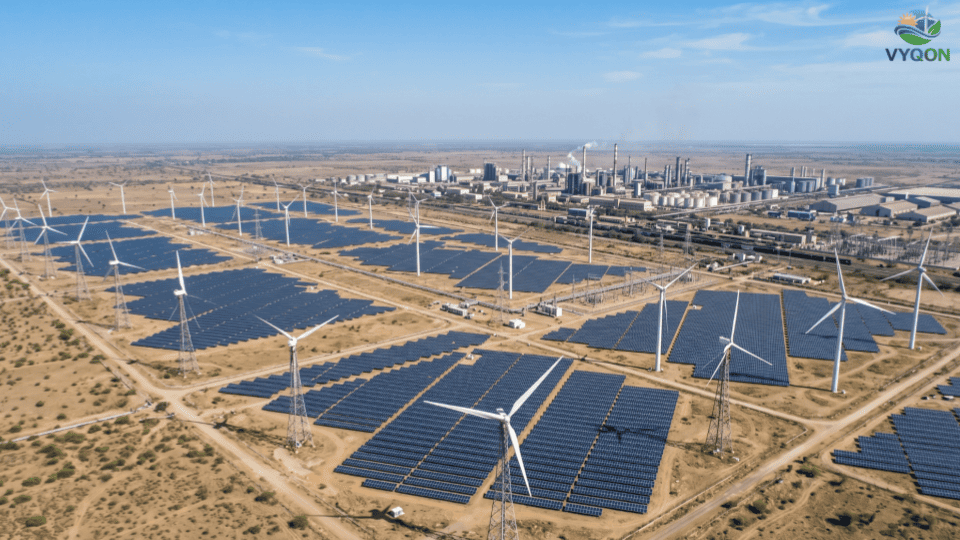
Gujarat Alkalies and Chemicals Limited (GACL), a state-promoted entity under the Government of Gujarat, has solidified a landmark 160 MW group captive agreement with Clean Max Enviro Energy Solutions (CleanMax) to decarbonize its energy-intensive industrial operations. This hybrid renewable project, situated in Gujarat, comprises a sophisticated mix of 75.9 MW wind and 84.34 MWp solar capacity. Under the group captive commercial structure, 100% of the generated power will be dedicated to GACL’s flagship Chlor-Alkali manufacturing complexes in Dahej and Vadodara, marking a significant shift toward renewable-led industrial manufacturing in the region.
Project Specifications and Execution Timeline
The 160 MW hybrid project is strategically bifurcated into two phases to optimize deployment. The integration of wind (measured in MW) and solar (measured in MWp/DC capacity) allows for a higher grid utilization factor, essential for the continuous power requirements of chemical manufacturing.
| Phase | Wind Capacity (MW) | Solar Capacity (MWp) | Total Phase Capacity |
| Phase 1 | 16.50 | 21.701 | ~38.2 MW |
| Phase 2 | 59.40 | 62.64 | ~122.0 MW |
| Total | 75.90 | 84.34 | 160.24 MW |
The project is being implemented across four dedicated renewable energy sites within Gujarat to leverage the state’s high-velocity wind corridors and superior solar irradiation:
- Kalikanagar
- Aji Dahisarda
- Rajula
- Ghuntu
Operational Impact on GACL Manufacturing Units
As a government-promoted leader in the domestic Chlor-Alkali industry, GACL’s transition to a 100% renewable sourcing model for this 160 MW allocation addresses the high energy intensity inherent in chemical electrolysis. The power will serve the Dahej and Vadodara complexes, which are critical to the supply chains of several high-growth sectors.
Key Operational Metrics:
- Annual Clean Energy Yield: The project is engineered to deliver approximately 36.9 crore clean units (kWh) per year.
- Downstream Supply Chain Support: This renewable energy will power the production of chemical derivatives essential for the textiles, paper, alumina, pharmaceuticals, and water treatment industries.
- Energy Reliability: By utilizing a hybrid wind-solar model, GACL mitigates the intermittency risks associated with single-source renewables, ensuring more stable power for its continuous-process manufacturing.
Environmental Sustainability Metrics
The partnership provides quantifiable progress toward GACL’s net-zero carbon commitments and India’s national climate goals:
- Carbon Mitigation: An estimated annual reduction of 2,64,204 tons of CO₂ emissions.
- Ecological Equivalence: The projected emission reduction is equivalent to the carbon sequestration capacity of approximately 15.27 million trees annually.
Strategic and Market Context
The Analyst’s Perspective: Partner Stability and Financial Resilience
From an industry analyst’s viewpoint, GACL’s selection of CleanMax as a long-term partner is underpinned by the developer’s significantly strengthened credit profile. CleanMax entered this 160 MW agreement following a successful IPO and pre-IPO funding round in Q4FY26, which raised ₹1,500 crore. This capital infusion allowed CleanMax to deleverage its balance sheet by prepaying approximately ₹1,000 crore in non-project debt. Consequently, CareEdge Ratings upgraded the company’s long-term bank facilities to CARE AA-; Stable, providing GACL with a partner that possesses both the technical scale (3.1 GW total operational capacity as of March 2026) and financial stability required for such a massive group captive undertaking.
Market Position and Commercial Rationale
For GACL, the project provides long-term price visibility and insulation from the volatility of grid tariffs. For CleanMax, the deal solidifies its leadership in the Commercial and Industrial (C&I) segment, particularly in Gujarat where it managed ~844 MW of operational capacity as of March 31, 2026.
Risk & Regulatory Outlook: The Banking Monitorable
While Gujarat’s current open-access policies are highly favorable for hybrid projects, analysts must note potential regulatory headwinds. The project’s long-term commercial viability is sensitive to state-level “banking rules” and “wheeling charges.” As seen recently in Maharashtra—where usage windows for banked power were significantly tightened—any shifts in Gujarat’s State Electricity Regulatory Commission (SERC) policies regarding energy banking could impact the project’s cash flow and the realized savings for GACL.
Corporate Leadership Perspectives
The leadership of both entities views this agreement as a benchmark for the scale at which Indian industrial players can decarbonize.
Avantika Singh (IAS, GACL) noted that sustainability is now a “central pillar” of GACL’s growth. Her focus on energy reliability through the hybrid model suggests that for energy-intensive state-promoted industries, the move to renewables is no longer just a CSR initiative but a core operational necessity.
Kuldeep Jain (Founder and MD, CleanMax) characterized this as the “single largest group captive deal” for the firm. In an industry context, Jain’s remarks signal that the C&I segment has matured to a point where manufacturing giants can transition at scale without compromising the reliability required for 24/7 industrial processes. This partnership effectively sets a new benchmark for “Group Captive” renewable procurement in India.
Leave a Comment