
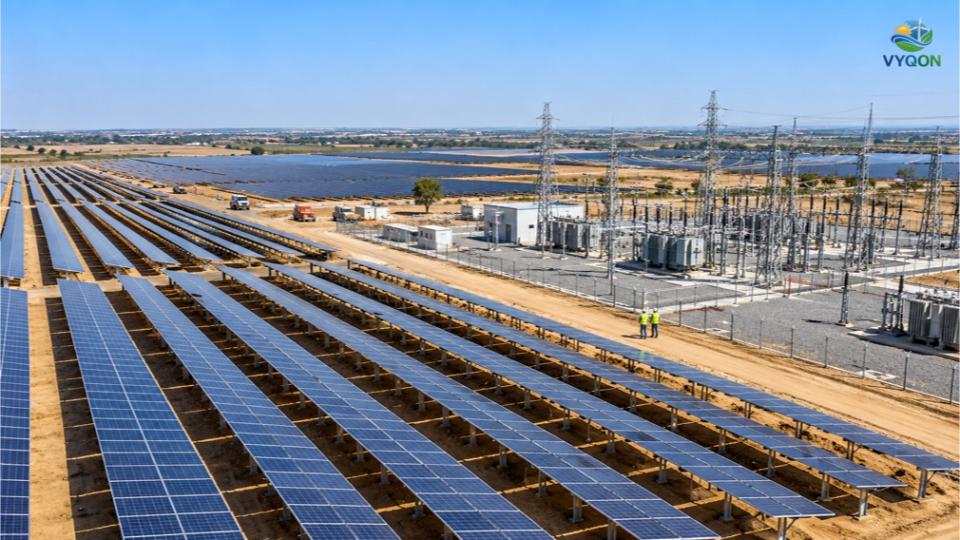
The agreement signed on 8 October 2026 follows GH2 Solar’s earlier award under SECI’s ISTS-XX tender at ₹2.87 per kWh, combining solar photovoltaic generation with a four-hour energy storage system under a long-term power purchase framework.
GH2 Solar Limited has announced the signing of a Power Purchase Agreement (PPA) with the Solar Energy Corporation of India Limited (SECI) for the development of a 50 MW solar photovoltaic project integrated with a 25 MW/100 MWh Battery Energy Storage System (BESS). The agreement was signed on 8 October 2026, marking a contractual milestone for the developer as India continues expanding renewable electricity generation supported by energy storage technologies.
The project combines solar photovoltaic generation with battery storage to support more flexible electricity delivery and improve the utilisation of renewable energy beyond periods of peak sunlight. According to GH2 Solar’s official company announcement, the agreement represents progress in its integrated renewable energy portfolio, bringing together solar power generation and battery energy storage as part of the company’s clean energy development strategy. The development follows an earlier competitive bidding process conducted by SECI for large-scale solar photovoltaic projects integrated with energy storage systems.
The agreement covers 50 MW of contracted solar project capacity and a battery system rated at 25 MW of power and 100 MWh of energy storage. These capacities represent two different technical functions within the project. The solar photovoltaic installation generates electricity from sunlight, while the battery system stores electrical energy for discharge at a later time. The PPA signing establishes the commercial framework for the project but does not indicate that the solar installation or battery storage system has already been constructed, connected to the grid or commercially commissioned.
GH2 Solar Secures Long-Term Agreement Following SECI Competitive Auction
The latest agreement is associated with SECI’s ISTS-XX competitive procurement programme, launched in June 2025 for the development of 2,000 MW of Interstate Transmission System-connected solar photovoltaic projects supported by 1,000 MW/4,000 MWh of energy storage capacity. The tender was issued under reference SECI/C&P/IPP/11/0004/25-26, dated 12 June 2025, with developers selected through tariff-based competitive bidding followed by an electronic reverse auction.
According to SECI’s official auction results, the electronic reverse auction was conducted on 15 October 2025, followed by the issuance of Letters of Award to successful bidders on 27 October 2025. GH2 Solar Limited secured an allocation of 50 MW at a discovered tariff of ₹2.87 per kWh. The signing of the PPA in October 2026 therefore represents a subsequent stage in the development of the previously awarded project rather than a fresh solar capacity award.
The original SECI Request for Selection establishes a 25-year power purchase framework from the Scheduled Commencement of Supply Date, subject to the applicable agreement and contractual provisions. This structure is intended to provide long-term commercial arrangements for renewable electricity procurement while placing project-development and performance responsibilities on the selected solar power developers.
Under the tender framework, developers are responsible for identifying project locations, arranging the necessary land, installing generating equipment, securing applicable approvals and establishing the required grid connectivity. The specific technical and commercial obligations for GH2 Solar will ultimately be governed by its executed PPA and applicable tender conditions.
The awarded tariff of ₹2.87 per kWh represents the result of the competitive procurement process and should not be interpreted as the independent cost of battery storage or the retail electricity tariff for an end consumer. The project’s economic performance will depend on solar generation, battery operation, financing expenditure, equipment performance and compliance with contractual electricity supply requirements.
The publicly reviewed announcements do not identify a final project site or confirm commercial commissioning. Consequently, the 50 MW capacity should be described as contracted renewable energy development rather than newly operational solar generation.
Integration of 50 MW Solar Generation with Four-Hour Battery Storage
One of the most important technical features of the project is its 25 MW/100 MWh battery energy storage system, which provides a nominal discharge duration of four hours at its rated 25 MW output. The relationship between battery power and energy capacity is central to understanding how storage supports renewable electricity delivery. The 25 MW rating indicates the maximum specified discharge power, while the 100 MWh rating represents the system’s nominal energy storage capacity.
In simple terms, a battery rated at 25 MW/100 MWh has the nameplate capability to discharge at 25 MW for approximately four hours. However, the actual electricity available at the grid delivery point will depend on usable state-of-charge limits, conversion losses, auxiliary consumption, battery operating conditions and contractual performance requirements. The storage system therefore provides an energy-shifting capability rather than four hours of guaranteed net delivery under every operating condition.
SECI’s original tender requires energy storage capacity of at least 0.5 MW/2 MWh for every 1 MW of contracted solar project capacity. For a 50 MW solar project, this corresponds to a minimum storage configuration of 25 MW/100 MWh, matching the capacity announced by GH2 Solar.
The tender also specifies that energy stored using a source other than solar power would not qualify as solar power under the relevant procurement provisions. This makes the coordination between solar generation and battery charging an important part of the project’s operational design.
Solar photovoltaic plants generally produce their highest output during periods of strong sunlight, while electricity demand may remain substantial during evening hours when solar generation declines. Battery energy storage can address part of this mismatch by storing electricity generated earlier in the day and releasing it when required according to the operating strategy and contractual framework.
The proposed project will therefore require coordinated operation of the photovoltaic arrays, solar inverters, battery power conversion systems and energy management equipment. A suitable control system must monitor solar generation, battery state of charge, available storage capacity and grid operating requirements to determine when electricity should be exported, stored or discharged.
Battery performance will also depend on factors such as round-trip efficiency, temperature management, charge-discharge cycles and long-term degradation. These parameters influence the quantity of electricity available for delivery and the ability of the storage system to maintain its expected performance throughout the operating period.
SECI’s tender framework further requires developers to declare an annual Capacity Utilisation Factor (CUF) within the range of 19% to 30%, with specified performance obligations and permissible deviations during the PPA term. However, GH2 Solar’s individual declared CUF has not been independently established from the available public announcement.
Grid Connectivity, Project Execution and India’s Solar-Plus-Storage Market
The development of a solar-plus-storage project requires additional technical and operational coordination compared with a conventional solar photovoltaic installation. While solar generation equipment converts sunlight into electrical energy, battery storage introduces another controllable resource that must operate safely within the plant’s electrical system.
The project will require appropriate arrangements for power conversion, electrical protection, metering, communication systems and grid connectivity. Developers must also establish operating procedures that coordinate photovoltaic generation with battery charging and discharging while meeting applicable grid regulations.
Battery safety will be an important consideration during engineering and commissioning. Large-scale BESS installations require appropriate battery management systems, thermal management, electrical isolation, protective equipment and suitable monitoring arrangements. These measures help operators identify abnormal battery conditions and maintain safe operation during charging, discharging and maintenance.
The technical configuration of the GH2 Solar project has not yet been disclosed in sufficient detail to identify the battery chemistry, cell supplier, power conversion equipment manufacturer or final engineering layout. These details should therefore remain unconfirmed until the developer provides additional project-specific information.
The wider significance of the project lies in the growing use of energy storage within India’s renewable electricity procurement framework. Solar power is increasingly being developed alongside storage systems to improve generation flexibility and support electricity delivery during periods when solar irradiation is limited.
For renewable energy developers, combining photovoltaic generation with battery storage introduces additional opportunities as well as financial and operational responsibilities. Energy storage can improve the timing of electricity delivery, but it also requires investment in battery equipment, control systems, monitoring infrastructure and long-term maintenance.
The commercial viability of such projects depends on balancing solar generation performance with battery cycling requirements, electricity delivery obligations, equipment degradation and financing costs. Reliable project execution is essential because the generation and storage components must function together to meet the intended operational requirements.
For GH2 Solar, the next important milestones will include confirmation of project location, completion of applicable approvals, financial arrangements, equipment procurement, construction progress, grid connectivity and eventual commissioning. Subsequent disclosures will be required before the project can be considered an operational solar-plus-storage asset.
Conclusion
GH2 Solar’s signing of a PPA with SECI for a 50 MW solar project integrated with 25 MW/100 MWh battery storage marks a step in the development of renewable energy projects combining photovoltaic generation with flexible electricity storage capabilities.
The agreement follows GH2 Solar’s earlier successful allocation under SECI’s ISTS-XX competitive procurement at a tariff of ₹2.87 per kWh. With a four-hour nominal battery storage configuration and a long-term power purchase framework, the project is intended to support improved renewable electricity delivery and greater operational flexibility.
However, the PPA signing represents a contractual milestone rather than confirmation of commercial operation. The project’s actual contribution to India’s electricity system will depend on successful construction, grid integration, equipment testing and commencement of contracted electricity supply.
Reference:
1. GH2 Solar Limited – Official Company Announcement
2. SECI – Official ISTS-XX Auction Results (PDF)
3. SECI – Official Solar with Energy Storage Request for Selection (PDF)
Leave a Comment