
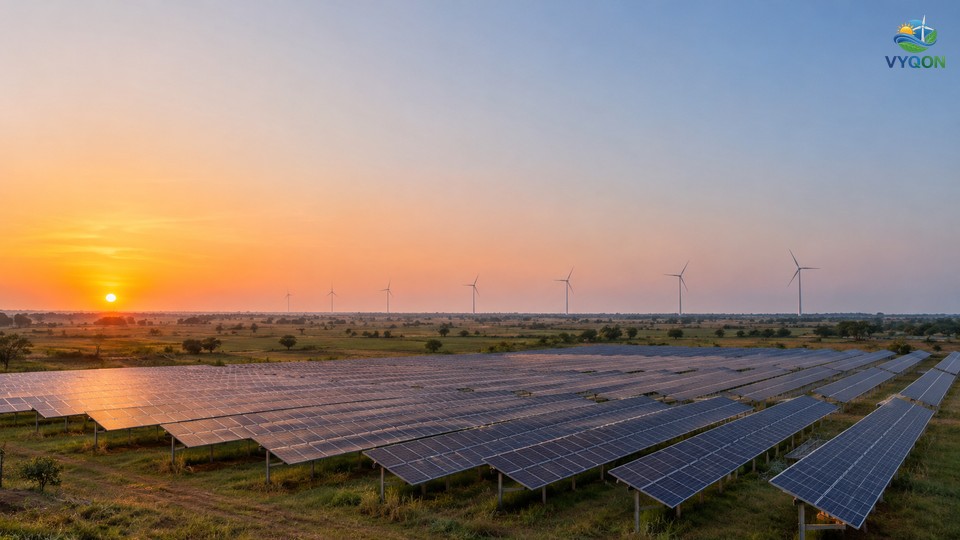
India’s installed power capacity stood at around 560 GW in October 2026, up from 249 GW in 2014, according to a factsheet released by the Press Information Bureau (PIB) on 13 November 2026. The factsheet, titled “India’s Renewable Energy Journey: Powering a Cleaner Future”, puts non-fossil capacity at 308 GW, which it says accounts for 55% of total installed capacity. It also states that India ranks third globally in renewable energy installed capacity.
Installed power capacity: the headline numbers
The factsheet opens with four figures. Total installed power capacity is around 560 GW in October 2026, against 249 GW in 2014. Non-fossil capacity is 308 GW, or 55% of the total. India holds third place worldwide for renewable energy installed capacity. The country also invested USD 63.7 billion in its renewable energy sector between July 2024 and June 2026.
The document describes a transformation that spans solar, wind, hydro, bio-energy, geothermal and green hydrogen, and it points to rooftop solar, large wind projects, floating solar and storage as the main areas of growth.
It also covers the Bharat Renewable Energy Summit and Expo (BRESE) 2026, held from 2 to 5 November in New Delhi. Thirteen Indian States and Union Territories showcased their investment opportunities, and the exhibition brought together more than 400 manufacturers, technology providers, startups and research institutions.
Solar: about 175 GW and the rooftop push
Installed solar capacity has reached about 175 GW as of 31 October 2026, up from 2.8 GW in 2014, and solar is now the largest component of India’s renewable energy capacity. The factsheet says India became the world’s second-largest solar growth market in 2025, adding more than 37 GW against 34 GW added by the United States.
On rooftop solar, the PM-Surya Ghar: Muft Bijli Yojana was launched in February 2024 with an outlay of Rs 75,021 crore for 1 crore households. As of 2 November 2026, 65.26 lakh households are benefiting from rooftop installations. About Rs 35,800 crore in subsidy has been transferred to beneficiaries, and 19.1 GW of rooftop solar capacity has been commissioned under the scheme so far.
The government approved the Pradhan Mantri Surya Sarovar Yojana on 31 July 2026 with an outlay of Rs 5,070 crore. It targets 5,000 MW of floating solar projects with co-located storage of at least two hours, equal to 10,000 MWh. Projects are to be sanctioned from FY 2026-27 to FY 2030-31.
Wind, bio-energy and hydro
Installed wind capacity is 59.20 GW as on 29 October 2026, and the factsheet places India fourth globally in installed wind power capacity. The country added 6.05 GW in FY 2025-26, its highest-ever annual wind addition and 46% above FY 2024-25. Around 28 GW of additional wind capacity is under implementation. Wind turbine manufacturing capacity reached about 24 GW in March 2026, up from 10 GW in 2014.
Bio-power capacity stands at 11.75 GW as of 29 October 2026. There are 839 compressed biogas (CBG) plants registered as of 2 November 2026, of which 210 are commissioned and 255 are under construction. The GOBARdhan National Circular Bioenergy Scheme, approved on 6 August 2026 with an outlay of Rs 23,731 crore for FY 2026-27 to FY 2035-36, aims to raise domestic CBG production nearly ten-fold.
Cumulative hydropower capacity, large and small together, is 57.49 GW as of 29 October 2026. The Small Hydro Power Development Scheme, approved in March 2026 with an outlay of Rs 2,584.60 crore for FY 2026-27 to FY 2030-31, aims to add about 1,500 MW through projects of 1-25 MW.
Green hydrogen and geothermal
The National Green Hydrogen Mission, approved in January 2023 with an outlay of Rs 19,744 crore, targets 5 million metric tonnes of green hydrogen production by 2030. Indian companies have signed 5.5 lakh tonnes per annum of offtake commitments since 2023, of which over 70% is earmarked for exports, including 18 new agreements in 2026 covering over 4 lakh tonnes per annum. Around 8,000 tonnes per annum of production capacity had been commissioned by February 2026.
On geothermal, the National Policy on Geothermal Energy was notified on 15 September 2025. The Geological Survey of India estimates potential at around 10,600 MW, based on exploration across 381 hot springs, with 42 geothermal manifestations identified as promising.
What it means for India’s clean-energy sector
The factsheet is a government summary rather than a new regulatory order, but it gives one reference point for where the sector stands. The 55% non-fossil share, the 175 GW solar base and the 59.20 GW wind fleet show how large renewables have become in the national mix. The listed pipelines, including 28 GW of wind under implementation, 5,000 MW of floating solar with 10,000 MWh of storage, and the rooftop programme, indicate where developers, equipment makers and financiers are likely to find demand.
Readers should note that the factsheet gives different dates for different figures: the 560 GW total is for October 2026, the solar figure is as of 31 October 2026, and wind and hydro are as of 29 October 2026. Each number should be read with its own date and not combined into a single share calculation.
For earlier VYQON coverage of the same themes, see our reports on the 300 GW non-fossil capacity milestone and the PM-Surya Sarovar Yojana for floating solar.
Leave a Comment