
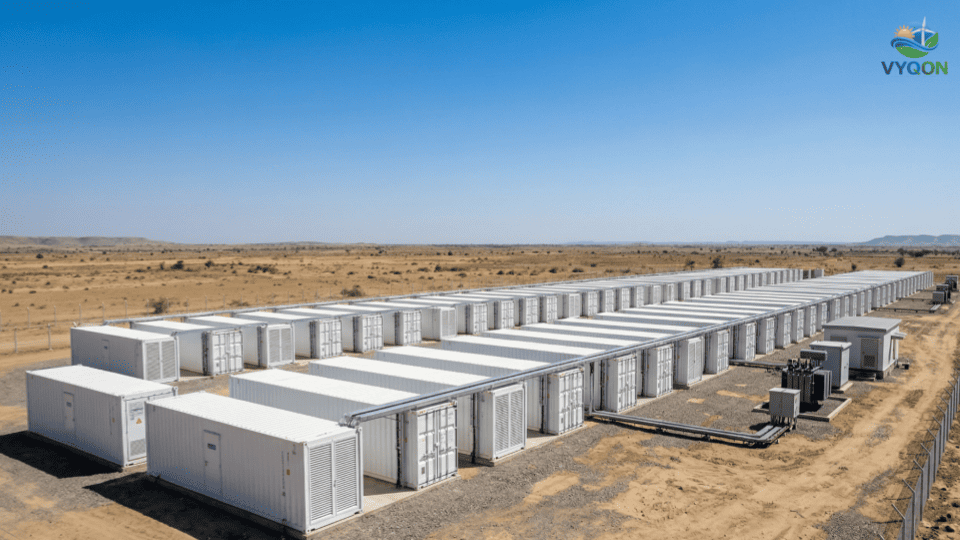
India’s energy transition has reached a structural inflection point as cumulative utility-scale battery storage capacity surpassed the 1 GWh milestone in Q4 FY2026. This national achievement was driven primarily by the aggressive commissioning schedule of ACME Solar Holdings Limited (ASHL), which announced the successful operationalization of Phase IV of its Battery Energy Storage System (BESS) project in Rajasthan on April 3, 2026. The rollout signals a significant shift in India’s grid strategy toward grid-balancing and the mitigation of renewable energy curtailment.
Project Details and Strategic Merchant Logic
The Phase IV BESS project, connected to the Inter-State Transmission System (ISTS), achieved its Commercial Operation Date (COD) on April 3, 2026. This latest phase follows a rapid sequence of deployments; immediately prior to this commissioning, ASHL had reached a cumulative BESS capacity of 100.003 MW / 481.5 MWh. The Phase IV addition brings the company closer to its massive corporate mandate of installing approximately 17 GWh of BESS capacity across its national portfolio.
In an effort to generate early cash flows and gather critical operational data, ASHL is currently utilizing a merchant-based operational strategy for these assets. This interim model focuses on revenue arbitrage, capturing the price differentials between peak and non-peak demand hours. Beyond immediate revenue, this strategy serves as a performance testing ground to de-risk the company’s upcoming Firm and Dispatchable Renewable Energy (FDRE) projects, ensuring battery performance parameters are optimized before full integration with renewable generation.
Technical Specifications
The following table outlines the technical capacity of the Phase IV commissioning and the aggregated milestone achieved during the final quarter of FY2026.
| Project Phase/Metric | Power Capacity (MW) | Energy Capacity (MWh) |
| Phase IV Commissioning | 33.333 MW | 160.48 MWh |
| Total Commissioned by ASHL in Q4 FY2026 | Aggregated across multiple phases | ~1 GWh |
Financial Backbone and National Portfolio
The expansion is supported by ASHL’s enhanced financial flexibility following its November 2024 Initial Public Offering (IPO), which raised ₹2,900 crore. This capital infusion, coupled with a reaffirmed [ICRA]AA- (Stable) credit rating, provides the necessary liquidity to execute a capital-intensive pipeline.
ASHL’s broader under-construction portfolio of 2.67 GWac is characterized by high bankability, with 84% of its offtaker mix tied to top-tier Central counterparties, including the Solar Energy Corporation of India (SECI), NHPC, NTPC, and SJVN. These projects are secured through long-term Power Purchase Agreements (PPAs) or Battery Energy Storage Purchase Agreements (BESPA). To mitigate regional generation variations, ASHL is diversifying its footprint across 11 states: Rajasthan, Gujarat, Punjab, Madhya Pradesh, Uttar Pradesh, Bihar, Chhattisgarh, Maharashtra, Telangana, Andhra Pradesh, and Odisha.
Operational and Performance Parameters
The successful integration of utility-scale storage requires adherence to rigorous technical standards and the management of long-term degradation risks. According to ICRA, the following operational parameters and mitigation strategies define the current BESS and FDRE landscape:
- Availability Mandates: PPAs include stringent requirements for minimum annual availability and peak period availability. Failure to meet these metrics triggers significant penal provisions, impacting overall project returns.
- Performance Vulnerabilities: Technical risks center on round-trip efficiency and the natural degradation of battery cells over the asset’s lifecycle.
- Strategic Project Sizing: ASHL employs strategic sizing and the inclusion of wind components in project configurations to reduce generation volatility and maximize BESS efficiency.
- Maintenance Lifecycle: To manage long-term operational integrity, the company plans to transition to long-term service maintenance agreements (LTSAs) with battery suppliers immediately following the expiration of the initial five-year warranty periods.
- Grid Integration: Projects must navigate evolving regulatory frameworks for scheduling and forecasting to manage the inherent variability of solar and wind inputs.
Leave a Comment