
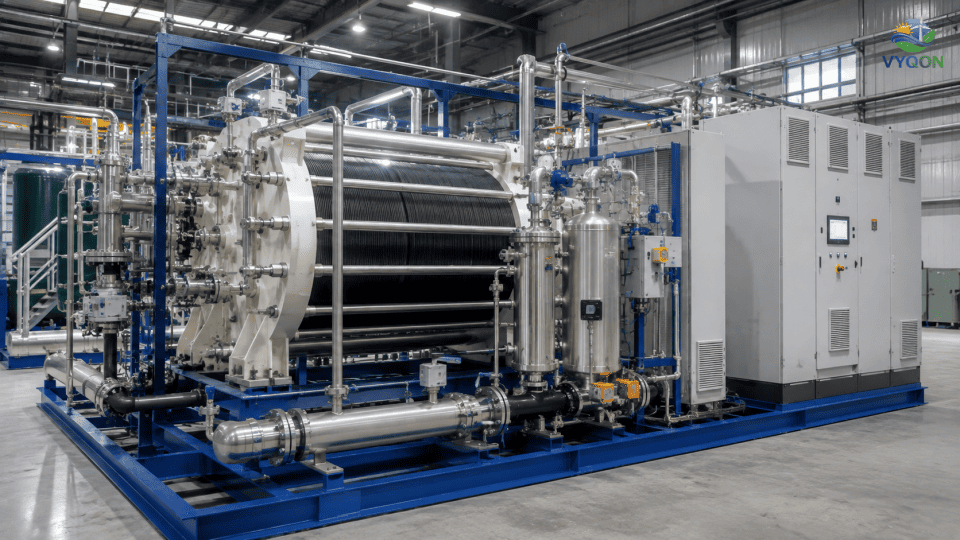
Key Points
- Issuing Authority: Ministry of New and Renewable Energy (MNRE), Government of India.
- Framework Name: Electrolyzer as a Service (EaaS) Model Service Agreement.
- Primary Structure: Build-Own-Operate (BOO) business model.
- Mission Alignment: Part of the Strategic Interventions for Green Hydrogen Transition (SIGHT) programme under the National Green Hydrogen Mission.
- Objective: Reducing upfront capital expenditure (CapEx) barriers to accelerate industrial adoption.
On July 23, 2026, the Ministry of New and Renewable Energy (MNRE) released a Model Service Agreement for Electrolyzer as a Service (EaaS), a pivotal development under the SIGHT programme designed to lower capital entry barriers for the hydrogen economy. By providing a standardized contractual foundation for the National Green Hydrogen Mission, the framework seeks to accelerate industrial decarbonization by shifting the sector’s financial burden from capital expenditure (CapEx) to operational expenditure (OpEx). The initiative is intended to simplify commercial negotiations, reduce transaction costs, and mitigate technical risks for industrial consumers hesitant to invest in emerging production technologies.
Business Model Breakdown: Build-Own-Operate (BOO) Framework
The EaaS model facilitates a strategic transition in renewable energy financing, allowing industrial firms to avoid the intensive asset ownership typically required for green hydrogen production. By adopting a BOO structure, the framework enables a service-based approach similar to successful models in the rooftop solar and battery storage sectors.
Ownership and Service Rights
The model agreement establishes a clear distinction between asset ownership and the consumption of output:
- Service Provider (Developer): Responsible for the financing, construction, ownership, and technical operation of the electrolyzer facility. The developer retains ownership of the infrastructure throughout the duration of the contract.
- Off-taker (Industrial Consumer): Obtains the hydrogen and oxygen molecules as a service. The off-taker does not hold equity in the plant but pays for the output delivered to their facility.
Risk Allocation
A primary function of the EaaS model is the transfer of technical and investment risks. Under this arrangement, specialized developers assume the burden of technological obsolescence and the complexities of uncertain electricity prices. This shift ensures that industrial consumers are shielded from the performance risks associated with relatively immature electrolyzer technologies, leaving plant optimization to entities with specific technical expertise and better access to project financing.
Commercial and Operational Terms of the Model Agreement
The standardized agreement provides a ready-made template for long-term commercial relationships, ensuring revenue visibility for developers and cost predictability for consumers.
- Contract Duration: The framework specifies a 15-year operating period, which begins only after the successful completion of the Performance Guarantee Test (PGT).
- Payment Structure: Financial obligations are managed via a Fixed Monthly Payment system. This fee includes equipment lease charges and operations and maintenance (O&M) costs. To maintain commercial viability over 15 years, the agreement includes annual price escalation linked to the Consumer Price Index (CPI).
- Performance Metrics: Developers are held to rigorous benchmarks to ensure industrial reliability:
- Specific Energy Consumption (SEC): Efficiency must meet a threshold of \le 56 \text{ kWh/kg}.
- Product Quality: Strict standards for product purity and output volumes.
- Annual Performance Degradation: The framework explicitly tracks and accounts for the natural decline in electrolyzer efficiency over time.
- Minimum Annual Availability: Developers must guarantee plant uptime; failure to meet these targets results in payment deductions or penalties.
Division of Roles and Compliance Obligations
Developer Obligations
The Service Provider is responsible for the complete lifecycle of the production facility. Beyond installation and O&M, the developer must ensure compliance with:
- Local Value Addition (LVA): Adherence to domestic content procurement rules, which scale over the life of the project.
- LOA Compliance: Developers must achieve operational status within two years of receiving the Letter of Award (LOA).
- Trade Regulations: Compliance with national land border trade and procurement rules.
Industrial Off-taker Obligations
The consumer must facilitate the operational environment for the facility by providing:
- Infrastructure: Provision of the project site and utility supplies.
- Statutory Approvals: Securing all necessary environmental and safety clearances required for plant operation.
- Legal Compliance: Obtaining Green Hydrogen Certification independently, in accordance with government guidelines.
Legal Status
The MNRE has designated this model agreement as a non-binding reference model. While it provides a robust baseline for negotiations, project developers and off-takers maintain the flexibility to modify technical, commercial, and financial provisions to meet the specific requirements of diverse sectors, such as steelmaking, refining, and chemicals.
Strategic Context: National Green Hydrogen Mission (NGHM)
The EaaS agreement is a critical instrument for achieving the SIGHT programme’s goal of reaching 5 MMTPA of green hydrogen production capacity by 2030. The framework arrives as the service model gains commercial traction, exemplified by the 2.5 MW project in Uttar Pradesh which includes provisions to scale to 50 MW.
By standardizing these contracts, the government aims to lower the levellised cost of hydrogen (LCOH). Current projections indicate that the LCOH in India could reach Rs 260-310/kg, provided specific enabling conditions are met, including the waiver of Interstate Transmission System (ISTS) charges and a GST reduction to 5%. These measures, combined with the EaaS model, are intended to bring green hydrogen into cost parity with conventional “grey” hydrogen produced from fossil fuels.
Official Source Citation
Ministry of New and Renewable Energy (MNRE), Government of India. (2026). Model Service Agreement for “Electrolyser as a Service” (EAAS). Issued under the National Green Hydrogen Mission. Available at: S3WaaS Government Portal.
Leave a Comment