
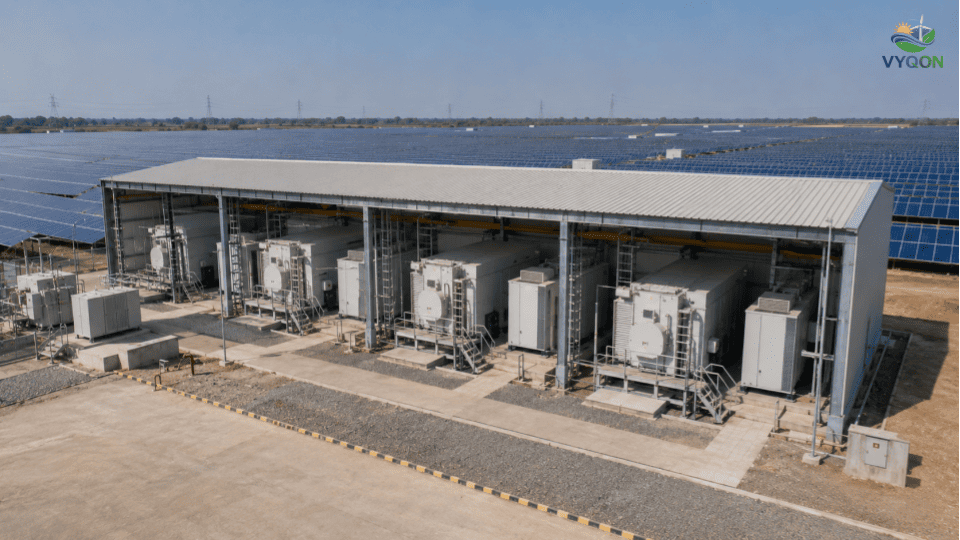
The Ministry of New and Renewable Energy (MNRE) has issued a further extension for mandatory Bureau of Indian Standards (BIS) compliance for solar photovoltaic (SPV) inverters with a capacity exceeding 200 kW. Under the new directive, these high-capacity inverters are permitted for sale based on self-certification until December 31, 2026, or until further orders, whichever is earlier. This regulatory update provides an additional transition window for manufacturers to align with quality control requirements as specified in the current framework.
The Core Update: Regulatory Facts and Scope
In exercise of the powers conferred by the Bureau of Indian Standards Act, 2016, the Central Government has modified the implementation schedule for high-capacity power conversion equipment. The extension applies specifically to the following categories defined in the “Solar Systems, Devices and Components Goods Order, 2025”:
- Item 4: Solar Photovoltaic Inverters.
- Item 5: Utility-Interconnected Photovoltaic Inverters.
This directive applies exclusively to SPV inverters with a capacity of more than 200 kW. The official notification, S.O. 3706(E), was issued on July 3, 2026, and published in the Gazette of India (Extraordinary), No. 3544, on July 8, 2026. This order amends the implementation timeline of the original order (S.O. 492(E) dated January 27, 2025). This update grants a six-month extension beyond the previous deadline of June 30, 2026. The new cutoff is December 31, 2026, or until further orders, whichever is earlier.
Compliance Requirements and Mandatory Standards
Manufacturers utilizing the self-certification extension must adhere to prescribed Indian and international standards. The following table identifies the technical requirements for Item 4 and Item 5:
| Product Category | Prescribed Indian & International Standards |
| Item 4 (SPV Inverters > 200 kW) | • IS 16221 (Part 2): 2015 / IEC 62109-2: 2011<br>• IS/IEC 61683: 1999 |
| Item 5 (Utility-Interconnected Inverters > 200 kW) | • IS 16221 (Part 2): 2015 / IEC 62109-2: 2011<br>• IS 16169: 2019 / IEC 62116: 2014<br>• IS 17980: 2022 / IEC 62891: 2020 |
Prerequisites for Self-Certification
The use of self-certification is subject to the condition that manufacturers fulfill the following regulatory prerequisites:
- Manufacturers must possess valid International Electrotechnical Commission (IEC) certificates corresponding directly to the prescribed Indian Standards (IS).
- Manufacturers must hold valid test reports issued by accredited testing laboratories for the implementation of the order.
Rationale: Addressing Testing Infrastructure Gaps
According to the official Gazette notification dated July 8, 2026, the MNRE issued this extension to address specific bottlenecks in the certification ecosystem. The primary reasons for the postponement of mandatory third-party registration include:
- Limited Testing Facilities: Restricted availability of domestic laboratories equipped to test and certify high-capacity solar inverters above the 200 kW threshold.
- Supply Chain Continuity: The necessity of providing manufacturers additional time to transition to mandatory quality standards without causing disruptions to the supply chain for utility-scale solar projects.
Operational Impact and Implementation Timeline
The regulatory landscape for solar inverter compliance has evolved through the following progression:
- Original Order (January 27, 2025): The “Solar Systems, Devices and Components Goods Order, 2025” (S.O. 492(E)) was issued, formally superseding the “Solar Photovoltaics, Systems, Devices and Components Goods (Requirements for Compulsory Registration) Order, 2017.”
- First Extension (August 5, 2025): Notification S.O. 3597(E) extended the self-certification deadline for Item 4 and Item 5 to June 30, 2026, or until further orders, whichever is earlier.
- Latest Extension (July 3, 2026): Notification S.O. 3706(E) further extends the timeline for these specific items to December 31, 2026, or until further orders, whichever is earlier.
Next Steps for Compliance
Compliance officers, developers, and Engineering, Procurement, and Construction (EPC) firms must prioritize the verification of supplier documentation. Access to the Indian market remains subject to the condition that all SPV inverters exceeding 200 kW are backed by valid IEC certificates and test reports from accredited laboratories. These documents must be secured before the December 31, 2026, cutoff (or until further orders, whichever is earlier) to avoid market exclusion and ensure the smooth implementation of project schedules.
Official Sources
- Ministry of New and Renewable Energy (MNRE) – Current Notices Portal https://mnre.gov.in/en/notice-category/current-notices/
- The Gazette of India: Notification S.O. 3706(E) — Extension of Self-Certification for Solar Inverters (>200 kW) https://cdnbbsr.s3waas.gov.in/s3716e1b8c6cd17b771da77391355749f3/uploads/2026/07/2026071025383477.pdf
Leave a Comment