
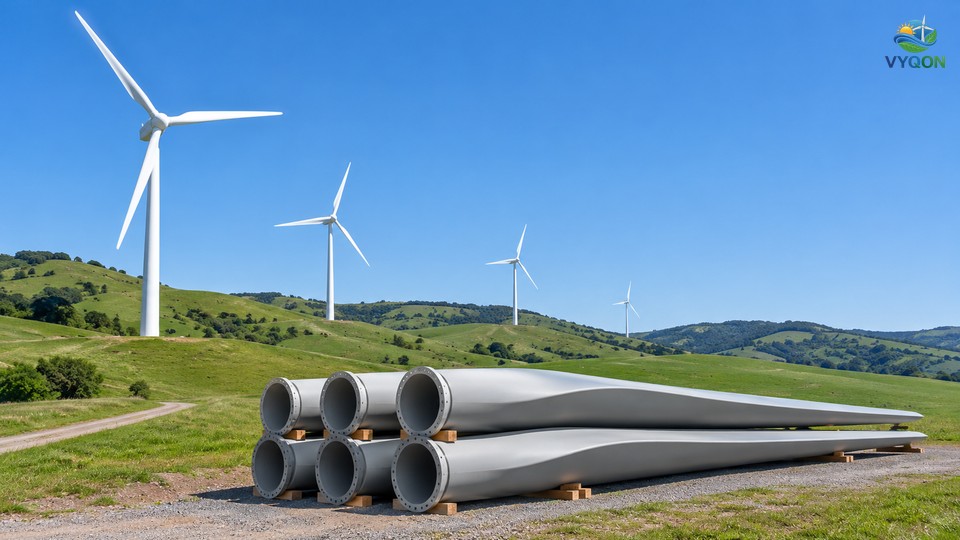
Grasim Industries Limited’s Advanced Materials Division and its renewable energy arm, Aditya Birla Renewables Limited (ABRen), have signed a Memorandum of Understanding (MoU) with Suzlon Energy Limited to develop, commercialise and scale wind turbines with recyclable blade technology on a pilot basis. The agreement, announced in a press release dated 4 November 2026 from New Delhi, was signed at the Bharat Renewable Energy Summit & Expo 2026. It centres on recyclable wind turbine blades made with Grasim’s Recyclamine epoxy technology, and the press release is titled as a pact to develop, commercialise and scale India’s first wind turbines with recyclable blades.
What the MoU covers
Under the MoU, the three companies will work together on a pilot to develop, commercialise and scale wind turbines equipped with recyclable blades. Each partner has a defined role. Grasim supplies the Recyclamine epoxy technology. Suzlon, as the wind turbine original equipment manufacturer (OEM), will integrate Recyclamine into the manufacturing of recyclable wind turbine blades. ABRen will deploy a wind turbine fitted with recyclable blades at one of its selected project sites, so that the technology can be shown to work commercially in real operating conditions.
The parties have also said they will explore wider commercialisation of the technology across India and in other agreed markets. The press release does not state the size of the pilot, the rating of the turbine, the location of the project site, a timeline or any investment amount. Because the agreement is an MoU at pilot stage, it is a statement of intent to collaborate rather than a firm supply contract or a commissioned project.
Why recyclable wind turbine blades matter
Most conventional wind turbine blades are made from thermoset composite materials. These are difficult to recycle when the blades reach the end of their service life, and the blades often end up in landfill or are incinerated. Blades made with Grasim’s Recyclamine epoxy technology can instead be chemically recycled at the end of their life, which makes it possible to recover the composite constituents for reuse in new applications. The companies say this supports circular economy principles, reduces waste and lowers the environmental impact of wind energy projects.
For a country that is adding wind capacity every year, end-of-life blade management is a question that will grow in importance as the first generation of turbines ages. A recyclable blade route gives developers and turbine makers one possible way to deal with that material before volumes become large.
The three companies
Grasim Industries Limited is listed on the BSE and the NSE. The announcement was made through a filing under Regulation 30 of the SEBI Listing Regulations, signed by the company secretary, which carried the joint press release. ABRen is a subsidiary of Grasim and, according to the release, has a renewable energy capacity of more than 4.4 GWp across over 60 projects in more than 12 states of India. VYQON has earlier reported on the company’s acquisition of Sprng Energy: Aditya Birla Renewables to Acquire Shell’s Sprng Energy in $1.8 Billion Landmark Transaction.
Suzlon, the turbine partner, reported revenue of more than USD 1.75 billion for FY26, according to the press release. An earlier quarterly result was covered here: Suzlon’s Q1 FY 2027 Revenue Rises 23% YoY to Rs 3,819 Crore.
What the partners said
Rajesh Balakrishnan, CEO of the Advanced Materials business at Grasim, and Amit Jain, CEO of ABRen, are quoted in the release on the collaboration. Girish Tanti, Co-Founder of the Suzlon Group, said in the release that Suzlon is working towards making all its future turbines recyclable within the next three to four years. He also referred to Suzlon’s flagship S144 platform, which the company describes as having one of the lowest carbon footprints in the world. These are company statements and targets, not outcomes that have been independently verified.
What it means for India’s clean-energy sector
India’s wind industry is expanding and the supply chain is increasingly focused on lifecycle questions, not only on installed megawatts. A pilot that brings a materials supplier, a turbine manufacturer and a project developer together under one MoU covers the three links that matter for recyclable blades: the resin technology, the blade manufacturing and the field operation.
If the pilot works, the main questions will be practical ones. These include whether recyclable blades match the performance and durability of current blades, how the cost compares, and whether an organised system can be built to collect and chemically recycle the blades at end of life. The press release does not answer these questions. They are likely to be tested only when a turbine with the new blades has been built and operated at the ABRen site.
For developers, the announcement is an early marker that recyclability is becoming part of turbine specifications. For policy makers, it is a reminder that end-of-life rules for wind and solar equipment are a topic that the sector will have to deal with in the coming years. Further details on the pilot will be known only when the companies publish them.
Official references
1. Grasim Industries Limited, BSE/NSE filing “Press Release” dated 4 November 2026 (scrip code 500300, symbol GRASIM), carrying the joint press release of Grasim and Suzlon: https://www.bseindia.com/xml-data/corpfiling/AttachLive/0b181f48-9022-483a-83e2-00ad84c27f0f.pdf
Leave a Comment