
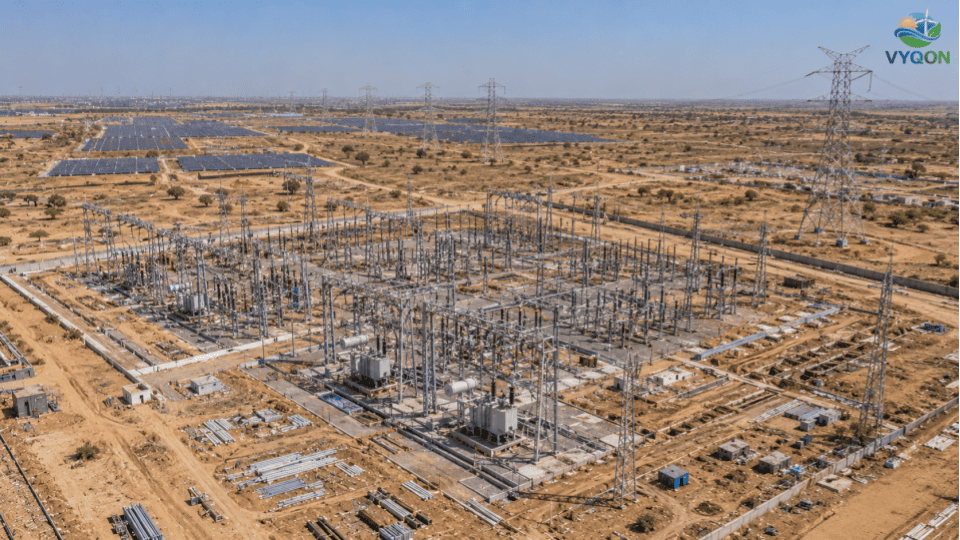
Jaipur — The Rajasthan Electricity Regulatory Commission (RERC) has issued a significant regulatory order approving the Capital Investment Plan (IP) for Rajasthan Rajya Vidyut Prasaran Nigam Ltd. (RVPN) for the financial year 2026-27. Distinguishing this investment approval from a routine tariff order, the Commission authorized a total outlay of ₹6,312.20 crore. The approved plan is strategically designed to facilitate grid modernization, accommodate the rapid integration of renewable energy (RE) capacity, and expand the state’s transmission backbone to manage projected increases in peak power demand.
Financial Allocation and Project Scope
The final approval follows a rigorous regulatory cycle that began with RVPN’s initial petition in December 2025, which sought an investment of ₹6,340 crore. Following subsequent state budget announcements and emerging grid contingencies, the utility filed an Interlocutory Application to revise the proposal upward to ₹6,500 crore. After examining technical load flow studies and stakeholder interventions, the Commission pruned the final figure to ₹6,312.20 crore.
The approved expenditure targets specific technical deficiencies and modernization requirements, including:
- Modernization of Grid Security: Systematic replacement of legacy static relays with advanced numerical distance and differential protection systems to minimize protection failures.
- System Automation: Comprehensive upgradation of Substation Automation Systems (SAS) to enhance real-time monitoring and fault analysis.
- Capacity Expansion: Installation of high-capacity 500 MVA transformers, particularly in regions experiencing high load growth and high concentrations of RE generation.
- Technical Compliance: Adherence to technical standards for connectivity, necessitating the installation of Phasor Measurement Units (PMUs) at major pooling points.
Priority Renewable Energy (RE) Evacuation Schemes
A central directive of the Commission involves the prioritization of infrastructure within the state’s primary renewable energy hubs. The investment plan emphasizes capacity expansion in the Bhadla, Ramgarh, and Jaisalmer-Barmer regions. This geographic focus is aligned with the 20 GW Renewable Energy Zones (REZ) Phase-III program and the Green Energy Corridor-III (GEC-III) initiatives.
The Commission noted that the recent commissioning of projects like the Apraava Energy Fatehgarh IV transmission line and the associated 400/220 kV Barmer pooling substation underscores the need for continued state-level investment to ensure seamless evacuation from these clusters. These schemes are critical for stabilizing the state grid as Rajasthan moves toward supporting the national target of 500 GW of non-fossil fuel capacity by 2030.
Regulatory Oversight and Compliance Directives
The Commission accompanied its financial approval with stringent mandates aimed at enhancing RVPN’s operational accountability and project management.
Monitoring Improvements The RERC expressed a “serious view” regarding chronic inefficiencies in project execution. The Commission specifically cited the 400 kV Suratgarh TPS–Babai transmission line, which has remained incomplete for over a decade, leading to significant cost escalations. RVPN has been directed to provide a detailed justification for completion timelines and clarify financial liabilities for all pending projects. Furthermore, all future investment proposals must be substantiated by updated load flow studies and technical documentation to prevent duplication of works.
Bidding Compliance In a landmark ruling regarding the 765 kV Hindaun project, the Commission explicitly disallowed the use of the Regulated Tariff Mechanism (RTM), citing the RERC Tariff Regulations, 2025. The Commission observed that the Hindaun, Anta-II, and Ajarka substations function as a single, interdependent evacuation corridor rather than independent schemes. Consequently, the RERC ruled against “splitting” interconnected transmission elements into smaller units to bypass the cost thresholds that mandate Tariff-Based Competitive Bidding (TBCB). RVPN must now execute the entire corridor through the TBCB route to ensure regulatory compliance and cost-efficiency.
Key Stakeholder Observations
The regulatory process incorporated feedback from consumer groups and industry experts, resulting in the following critical observations:
- Transmission Tariff Pressure: Stakeholders expressed concern that substantial capital outlays would ultimately lead to a spike in transmission tariffs, impacting the end-consumers’ electricity bills.
- Historical Budget Under-utilization: It was noted that by the end of 2025, RVPN had utilized less than 50% of its previously approved capital expenditure budget, raising questions about the utility’s capacity to deploy the newly requested funds effectively.
- Interdependence Study: In an order dated May 20, the Commission directed the formation of a specialized committee to study the growing interdependence between intra-state and inter-state transmission systems. The committee will analyze the impact of wheeling out RE to other states, specifically focusing on transmission losses and the allocation of costs between state and national grid systems.
Implementation and Funding Roadmap
The implementation of the FY 2026-27 plan utilizes a mix of state support and debt financing. The Government of Rajasthan has already sanctioned ₹402.54 crore in equity, fulfilling a portion of the support announced in the state budget in February 2025.
To bridge the remaining funding gap, the RERC has provided in-principle approval for asset hypothecation. This mechanism allows RVPN to secure the necessary loans from financial institutions and development banks, such as KfW, up to a total security amount of ₹6,108.32 crore.
Leave a Comment