
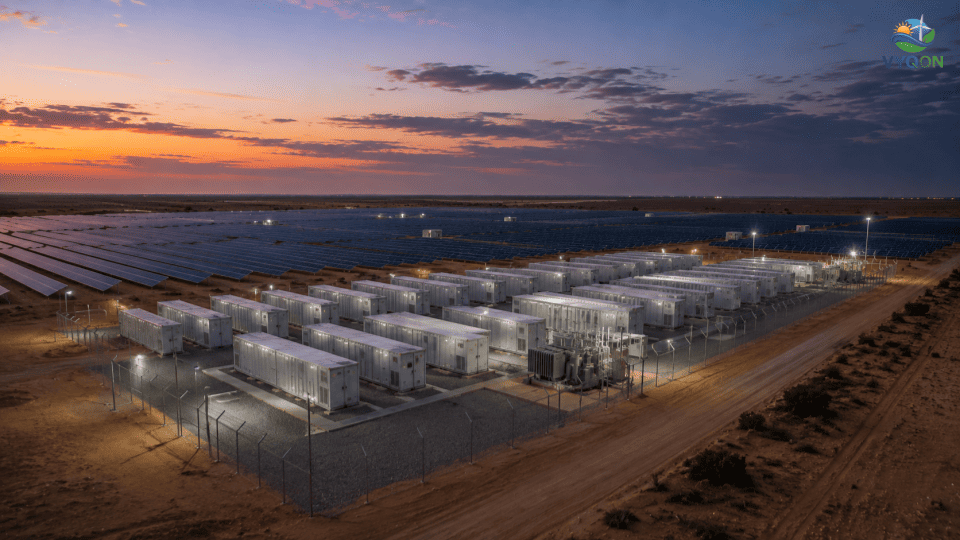
Ahmedabad-based Sahaj Solar Limited has approved the setting up of a battery energy storage system (BESS) manufacturing facility with a capacity of 1.8 GWh at Dakor in Gujarat. The Board of Directors cleared the proposal at its meeting on October 19, 2026, and the company disclosed the decision to the National Stock Exchange (NSE) the same day under Regulation 30 of the SEBI (Listing Obligations and Disclosure Requirements) Regulations, 2015.
The move marks the company’s entry into storage manufacturing. Its disclosure states that existing BESS capacity is nil, making the Dakor unit its first facility in the segment.
Key Project Details
As per the exchange filing, the new capacity is to be added and the BESS product launched within 12 months. The estimated investment of approximately ₹25 crore excludes the cost of factory premises that have already been constructed at the site, and the project will be financed through a combination of debt and internal accruals. The products are intended for both domestic and international markets, with India named as the initial launch market in the disclosure, which was filed under the category of capacity addition and product launch.
The company has described the rationale as vertical integration of its existing solar systems business. The filing does not specify the battery chemistry, cell sourcing arrangements, product ratings or technology partners, which are expected to become clearer as the project progresses.
Dakor is not a new location for the company. In its investor presentation filed with NSE in November 2025, Sahaj Solar had identified Dakor as the site of a planned 1,500 MW solar module capacity expansion, in addition to its existing 100 MW module plant at Bavla near Ahmedabad.
Strategic Fit with the Existing Business
Incorporated in 2010, Sahaj Solar operates across PV module manufacturing, solar water pumping solutions and engineering, procurement and construction (EPC) services. According to its May 2026 investor presentation, the company has executed more than 60,000 solar water pumps, including through state nodal agencies under programmes such as PM-KUSUM, and manufactures around 70% of the raw materials required for its pumping systems in-house.
Storage already features in the company’s project pipeline. Sahaj Solar has an exclusive partnership with IDMC Limited, a subsidiary of the National Dairy Development Board (NDDB), to deploy hybrid solar-battery systems for nearly 10,000 bulk milk coolers over three years across Gujarat, Uttar Pradesh, Rajasthan and the North-East, with project values ranging from ₹5 lakh to ₹35 lakh per cooler depending on capacity. Its domestic EPC pipeline also includes off-grid solar systems with BESS valued at about ₹44 crore. An in-house storage line would allow the company to meet battery requirements for such projects internally while also supplying third-party customers.
Financial Performance
The investment follows a year of steady growth. As per the audited consolidated results for FY2025-26, revenue from operations rose to ₹419.19 crore from ₹329.79 crore in FY2024-25, an increase of about 27%, while EBITDA rose to about ₹54 crore from ₹43 crore. Profit after tax stood at ₹29.57 crore, compared with ₹27.54 crore in the previous year. The company reported an order book of ₹402 crore as of March 31, 2026, and stated that it repaid a ₹100 crore working capital loan in the first week of April 2026.
Alongside its domestic plans, Sahaj Solar is expanding overseas. In May 2026, its board approved the incorporation of a 50:50 joint venture in the UAE, through its Dubai-based wholly owned subsidiary, to develop a 750 MW manufacturing and project facility. The company has also signed an agreement for a 10 MW EPC project in Zambia.
Policy Backdrop
The announcement comes as the Centre steps up support for energy storage. According to the Ministry of Power, the Central Electricity Authority’s (CEA) National Electricity Plan (2023) projects a requirement of 208 GWh of BESS by 2030 to integrate the growing share of renewable energy. The ministry reported in March 2026 that 35.8 GWh of BESS capacity was under construction across the country.
The government is implementing two Viability Gap Funding schemes to support about 43 GWh of BESS. The Ministry of Heavy Industries’ Production-Linked Incentive scheme for Advanced Chemistry Cells, with an outlay of ₹18,100 crore, targets 50 GWh of domestic cell manufacturing, of which 10 GWh is earmarked for grid-scale storage. In February 2025, the CEA advised that solar projects be co-located with storage equal to at least 10% of installed solar capacity for a minimum of two hours, while Inter-State Transmission System charges have been waived for co-located BESS projects commissioned up to June 2028. An amendment to the Electricity Rules in September 2025 also permitted consumers to develop, own, lease or operate energy storage systems.
Other measures include the inclusion of energy storage in the Ministry of Finance’s Harmonised Master List of Infrastructure in October 2022, which eases access to long-tenure, lower-cost financing, and the National Framework for Promotion of Energy Storage Systems issued in September 2023. Electricity supplied from BESS is also allowed to participate in the High-Price Day-Ahead Market launched in March 2023.
Outlook
With the factory premises already in place, the stated timeline for capacity addition and product launch will be the key benchmark for Sahaj Solar’s entry into storage. Details on technology, product specifications and commissioning will determine how quickly the Dakor facility contributes to the company’s solar-plus-storage offerings in India and abroad.
Official Sources
- Sahaj Solar Limited – Outcome of Board Meeting dated October 19, 2026 (Disclosure to NSE under Regulation 30, SEBI LODR): https://www.sahajsolar.com/wp-content/uploads/2025/09/Outcome-of-Board-Meeting-dated-October-19-2026.pdf
- Sahaj Solar Limited – Audited Financial Results for the Year Ended March 31, 2026 and Outcome of Board Meeting dated May 16, 2026: https://www.sahajsolar.com/wp-content/uploads/2025/09/1.-Audited-Financials-for-Half-Year-and-Year-ended-on-March-31-2026.pdf
- Sahaj Solar Limited – Investor Presentation, H2 & FY26 (May 2026): https://www.sahajsolar.com/wp-content/uploads/2025/09/Investor-Presentation-as-on-18.05.2026.pdf
- Sahaj Solar Limited – Investor Presentation filed with NSE (November 12, 2025): https://nsearchives.nseindia.com/corporate/SahajSolar_12112025150925_121125_SSL_Intimation_of_Investor_Presentation_Signed.pdf
- Press Information Bureau, Ministry of Power – Development of Battery Energy Storage Systems (March 30, 2026): https://www.pib.gov.in/PressReleasePage.aspx?PRID=2246898
Leave a Comment