
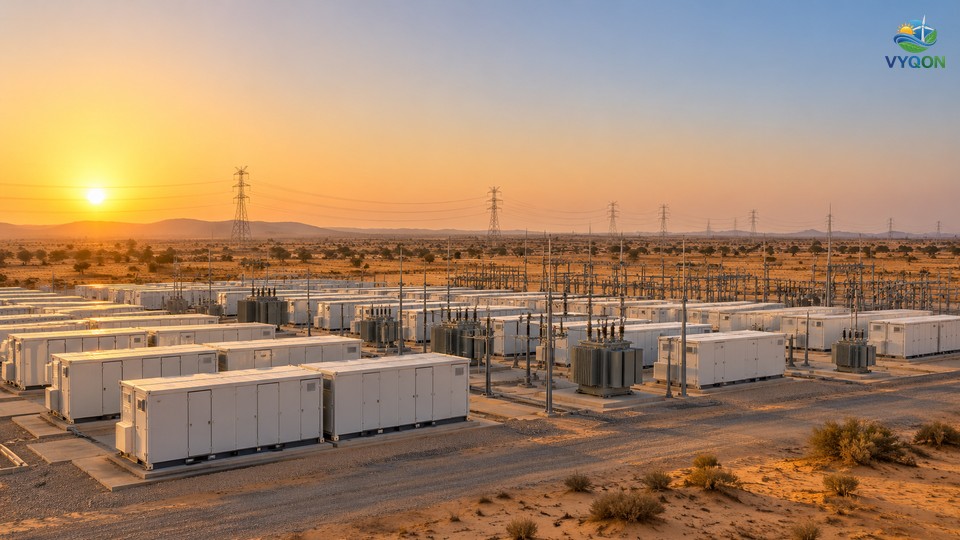
Solar Energy Corporation of India Limited (SECI) has invited bids to select developers for 4,000 MW / 16,000 MWh of standalone battery energy storage systems (BESS) in Rajasthan and Gujarat under tariff-based competitive bidding. The Request for Selection (RfS) No. SECI/C&P/IPP/15/0013/26-27, called ESS-V, is dated 28 October 2026 and is listed on the SECI tender portal as Tender ID SECI000296. The online bid deadline is 18:00 on 19 November 2026, and bids will be opened at 10:00 on 24 November 2026. The capacity is split into Package I, 2.5 GW / 10 GWh in Rajasthan, and Package II, 1.5 GW / 6 GWh in Gujarat. A bidder may bid for either package or both.
Key dates
SECI published the tender on 28 October 2026 at 21:00 IST. A notification uploaded on 29 October fixes the pre-bid meeting for 14:30 on 6 November. Offline submission closes at 18:00 on 23 November.
How the projects will work
The projects will be built on a Build-Own-Operate basis. The RfS is technology agnostic, so developers may choose any battery chemistry that meets the performance criteria. Each system must be rated for four hours of charging and four hours of discharging in one cycle, so a bid is quoted as X MW / 4X MWh. The developer arranges land, connectivity, approvals and operation, and must source at least 51 per cent of the charging energy from renewable sources. Discharge is “on demand”: the buying entity schedules any four hours between the start of evening non-solar hours and the end of non-solar hours the next morning.
SECI will sign a Power Purchase Agreement (PPA) with the successful bidders and act as an intermediary nodal agency. The buying entities will be named later. The PPA runs for 20 years from the scheduled commissioning date or the date of full commissioning, whichever is later.
Bid size and financial support
Each bidder, including its parent, affiliates and group companies, may submit one bid per package. In Package I the minimum is 50 MW / 200 MWh and the maximum is 625 MW / 2,500 MWh. In Package II the minimum is the same and the maximum is 375 MW / 1,500 MWh.
The RfS provides for Central Financial Assistance of Rs 15 lakh per MWh of BESS, which comes to Rs 2,400 crore for 16 GWh. The Viability Gap Funding order for these projects will be communicated later. Projects must follow the Make in India requirements of the Ministry of Power order dated 24 December 2025, with an auditor’s certificate on local content.
Fees, guarantees and eligibility
The cost of the RfS is Rs 50,000 plus GST. The bid processing fee is Rs 20,000 per MW plus GST, capped at Rs 20 lakh per package. The earnest money deposit is Rs 7,18,400 per MW for each package, valid for 12 months from the bid deadline. Winners must furnish a performance bank guarantee of Rs 17,96,000 per MW before signing the PPA, and pay success charges of Rs 1,00,000 per MWh in two equal instalments.
Bidders must show a net worth of at least Rs 71,84,000 per MW. They must also meet one liquidity test: annual turnover of Rs 87,51,400 per MW, PBDIT of Rs 17,50,280 per MW, or a line-of-credit letter for Rs 21,87,850 per MW.
How winners are chosen
The process is a single-stage, two-envelope bid followed by an e-reverse auction, held separately for each package. Tariff is quoted in rupees per kWh of discharged energy, and each bid in the auction must be at least one paisa below the bidder’s previous quote. Bidders within 2 per cent of the lowest tariff become successful bidders, subject to a cap on awardable capacity of 80 per cent of qualified bid capacity, up to the tendered capacity.
Performance and timelines
Developers must guarantee monthly system availability of at least 85 per cent. A shortfall attracts liquidated damages of twice the PPA tariff for the discharge energy not made available. To allow for battery ageing, the minimum dispatchable capacity at the end of each contract year is set at 98.5 per cent of the commissioning capacity in year one, falling to 70 per cent in year 20, and developers must replenish capacity as needed.
Commissioning is due 12 months after the PPA effective date, with a further six months allowed against liquidated damages recovered by pro-rata encashment of the performance guarantee. Financial closure is due two months before the scheduled commissioning date.
What it means for India’s clean-energy sector
The RfS states that the aim is to strengthen intra-state transmission and provide grid flexibility, and to address intermittency, congestion, peak-hour curtailment and non-solar-hour demand in Rajasthan and Gujarat. At 16 GWh in a single tender, with evening discharge, a renewable charging condition and a local content requirement, ESS-V is a large test of developer appetite for four-hour storage. The outcome will depend on the tariffs discovered in the auction and on the timing of the VGF order, which the RfS says will follow.
Leave a Comment