
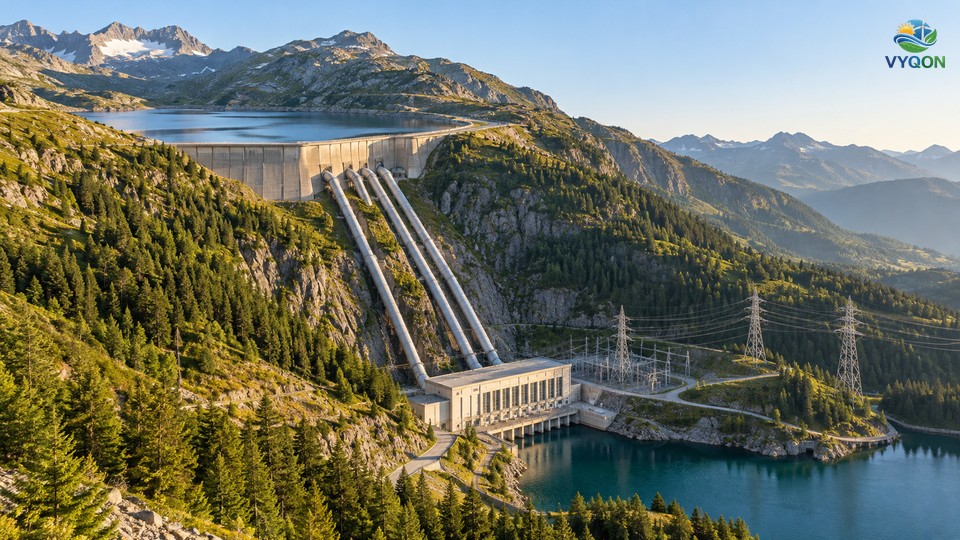
The Central Electricity Regulatory Commission (CERC) has proposed adding pumped storage plants (PSPs) to the list of generating stations eligible to sell in the High Price Day Ahead Market (HP-DAM) on India’s power exchanges. In an order dated 28 October 2026 in Petition No. 13/SM/2026, a suo-motu case, the Commission said PSPs may be permitted to participate in the existing HP-DAM segment, and directed interested parties to file written submissions within 15 days of the order. A public hearing under Regulation 56 of the Conduct of Business Regulations, 2023 will follow after a public notice. The order was signed by Chairperson Jishnu Barua and three Members.
What HP-DAM is and who can use it today
HP-DAM was created inside the Integrated Day Ahead Market (I-DAM) to give generating stations with high generation costs a market avenue, because the price ceiling in the regular Day Ahead Market (DAM) could stop them from participating. Through orders dated 16 February 2023 (Petition No. 359/MP/2022), 11 April 2023 (Petition No. 14/MP/2023) and 24 July 2023 (Petition No. 122/MP/2023), CERC allowed power exchanges to open the segment to three categories: gas-based stations using imported RLNG and naphtha, imported-coal stations using only imported coal, and battery energy storage systems (BESS).
In the same orders, CERC asked the National Load Despatch Centre (NLDC) to publish a list of eligible sellers and to submit quarterly reports recommending any other resource that should be added. NLDC wrote to the Commission on 2 July 2026 and again on 24 July 2026 recommending that PSPs be included. The Ministry of Power (MoP) then wrote on 30 July 2026, asking the Commission to consider including PSPs as eligible generating stations, citing their role in long-duration storage, peak power support and grid balancing.
The Ministry’s pumped storage guidelines of 10 April 2023 already say PSPs shall be allowed to participate in all market segments, including HP-DAM, to benefit from peak and off-peak price differences.
Capacity figures in the order
NLDC’s analysis, which the order reproduces, relies on the Central Electricity Authority (CEA) report of January 2026, “Roadmap to 100 GW of Hydro Pumped Storage Projects by 2035-36”. Operational PSP capacity in India stands at 7,425.6 MW across 10 projects: 4,845.6 MW (eight projects) of on-stream capacity and 2,580 MW (two projects) of off-stream capacity. NLDC noted that the operating plants are almost fully tied up, so the merchant capacity available from ISTS-connected PSPs today is limited.
The pipeline is far larger. Eleven projects totalling 15,870 MW are under construction. Five projects with 6,580 MW have had their detailed project reports concurred or appraised by CEA, two projects with 2,200 MW are under examination, and 65 projects with 93,350 MW are at the survey and investigation stage. The estimated national potential is about 290,196 MW across 264 sites.
Why the Commission thinks DAM alone is not enough
NLDC examined how HP-DAM performed between April 2025 and July 2026. The segment cleared on only 47 days, or 9.65 per cent of the period, and in 965 time blocks, or 2.06 per cent. The order calls it a relatively limited segment in terms of trading activity and liquidity, though it still offers an additional avenue during periods of high price discovery.
The regular DAM price exceeded Rs 5 per kWh on 322 days, about 66.12 per cent of the days analysed. Over the same period, unconstrained market-clearing prices averaged about Rs 2.2 per unit in solar hours and about Rs 6.57 per unit in evening peak hours, a gap of roughly Rs 4.37 per unit that a storage plant could try to capture by pumping during the day and generating in the evening.
NLDC also compared this with what PSPs cost. The levelised fixed cost ranges from about Rs 3.3 to Rs 4.98 per unit, and the effective landed tariff including pumping may go up to Rs 8.92 per unit. Reference points in the order include Purulia at Rs 6.89 per unit, an Assam bid-discovered tariff of Rs 5.19 per unit, and Greenko’s 500 MW/3,000 MWh project awarded by NTPC REL in December 2022 at Rs 6.69 per unit.
On this basis, the Commission took the prima facie view that the opportunity in DAM alone may not be sufficient for PSPs under present conditions. It said that access to periods of higher demand through HP-DAM would improve their commercial viability and allow fuller use of PSPs as flexible storage when supply is constrained.
What it means for India’s clean-energy sector
The proposal is not yet a final decision: the Commission will hear stakeholders before it decides. Even so, it shows regulators looking at market design to support long-duration storage.
For developers, the main effect would be a second price window for merchant capacity. Because operating plants are almost fully contracted, the immediate gain would be modest, but new projects among the 15,870 MW under construction could factor a possible HP-DAM revenue stream into their plans, subject to the final rules. For the grid, more flexible storage in the evening peak helps absorb solar output in the middle of the day and release it when demand is high. The low liquidity of HP-DAM, which the order itself stresses, means any benefit will depend on how often the segment actually clears.
Leave a Comment