
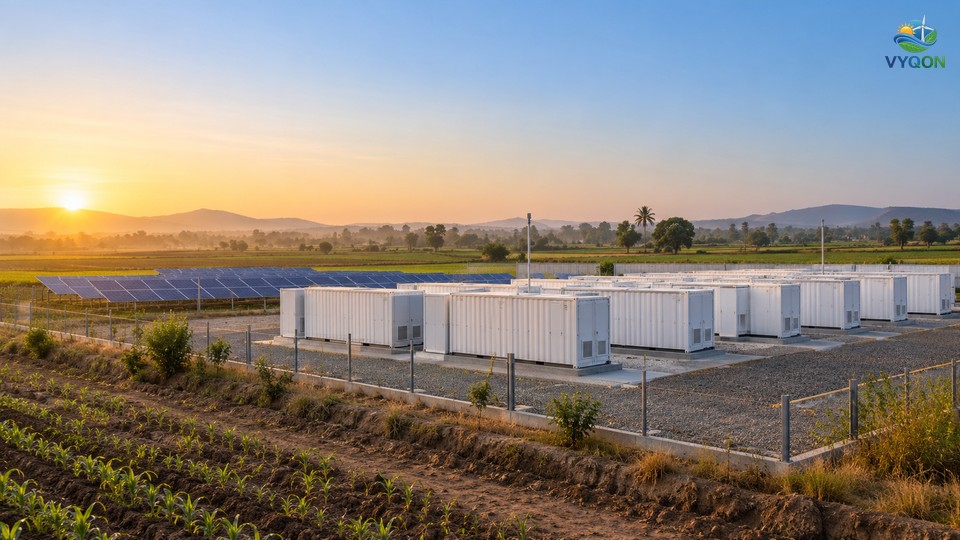
Pune-based GK Energy Limited (NSE: GKENERGY, BSE: 544525) reported revenue from operations of Rs 4,026.54 million (about Rs 402.7 crore) for the quarter ended 30 September 2026, up 12.3% from Rs 3,585.04 million in Q2 FY26. Profit after tax was Rs 493.64 million (about Rs 49.4 crore), up 6.3% year on year. The company announced the results on 29 October 2026 and said it had installed 19,391 renewable energy systems in the quarter, 41.8% more than a year earlier. It also reported its first utility-scale battery energy storage system (BESS) order, for 150 MW / 300 MWh in Maharashtra.
Quarter and half-year numbers
EBITDA for Q2 FY27 was Rs 744.15 million, up 0.9% from Rs 737.43 million a year earlier, with the EBITDA margin at 18.5% against 20.6% in Q2 FY26. Profit before tax rose 6.0% to Rs 657.85 million, and earnings per share were Rs 2.43. The PAT margin was 12.3%, compared with 12.9% a year earlier. Finance costs fell 32.9% to Rs 72.74 million, while cost of goods sold rose 10.8% to Rs 2,732.37 million.
Compared with the previous quarter, the picture is softer. Q1 FY27 revenue was Rs 5,051.92 million and PAT was Rs 596.73 million, so Q2 revenue was 20.3% lower and PAT 17.3% lower on a sequential basis. Installations followed the same pattern, falling 19.6% from 24,118 systems in Q1.
The half-year picture is stronger. For H1 FY27, revenue reached Rs 9,078.46 million, up 38.9% from Rs 6,537.72 million. EBITDA grew 21.6% to Rs 1,605.29 million at a 17.7% margin, and PAT rose 30.7% to Rs 1,090.37 million. In H1 the company installed 43,509 systems, up 77.6%, and 193 MW of capacity, up 70.8%; in Q2 alone it installed 84 MW, 33.3% more than a year earlier.
Orders and operations
GK Energy said it has cumulatively installed more than 184,000 renewable energy systems and commissioned over 800 MW of capacity across India as of September 2026. Its network covers six states and more than 7,500 villages, with over 1,300 installation and commissioning partners.
The order book stood at Rs 7,880 million, counting orders as of 30 September 2026 and those received after it. Among the recent wins, the company cited an institutional order to install 100,000 rooftop solar systems and an additional award for 14,000 off-grid solar photovoltaic water pumping systems in Maharashtra, received in October 2026.
The balance sheet reflects the pace of growth. Debtor days rose to 204 at September 2026 from 140 at March 2026, and net working capital days stood at 191 against 112. Total borrowings were Rs 3,440.70 million and total cash Rs 1,902.92 million, leaving net debt of Rs 1,537.78 million, against a net cash surplus of Rs 2,406.15 million at the end of FY26. It said Rs 3,774.80 million was received after 30 September 2026.
First battery storage award
On 21 September 2026 GK Energy announced a Letter of Award from the Maharashtra State Electricity Distribution Company Limited (MSEDCL) for 150 MW / 300 MWh of BESS in Maharashtra. The award came from a tariff-based global competitive bidding, run as an e-reverse auction, for 2,000 MW / 4,000 MWh of storage with Viability Gap Funding (VGF) support.
GK Energy was declared one of the successful bidders at a tariff of Rs 2,38,000 per MW per month. That works out to yearly revenue of Rs 42.84 crore, excluding GST, for 15 years from the commencement of commercial operations. The company described the award as its entry into the BESS segment, alongside solar pumping, rooftop solar and distributed renewable infrastructure.
Managing Director and CEO Gopal Rajaram Kabra said the company is “scaling rooftop solar and expanding into energy storage”, and that further storage opportunities are in the pipeline. The company’s stated aim is to reach 1 million installed systems and a USD 1 billion business by 2030, from about 184,000 systems today.
Market backdrop cited by the company
The investor presentation places the results against national data drawn from MNRE sources. India’s installed solar capacity was 171.05 GW at 30 September 2026, including 125.65 GW ground-mounted and 33.41 GW grid-connected rooftop. Solar additions were 44.61 GW in FY26.
On storage, the presentation says about 75 GWh of BESS capacity was at various stages of tendering and construction as of December 2025. It also cites Central Electricity Authority projections, as quoted by MNRE, that BESS requirements could rise from 34.72 GWh in FY 2026-27 to 236.22 GWh by FY 2031-32.
What it means for India’s clean-energy sector
GK Energy’s results show how a company built on rural solar pumps is now pushing into two areas that India’s targets depend on: residential and commercial rooftop solar, and grid-scale storage. Revenue growth of 38.9% in the half year came with a slowdown in the second quarter and heavier receivables, a reminder that business tied to government schemes and institutional buyers can be uneven from quarter to quarter.
The BESS award is small next to the 2,000 MW / 4,000 MWh auction it came from, but it adds another bidder to India’s VGF-backed storage build-out. A 15-year fixed monthly tariff gives the project a defined revenue stream, while delivery will test whether a distributed solar installer can handle utility-scale storage execution.
Official references
- GK Energy Limited, Q2 and H1 FY2027 press release, NSE filing of 29 October 2026: https://nsearchives.nseindia.com/corporate/GKENERGY_29102026142834_intimation_sd.pdf
- GK Energy Limited, Investor Presentation Q2 and H1 FY27, NSE filing of 29 October 2026: https://nsearchives.nseindia.com/corporate/GKENERGY_29102026152157_Investor_Presentation_sd.pdf
- GK Energy Limited, press release on the MSEDCL Letter of Award for 150 MW / 300 MWh BESS, NSE filing of 21 September 2026: https://nsearchives.nseindia.com/corporate/GKENERGY_21092026183326_Intimation_sd.pdf
Leave a Comment