
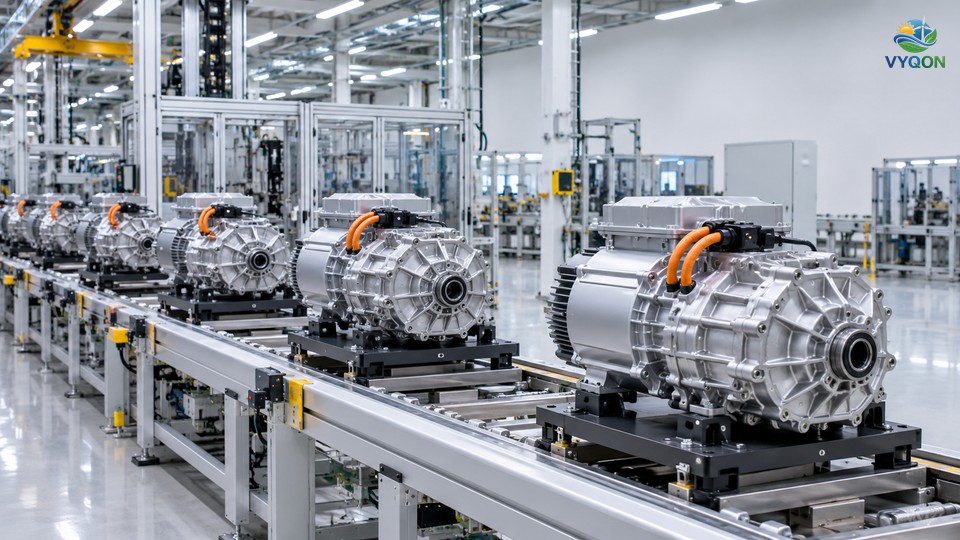
Toyota Kirloskar Auto Parts (TKAP) has inaugurated a new Toyota Kirloskar E-Drive line at its Bidadi facility in Bengaluru, Karnataka, after an investment of about Rs 460 crore, the company announced on 16 November 2026. The new line adds an annual capacity of 2 lakh units and takes TKAP’s total E-Drive capacity to 3.6 lakh units a year.
What the new Toyota Kirloskar E-Drive line adds
The E-Drive is a key component of the hybrid electric powertrains that Toyota sells in India. It is part of a hybrid system, not a battery-electric drive, so the new capacity serves hybrid vehicles rather than plug-in cars. The line will manufacture products registered under the Advanced Automotive Technology (AAT) category of the Government of India’s Production Linked Incentive (PLI) scheme for the automobile industry.
At Bidadi, the new line will run alongside TKAP’s existing fourth-generation E-Drive line, which was commissioned in 2022. With the addition of 2 lakh units a year, the plant’s total annual E-Drive capacity moves to 3.6 lakh units. Put simply, the earlier line and the new one together can now supply 3.6 lakh E-Drive units every year.
Part of a larger Rs 4,800 crore plan with Karnataka
The project forms part of a larger Rs 4,800 crore Memorandum of Understanding (MoU) signed between Toyota Group companies and the Government of Karnataka. The agreement aims to promote advanced manufacturing, localisation and green mobility in the state. The Rs 460 crore line is therefore one step within that wider commitment and not a separate, stand-alone programme.
The company has not disclosed, in the material available, how much of the Rs 4,800 crore has been spent so far, how many jobs the line will create or when it will reach full output. These details are left out here rather than estimated.
What the company said
Manasi Tata, Vice Chairperson of Toyota Kirloskar Motor, described the start of the new line as a significant milestone in Toyota’s commitment to localising advanced electrified technologies in India. She said that expanding local production of next-generation hybrid technologies supports India’s journey towards electrification and strengthens the domestic automotive value chain.
Tabrez Ahmed, Managing Director of Toyota Kirloskar Auto Parts, said the new line builds on the foundation of the fourth-generation line and raises the bar for technology-driven manufacturing in India. He added that producing the technology locally allows the company to deepen its supplier ecosystem and build a highly skilled workforce.
The PLI scheme behind the AAT category
The Union Cabinet approved the PLI scheme for automobiles and auto components on 15 September 2021 with a budgetary outlay of Rs 25,938 crore for five years, covering FY2022-23 to FY2026-27. According to the Ministry of Heavy Industries, the scheme is meant to boost the manufacturing of Advanced Automotive Technology products and to promote deep localisation of such products, enabling both domestic and global supply chains.
The ministry also says the scheme is focused on zero-emission vehicles, meaning battery electric and hydrogen fuel cell vehicles. Incentives apply from FY2022-23 to FY2026-27, and disbursement happens in the following financial year, from FY2023-24 to FY2027-28. The reports on the Bidadi line state that its products are registered under the AAT category; they do not state the amount of incentive TKAP expects to receive, so no figure is given here.
What it means for India’s clean-energy sector
The line is a manufacturing story rather than a power-generation one, but it matters for India’s wider push towards electrified transport. Hybrid vehicles run an electric motor and battery together with an engine, and the E-Drive is the part that makes this electric side work. Building that component in India reduces the need to bring such parts from abroad and gives local suppliers more work.
For the electric-mobility value chain, three points stand out:
- Local capacity: E-Drive capacity at Bidadi rises from about 1.6 lakh to 3.6 lakh units a year, which is the arithmetic implied by the 2 lakh-unit addition.
- Supplier base: the company says local production lets it deepen its supplier ecosystem and build a skilled workforce.
- Policy link: the products fall under the AAT category of the PLI scheme, which the ministry links to deep localisation.
It remains to be seen how quickly the new capacity is used, because that depends on demand for hybrid vehicles and on how the company ramps up production. The announcement gives no output or sales target, and none should be assumed.
Official references
- Ministry of Heavy Industries, Government of India: PLI Scheme for Automobile and Auto Component Industry
Leave a Comment