
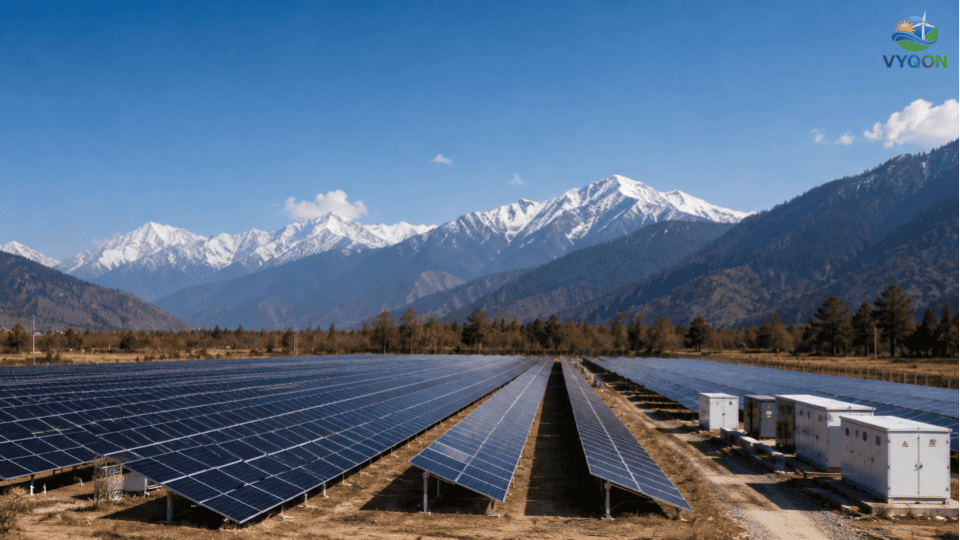
The Uttarakhand Electricity Regulatory Commission (UERC) has issued a comprehensive Order finalizing benchmark capital costs and generic tariffs for Solar Photovoltaic (PV) and other renewable sources for financial year (FY) 2026-27. In a decisive move to safeguard consumer interests during an election year and amid global economic volatility, the Commission rebuffed a proposed 18.86% overall tariff hike submitted by state utilities, including Uttarakhand Power Corporation Ltd (UPCL). Alongside this tariff freeze, the UERC mandated the state’s first formal framework for Battery Energy Storage Systems (BESS), establishing capacity charges and cost norms to facilitate grid modernization.
Solar PV Tariffs and Updated Capital Costs
While draft benchmarks initially proposed a tariff reduction to ₹3.96/kWh, the Commission finalized the decision to retain the existing FY 2025-26 rate of ₹4.10/kWh for Solar PV and Canal Bank projects. This retention serves as a regulatory buffer against market volatility, the challenging logistics of hilly terrain, and the impending implementation of ALMM (Approved List of Models and Manufacturers) List-II and mandatory DCR (Domestic Component Requirement) norms effective June 2026.
| Category | Solar PV Plants |
| Draft Proposed Tariff | ₹3.96/kWh |
| Finalized Generic Tariff (Ceiling) | ₹4.10/kWh |
| Benchmark Capital Cost | ₹285.32 Lakh/MW |
The benchmark capital cost of ₹285.32 Lakh/MW is synthesized from the following components:
- Module Cost: ₹92.17 Lakh/MW (calculated at $0.081/Wp with a 20% import duty).
- Land Cost: ₹40.00 Lakh/MW.
- Civil Works, Mounting Structures, and PCUs: ₹153.15 Lakh/MW.
The Commission also established a precise technical formula for capital subsidies: the Gross and Net tariffs for Solar PV shall decrease by 1.59 paisa/kWh and 1.49 paisa/kWh, respectively, for every one percent of capital subsidy received.
Introduction of BESS Capacity Charges and Norms
UERC has introduced a specialized framework for BESS to manage peak demand and provide ramping support. These norms specifically target short-duration systems of 2.5 hours.
- Benchmark Capital Cost: ₹160 Lakh/MW.
- Capacity Charges (Ceiling): ₹2,59,244/MW/month for FY 2026-27.
- Useful Project Life: 12 years.
- Operational Requirement: Preference for systems capable of two complete charge-discharge cycles per day.
In a stinging observation, the Commission criticized state utilities for their lack of proactiveness, noting they failed to finalize tenders even five months after previous regulatory clarifications were issued. Regarding financial support, the Commission ruled that utilities may apply for Viability Gap Funding (VGF) to mitigate state-specific terrain challenges; notably, these funds will not be adjusted against the benchmark capital cost, allowing developers to retain the incentive to ensure project viability.
Additional Renewable Category Tariffs
The Commission aligned the Canal Bank SPV tariff with ground-mounted Solar PV, significantly dropping it from ₹4.31 to ₹4.10/kWh. This correction followed site visits revealing that projects were frequently built on plain land 0.5 km to 1 km away from canals rather than on actual slopes, removing the justification for higher engineering costs.
| Technology | Finalized Net Tariff (FY 2026-27) |
| Canal Top SPV | ₹4.20/kWh |
| Canal Bank SPV | ₹4.10/kWh |
| Rooftop & Small Solar PV (Net Metering) | ₹2.00/kWh |
| Solar Thermal Plants | ₹11.82/kWh (Net of Accelerated Depreciation) |
Regulatory Clarifications and MSME Treatment
UERC clarified the “policy intent” regarding the state’s MSME framework to prevent a “double financial impact” on developers. Incentives provided under the MSME policy—intended for industrial growth and entrepreneurship—will not be adjusted against benchmark capital costs or generic tariffs. Such adjustments will only occur if a subsidy is directly linked to renewable energy generation or solar development. The Commission emphasized that generic tariffs serve strictly as “ceiling tariffs” for procurement via competitive bidding.
Effective Timeline and Implementation
The mandates within this Order became effective on June 4, 2026. To qualify for the established capacity charges, BESS projects must be commissioned within an 18-month window from the date of the Order. The Commission maintains the authority to “true-up” or review these benchmark costs annually to reflect technological advancements and stabilized market conditions.
Leave a Comment