
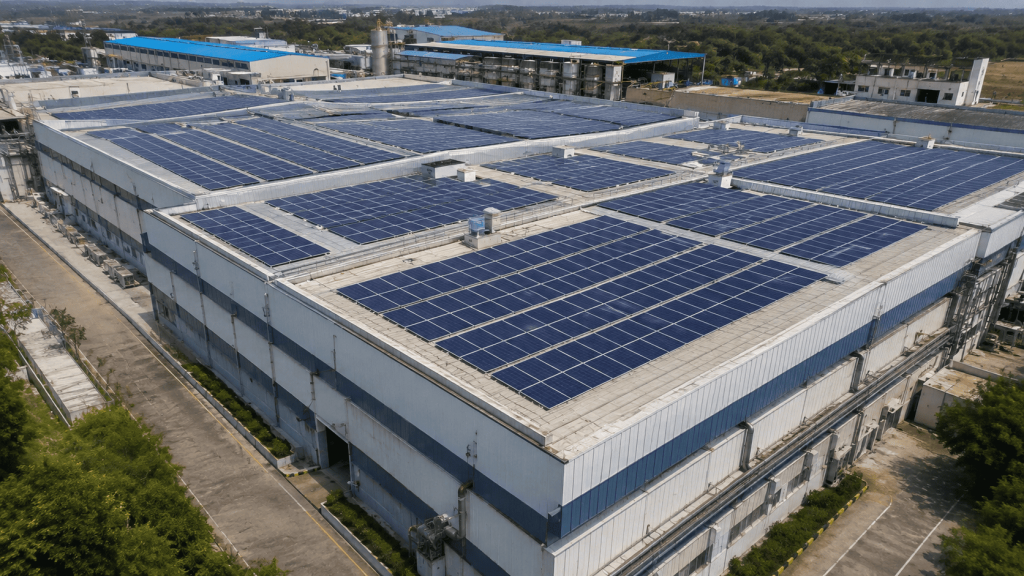
Uflex Limited, a global leader in the packaging sector, has commissioned a 2.9 MW rooftop solar installation at its manufacturing facility, marking a significant shift in its industrial energy strategy. The project has reduced the company’s monthly electricity expenditure from ₹2.5 million to ₹1.0 million, achieving a ₹1.5 million monthly saving. For industrial analysts, the most compelling metric is the immediate 60% reduction in energy costs, demonstrating the high-impact commercial viability of large-scale solar adoption in energy-intensive manufacturing.
The OPEX/RESCO Business Model: Strategic Capital Allocation
The project utilizes the OPEX (Operating Expenditure) model, frequently referred to as the RESCO (Renewable Energy Service Company) model. Under this framework, a third-party developer assumes the full responsibility for installing, owning, and managing the solar system. Uflex, as the consumer, enters into a Power Purchase Agreement (PPA) to pay only for the electricity consumed at a pre-agreed tariff.
From a senior analyst’s perspective, the choice of the OPEX model is a strategic move to preserve liquidity. By avoiding heavy upfront capital investment, Uflex can direct its internal funds toward its aggressive global expansion, such as the state-of-the-art aseptic packaging plant in Egypt and the WPP bags facility in Mexico.
Key characteristics of the Uflex OPEX framework include:
- Zero Upfront Capital: The system is financed by the developer, keeping Uflex’s balance sheet lean for core industrial investments.
- Managed Maintenance: The developer handles all technical repairs, cleaning, and upkeep for the duration of the agreement.
- Performance Monitoring: Includes remote monitoring via SIM card or Wi-Fi to ensure real-time efficiency.
- Operational Simplicity: Insurance and performance risks are managed externally, providing high cash flow predictability.
- Pay-as-you-go Structure: Energy payments are treated as operational expenses rather than asset depreciation.
Technical Standards & Component Requirements
The installation adheres to rigorous technical standards to ensure a 25-year design life, specifically engineered to withstand industrial environmental conditions and local wind zones.
| Technical Standard / Component | Metric & Requirement |
| Solar Module Type | Crystalline PV modules (Minimum 250 Wp) |
| Minimum Module Efficiency | 16% |
| Inverter Efficiency | >97% (for systems ≥10 kW without isolation) |
| First-Year Performance Warranty | >97% (Degradation <1% per annum) |
| Long-term Module Warranty | >90% for first 10 years; >80% for next 15 years |
| Enclosure Protection Index | IP65 (Minimum for outdoor enclosures) |
| Structural Integrity | Designed for local wind zones; factor of safety of 1.5 |
| Mounting Structure Life | Minimum 25-year design life |
| Remote Monitoring | Required via SIM card or Wi-Fi (API/protocol compatible) |
Commercial and Financial Impact Analysis
The financial restructuring of Uflex’s energy procurement provides immediate relief to its operational expenditure (OpEx). The “pay-as-you-go” PPA—typically spanning a tenure of 5 to 25 years—insulates the company from the volatility of grid tariffs. While typical renewable procurement can reduce grid tariff exposure by 20% to 30%, Uflex’s 60% reduction highlights an exceptionally high-yield configuration.
This transition allows the facility to significantly reduce its reliance on the grid during peak manufacturing hours, which are historically characterized by the highest tariff rates. By locking in a predictable solar tariff, Uflex gains long-term energy price certainty, which is critical for a company reporting a 12.4% year-on-year growth in consolidated net total income (reaching ₹151,838 million).
Industrial and Corporate Context: Decarbonization Roadmap
This solar initiative is a pillar of Uflex’s “Responsible Growth” strategy, balancing its industrial expansion in nine countries with aggressive climate action. The company is actively positioning itself as a leader in the circular economy, being the only Indian company certified by the US FDA to use recycled polymers in food-grade packaging.
“At UFlex, our commitment to ‘Responsible Growth, Resilient Future’ is the cornerstone of our operations… We are aligning our decarbonization strategy with the SBTi guidelines and aim to achieve carbon neutrality by 2035 (Scope 1 and Scope 2) and net zero by 2050.” — Ashok Chaturvedi, Chairman & Managing Director
Regional and National Solar Context
The implementation of the 2.9 MW project mirrors the rapid acceleration of India’s energy transition. As of March 31, 2026, India’s grid-connected rooftop solar capacity reached 25.73 GW, continuing its trajectory toward the national target of 40,000 MW.
For Uflex, this move serves as a critical regulatory hedge. With the Indian government’s ‘National Packaging Initiative’ promoting biodegradable solutions and the mounting momentum toward a full ban on single-use plastics by 2025, solar adoption is no longer just a cost-saving measure. It is a fundamental requirement for industrial resilience in a tightening ESG regulatory environment. While the OPEX model prioritizes liquidity and developer-led maintenance over the long-term ownership gains of a CAPEX model, it remains the most practical route for large-scale manufacturers to meet immediate decarbonization targets without compromising global growth capital.
Official Sources
- Tata Power Company Limited – Can the OPEX solar model maximize savings?
- UFlex Limited – Sustainability Report FY 2024-25 (See also: Official Corporate Policies)
- National Stock Exchange of India (NSE) – Official Filing: Uflex Joint Venture Disclosure (August 2025)
- Maharashtra State Electricity Distribution Co. Ltd. (MSEDCL) – Technical Specifications for Grid-Connected Rooftop Solar
Leave a Comment