
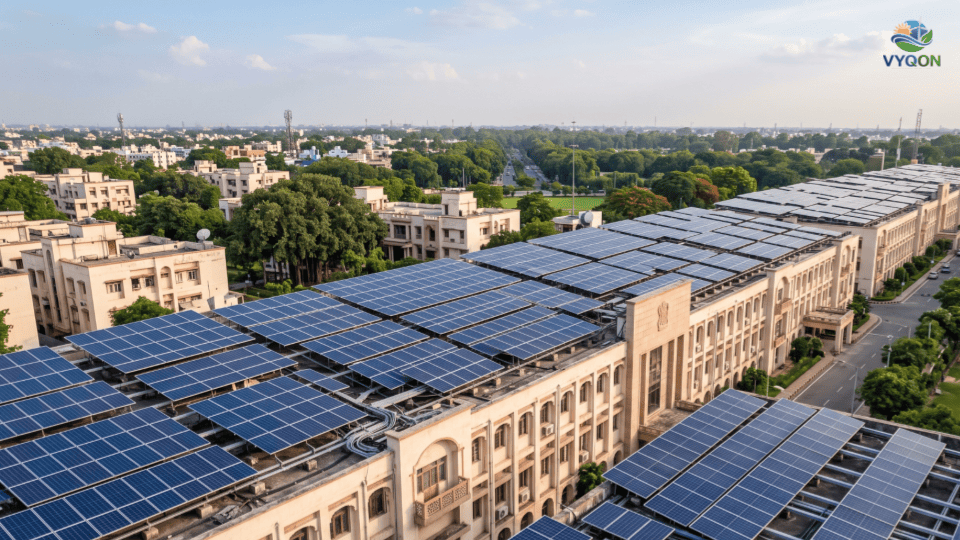
The Uttar Pradesh New and Renewable Energy Development Agency (UPNEDA) has initiated a new procurement cycle with a tender for 11 MW of grid-connected rooftop solar capacity designated for government buildings across the state. Operating under a RESCO (Renewable Energy Service Company) and rate-contract framework, the project utilizes tariff-based competitive bidding to secure long-term energy partnerships. While the directive establishes a commissioning timeline of approximately nine months from contract signing and a submission deadline of September 15, 2026, industry observers note that the primary challenge remains the structural friction point between tender announcement and final commissioning reporting.
Core Tender Specifications and Framework
This rollout is built upon a “Rate-Contract” basis, a foundational contracting mechanism used by UPNEDA to empanel firms at a standardized price point. This model is designed to streamline the solarization pipeline across diverse government departments by removing the need for individual building-level negotiations.
Key Tender Parameters
| Parameter | Detail |
| Total Capacity | 11 MW |
| Implementation Model | RESCO mode (Renewable Energy Service Company) |
| Procurement Method | Tariff-based competitive bidding |
| Power Purchase Agreement (PPA) Term | 25 years |
| Target Infrastructure | Government buildings across Uttar Pradesh |
- Government of Uttar Pradesh e-Procurement Portal (e-Tender UP) – The official bidding platform where UPNEDA’s technical and financial tender documents are uploaded and live bidding is tracked. (Readers can locate the active tender on this portal by searching for “UPNEDA” or “Rooftop Solar”).
- UPNEDA Official Website – The official homepage of the Uttar Pradesh New and Renewable Energy Development Agency, used for institutional announcements and general policy guidelines.
- UPNEDA Solar Rooftop Portal – The official portal dedicated specifically to rooftop solar programs and vendor tracking in Uttar Pradesh.
Technical Mandates and Warranty Standards
To maintain high pipeline execution standards and support the Domestic Content Requirement (DCR), UPNEDA has mandated rigorous technical benchmarks. A critical component of this framework is the potential for third-party inspections conducted by UPNEDA or the relevant Discom to verify compliance.
Mandatory Technical Requirements:
- Domestic Content Requirement (DCR): All installations must utilize solar modules and solar cells manufactured entirely within India.
- Regulatory Compliance: Systems must adhere to the UPERC RSPV Regulation 2019 and MNRE Phase-II technical specifications.
- Performance Warranty: Solar modules must provide a performance guarantee of 90% of rated output at 10 years and 80% at the end of the 25-year PPA term.
Deviations from these technical specifications carry severe institutional penalties, including the forfeiture of state incentives and the blacklisting of the offending firm.
Operational and Maintenance (O&M) Requirements
In the RESCO model, the empanelled firm’s long-term viability is tied to its service delivery. This tender emphasizes accountability through localized support and digital transparency.
- Maintenance Duration: A 5-year comprehensive maintenance period is mandatory, covering all parts and materials.
- Service & Response: Periodic service visits are required at least once every six months. The agency must provide a dedicated mobile number and the address of a local service center to the beneficiary.
- Fault Rectification: Initial contact or response to a complaint must occur within 72 hours, with full problem rectification completed within 7 days.
- Documentation for “Rajya Anudan”: Firms must maintain a physical O&M book and upload maintenance reports to the UPNEDA/Discom portals. This digital audit trail is the prerequisite for the release of the “Rajya Anudan” (State Subsidy), distinguishing it from central funding mechanisms.
Institutional Precedents and Regional Context
The 11 MW tender is an extension of UPNEDA’s recent procurement momentum. Institutional history is currently dominated by specialized firms like Sahaj Solar, which secured a ₹62.8 Cr turnkey project for 12 MW in July 2025. Sahaj’s previous success is notable for its complexity, managing a split between 4 MW of small-scale systems (1–10 kW) and 8 MW of mid-scale systems (11–100 kW). This demonstrated capacity to handle diverse system scales across the state grid informed their qualification in earlier, larger RESCO tenders.
This announcement situates Uttar Pradesh within an almost continuous rotation of state-level rooftop solar tenders observed throughout 2026. This national rotation includes significant tranches from Rajasthan (33 MW) and Uttarakhand (6.5 MW), reflecting a synchronized, albeit decentralized, push toward public infrastructure solarization.
Reporting and Transparency Data
While the pace of tender issuance is high, the “signal” for market success lies in the commissioning data. National reporting suggests a significant gap between the issuance of work orders and actual grid integration.
- National Level: As of August 2025, the Ministry of New and Renewable Energy (MNRE) reported action plans for 41,972 Central Government buildings. Of these, 24,376 (58%) have been solarized, representing 854 MW of capacity.
- State/UT Level: Combined reports from States and Union Territories show 81,754 solarized buildings totaling 1,447 MW cumulative capacity. However, a lack of “denominators” (total eligible buildings) in most state reporting makes true completion rates difficult to audit.
A critical fiscal nuance in this rollout is the absence of Central Financial Assistance (CFA). The MNRE considers government building projects financially viable without central subsidies due to the self-liquidating nature of RESCO tariffs. Consequently, while Central CFA is absent, the Uttar Pradesh state government continues to offer the “Rajya Anudan” to bridge financing gaps, provided firms adhere to the strict O&M and reporting protocols outlined in the tender.
Leave a Comment