
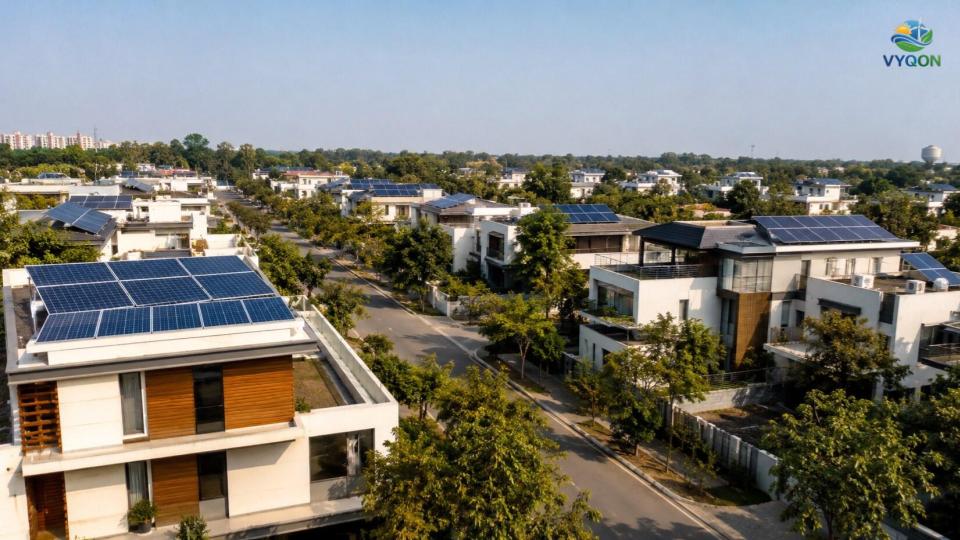
Chandigarh has shifted the next phase of its solar campaign towards private homes, with the Chandigarh Renewable Energy and Science & Technology Promotion Society (CREST) targeting nearly 1,600 independent Chandigarh Housing Board houses for rooftop solar adoption under PM Surya Ghar: Muft Bijli Yojana.
The move follows near-saturation of solar installations on feasible government buildings in the Union Territory. CREST’s latest outreach brings the housing board, the distribution company, banks and empanelled vendors together so residents can understand subsidies, financing, technical requirements and the application process in one place.
New Campaign Covers
CREST organised a two-day “Solar Weekend” on 29 and 30 August for freehold independent CHB dwelling units with roof rights. Joint teams were made available across Sectors 41-A, 46, 38 West, 40, 42 and 44. About 400 residents attended the camps, according to the latest report on the programme.
The target is important because a rooftop programme depends on thousands of individual household decisions. Unlike a utility-scale solar park, the administration cannot secure one parcel of land and build one plant. It must explain the scheme repeatedly, help each consumer assess the roof and support every application through installation and grid connection.
Why Chandigarh Is Turning to Residential Roofs
Government buildings offered a practical starting point for Chandigarh’s solar programme because public agencies could coordinate approvals and aggregate projects. With most feasible government roofs already covered, future growth increasingly depends on homes, commercial premises and other distributed sites. Independent CHB houses provide a clearly identifiable group for a focused campaign.
An official Chandigarh Net Zero report recorded a rooftop-solar baseline of 52.852 MWp on government buildings, 21.534 MWp in the residential category and 10.303 MWp in other categories. Those figures are a planning baseline rather than a live dashboard, but they show why residential adoption is now central to the city’s next phase.
Subsidy and Finance Can Remove the First Barrier
The PM Surya Ghar programme provides central financial assistance for eligible residential rooftop systems. Chandigarh’s official report states that assistance can reach ₹78,000 for systems up to 3 kWp. The final consumer contribution still depends on system size, vendor pricing, roof conditions and any extra civil or electrical work required at the property.
Banks joined the outreach because the upfront payment remains a barrier even when a subsidy is available. Loan and non-loan models allow residents to compare an immediate purchase with financed installation. A responsible decision should consider the total repayment, expected generation, present electricity use, warranty coverage and the likely time needed to recover the household’s net investment.
What Residents Should Check Before Signing
A suitable roof needs adequate sunlight, safe structural condition and enough usable area after leaving access around water tanks, parapets and service equipment. Shading from trees or nearby buildings can reduce output. The consumer should also confirm roof rights, sanctioned electricity load, meter arrangements and whether any housing-board permission is required for the proposed structure.
Vendor comparison should go beyond the lowest quotation. Residents should verify empanelment status, module and inverter specifications, product and performance warranties, installation workmanship, earthing, lightning protection, after-sales service and the party responsible for portal documentation. A clear single-line diagram and written scope reduce misunderstandings during inspection and commissioning.
From Registration to an Operating System
A rooftop installation normally moves through portal registration, feasibility approval, vendor selection, installation, inspection, meter-related work and subsidy processing. Delays can occur when consumer details do not match electricity records or when documents are incomplete. Bringing CREST, Chandigarh Power Distribution Limited, banks and vendors together can help residents resolve these issues earlier.
The official Chandigarh report recorded 5,433 PM Surya Ghar registrations, 1,352 applications and 637 installations at the time of its publication. The gap between interest and completed systems illustrates why end-to-end assistance matters. Outreach creates awareness, but conversion depends on simple documentation, credible vendors, timely inspections and predictable subsidy release.
Benefits Must Be Measured in Generation
The practical value of rooftop solar comes from electricity generated and used or exported, not simply from the number of panels installed. System orientation, module temperature, dust, shade, inverter availability and maintenance all affect performance. Homeowners should retain generation records and compare actual output with the vendor’s realistic annual estimate.
Daytime self-consumption can reduce the electricity drawn from the grid, while the applicable metering arrangement accounts for export and import. Savings will vary by household load profile and tariff. A home that shifts appliances to solar hours may use more of its own generation, although any behaviour change should remain convenient and safe.
Quality and Consumer Confidence Will Decide Scale
A concentrated campaign can accelerate installations, but poor-quality work would damage confidence across an entire neighbourhood. CREST and the distribution company will need consistent technical inspection, complaint handling and vendor accountability. Visible success on the first group of homes can encourage neighbours; unresolved leaks, faults or weak service can have the opposite effect.
The planned-house character of many Chandigarh sectors creates an opportunity for repeatable designs, yet every roof remains different. Installers should not force a standard layout where drainage, structure or shading requires modification. Quality control must cover mounting, waterproofing, cable routing, protective devices and safe access for future maintenance.
What to Watch Next
The most useful next indicators will be how many of the targeted houses submit applications, receive feasibility approval, complete installation and obtain subsidy. CREST has also said that more camps will be organised in different areas. Publishing a simple conversion dashboard would show where households are dropping out and where administrative support is most needed.
Chandigarh’s approach is relevant beyond the city. Residential solar programmes often have enough financial incentive but struggle with fragmented information and coordination. A neighbourhood-level model that combines consumer education, finance, technical vendors and the distribution utility can turn general interest into commissioned capacity more effectively.
Conclusion
CREST’s campaign for nearly 1,600 CHB homes marks a practical shift from public-building solar towards citizen-led generation. The Solar Weekend has created a single point of contact for key questions, but the programme’s success will be measured by safe installations, reliable output and satisfied households. If the targeted homes move smoothly from enquiry to operation, Chandigarh can build a strong residential layer on top of its established public-sector solar base.
References
1. Chandigarh Administration Net Zero report
This official government document provides Chandigarh’s rooftop-solar baseline, PM Surya Ghar registration and installation figures, and the central subsidy available to eligible homes.
https://chandigarh.gov.in/sites/default/files/Updation26/env26-dep2026-1901.pdf
2. CREST Solar Weekend announcement, 28 August 2026
This campaign announcement identifies the two outreach dates, eligible CHB housing category, participating agencies and the sectors covered by the joint teams.
3. Times of India report, 31 August 2026
The latest report confirms the target of nearly 1,600 independent CHB houses, attendance of around 400 residents and the administration’s shift from government to residential roofs.
Leave a Comment