
Key Highlights
- Cumulative Capacity: 2.5 MW (2,500 kW).
- Total Estimated Value: ₹24.26 Crore (inclusive of GST).
- Business Model: Turnkey CAPEX (Capital Expenditure) mode under a 12-month Rate Contract.
- Application Deadline: September 15, 2026.
- Target Locations: Designated government buildings and administrative hubs across Uttar Pradesh.
- Technology: Decentralized hybrid solar PV with Lithium Ferro Phosphate (LiFePO4) storage and intelligent energy management.
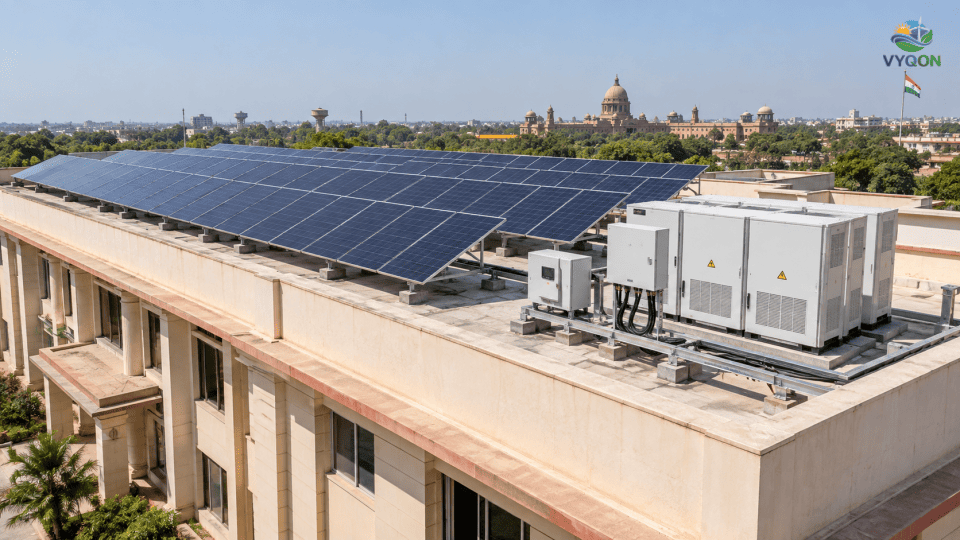
In a decisive shift toward energy sovereignty for state infrastructure, the Uttar Pradesh New and Renewable Energy Development Agency (UPNEDA) has issued a tender for 2.5 MW of decentralized hybrid rooftop solar systems. This initiative represents a strategic transition from standard grid-tied arrays to self-sustaining green energy microgrids. By leveraging intentional islanding capabilities and advanced battery storage, the state aims to secure administrative continuity and eliminate the reliance on polluting diesel generation during grid outages. Released on August 22, 2026, the tender provides a roadmap for establishing firm renewable power across government buildings, ensuring that critical public services remain operational independent of the central grid.
Tender Category Breakdown
The tender is structured as a Rate Contract, valid for 12 months with a provision for a 6-month extension. Capacity is divided into three categories to address diverse load profiles.
| Category | System Range | Total Capacity | Required EMD (BG) | Min. Avg. Annual Turnover (ATO) | Required Experience (Cumulative) |
| Category A | 1 kW to 10 kW | 1,000 kW (1 MW) | ₹20.29 Lakh | ₹3.04 Crore | 300 kW |
| Category B | 11 kW to 50 kW | 1,000 kW (1 MW) | ₹18.95 Lakh | ₹2.84 Crore | 300 kW |
| Category C | 51 kW to 75 kW | 500 kW (0.5 MW) | ₹9.28 Lakh | ₹1.39 Crore | 150 kW |
Technical Specifications and Standards
UPNEDA has established stringent benchmarks to ensure high specific energy throughput and system longevity:
- Battery Storage & Management: Mandates Prismatic LiFePO4 cells (min 3.2V 40Ah) with a storage capacity of 3,840 Wh per kW. Systems must deliver ≥ 90% Depth of Discharge (DoD) and 3,000+ cycles. A critical requirement is the integrated Battery Management System (BMS), which must support real-time cell balancing, thermal monitoring, and SOC/SOH tracking via RS485 or CAN bus protocols. A 7-year comprehensive battery warranty is required.
- Hybrid Inverters (PCUs): Must feature integrated MPPT and intentional islanding capabilities to facilitate autonomous operation. Efficiency must be ≥ 95% at 25%–100% loading and, crucially, ≥ 92% at 10% loading to optimize nighttime performance.
- PV Modules (DCR Compliance): All modules must be “Make in India” (DCR compliant) and listed on the MNRE’s ALMM. Requirements include a minimum module rating of 500 Wp and efficiency ≥ 19.5%. Contractors must provide a 25-year performance warranty (guaranteeing ≥ 90% output at year 10 and ≥ 80% at year 25).
- Remote Monitoring: Installations must include GPRS-based Remote Monitoring Systems (RMS) for minute-by-minute data logging, integrated directly with the state’s RESIMS portal.
Bidder Eligibility and Capacity Allocation Strategy
The tender introduces a specific commercial framework designed to balance scale and local participation:
- Capacity Allocation Strategy: The L1 bidder will be awarded 50% of the total tendered capacity. The remaining volume will be distributed among other empanelled bidders who match the L1 rate within a 25% price band.
- Local Content and Capacity Allocation Strategy (MSMEs): Uttar Pradesh-based Micro and Small Enterprises are eligible for a 100% EMD exemption. Furthermore, up to 25% of the total order capacity is reserved for qualified local MSEs matching the L1 price.
- Financial Health: Bidders must demonstrate positive net worth and meet the category-specific turnover (ATO) requirements listed in the breakdown table above.
- Performance Security: Successful bidders must submit a Bank Guarantee equivalent to 5% of the work order value, valid for 18 months.
Implementation Timeline and Maintenance Mandate
Project execution and long-term reliability are governed by strict service-level agreements (SLAs):
- Execution Timeline: Commissioning of each site must be completed within 4 months of the work order issuance.
- Maintenance Mandate: A 5-year comprehensive maintenance period is mandatory. To ensure administrative continuity, contractors are bound by a 7-day service response mandate, requiring the resolution of any breakdown within one week of registration.
- Payment Framework:
- 85% Disbursement: Released upon successful installation, testing, and commissioning.
- 15% Retention: Held as security/AMC fees, released in annual installments of 3% over the 5-year maintenance period, contingent on quarterly generation data verification.
Administrative Details
- Tender Reference Number: 01/UPNEDA/Off Grid Solar Power Plant (1kW-75kW)/2026-27.
- Official e-Procurement Portal: etender.up.nic.in
- Pre-bid Inquiries: UPNEDA Head Office, Vibhuti Khand, Gomti Nagar, Lucknow.
- Nodal Authority: Director, UPNEDA. Bidders are advised to monitor the portal for technical bid opening details following the September 15 deadline.
Official Tender Link & Bidding Access
Prospective developers and contractors can access the complete bidding documents and track the live bidding status online through the Government of Uttar Pradesh e-Procurement Portal (e-Tender UP).
To locate this specific tender on the e-procurement portal, use the following search parameters:
- Tender Inviting Authority: Uttar Pradesh New and Renewable Energy Development Agency (UPNEDA)
- Tender Reference Number:
01/UPNEDA/Off Grid Solar Power Plant (1kW-75kW)/2026-27 - Portal Search Keywords: “Hybrid Rooftop Solar” or “2.5 MW”
For general policy guidelines, updates, and institutional announcements, you can also visit the UPNEDA Official Website.
Leave a Comment