
Waaree Energies Limited, one of India’s largest solar module manufacturers, reported strong first-half revenue growth for FY27 but lower profit in the September quarter. The company released its unaudited results for the quarter and half year ended 30 September 2026 on 27 October 2026. Consolidated revenue from operations for the second quarter (Q2 FY27) was ₹7,517.7 crore, up 23.9% from ₹6,065.6 crore a year earlier. Profit after tax (PAT) was ₹753.6 crore, down 14.2% from ₹878.2 crore. The company reported an order book of about ₹59,200 crore.
Quarter and half-year figures
Operating EBITDA in Q2 FY27 was ₹1,335.2 crore, 5.1% lower than ₹1,406.4 crore in the same quarter last year. The EBITDA margin was 17.8%, compared with 23.2% a year earlier, and the PAT margin was 9.8%, against 14.1%.
For the first half (H1 FY27), consolidated revenue was ₹15,449.5 crore, up 47.3% from ₹10,491.5 crore. Operating EBITDA rose 15.5% to ₹2,775.1 crore, giving a margin of 18.0% against 22.9% in H1 FY26. PAT for the half year was ₹1,645.5 crore, almost unchanged from ₹1,651.1 crore a year earlier (a decline of 0.3%), with a PAT margin of 10.4%. Operating cash flow for H1 FY27 was ₹3,483.6 crore, up 506.1% from ₹574.7 crore.
The first-quarter revenue of ₹7,931.8 crore, implied by the half-year and Q2 figures, was higher than the second quarter’s, so the sequential trend was slightly lower, even though growth over the previous year remained firm. The order book of about ₹59,200 crore compares with roughly ₹61,500 crore reported after the first quarter.
Retail and manufacturing
The retail business was the main driver of growth. Retail revenue in H1 FY27 was ₹5,753.0 crore, against ₹1,976.8 crore in H1 FY26, a rise of 191.0%. Retail made up 37.2% of H1 revenue, up from 18.8% a year earlier, and 46.1% of Q2 revenue.
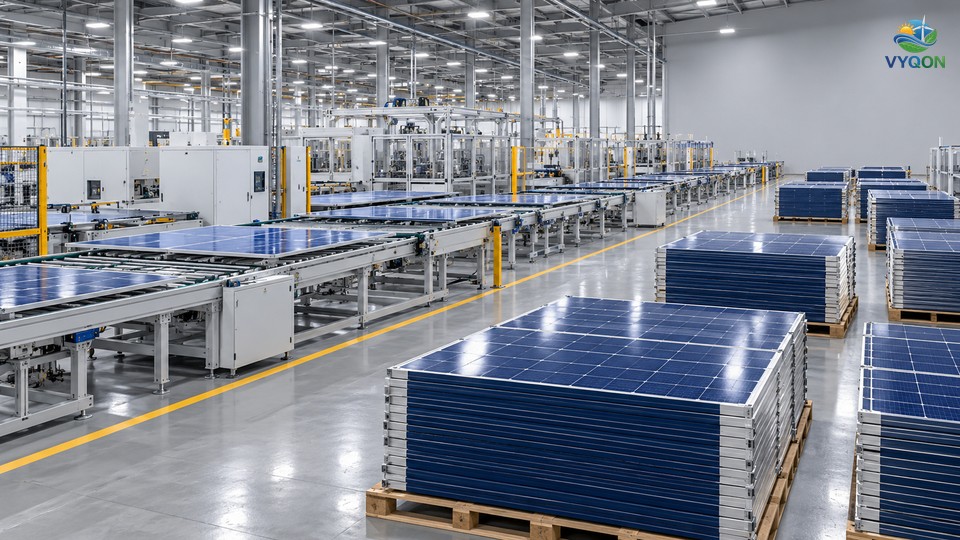
Module production in H1 FY27 was 6.3 GW, compared with 4.9 GW in H1 FY26, of which 3.0 GW was produced in Q2. Solar cell production reached 1.9 GW in the half year, against 0.8 GW a year earlier. In Q2 the company produced 1.1 GW of cells at a capacity utilisation of 81%, compared with 0.6 GW in Q2 FY26.
United States expansion, merger and storage
The board approved an investment of about US$37 million to expand the company’s Arizona facility in the United States by 0.6 GW. This would take the company’s total US capacity to 4.8 GW by March 2027. According to the company, its domestic US manufacturing business recorded revenue growth of 113% in H1 FY27.
During the quarter, a board resolution dated 23 September 2026 approved a scheme of amalgamation of the subsidiary Indosolar Limited with Waaree Energies, at an exchange ratio of one share of Waaree Energies for every 11 shares of Indosolar. The scheme remains subject to approvals under applicable regulatory requirements.
The company also said it has commenced advanced manufacturing of battery energy storage system (BESS) containers at Rola, Gujarat, with a capacity of 5.15 GWh of automated container manufacturing.
Management outlook
Jignesh Rathod, Whole Time Director and CEO, said the first-half performance reflects the strength of the company’s business fundamentals and consistent execution. He pointed to retail growth of 191% and US manufacturing growth of 113% as businesses that are becoming important contributors. He said the company expects its BESS, transformer, inverter, engineering, procurement and construction (EPC) transmission and distribution, and green hydrogen businesses to contribute to future growth.
According to the CEO, by the time the company enters FY28 it expects to be ready to operate capacities of about 29 GW of solar PV modules, 15.4 GW of solar cells, about 5 GWh of BESS packs and containers, about 3.5 GWh of battery cell manufacturing, 4 GW of inverters and 20,000 MVA of transformers, along with a larger integrated EPC entity covering projects and transmission and distribution. These are forward-looking targets rather than current capacity; the company’s own description lists present consolidated capacities of 25.8 GW of solar PV and 5.4 GW of solar cells.
What it means for India’s clean-energy sector
The results show a pattern visible across India’s solar manufacturing industry. Volumes and revenue are growing quickly, helped by expanding retail demand and new cell capacity, while margins are lower than a year ago. In Waaree’s case, the EBITDA margin fell by about five percentage points in Q2, even as revenue rose by almost a quarter. The company’s release does not give a reason for the margin change, so the cause cannot be stated from the filing.
The shift towards retail sales, which now account for nearly half of quarterly revenue, shows how growing retail demand is reshaping the business mix of module makers that earlier depended mainly on utility-scale orders. The expansion into cells, storage, transformers and inverters reflects a broader move by large Indian manufacturers to become integrated suppliers across the clean-energy value chain rather than module makers alone.
Several details are not disclosed in the press release, including a breakdown of Q2 revenue by segment and the order book split between domestic and export customers.
Official references
- Waaree Energies Limited, Regulation 30 press release on unaudited financial results for the quarter and half year ended 30 September 2026 (Q2 and H1 FY27 earnings press release), 27 October 2026: https://www.bseindia.com/xml-data/corpfiling/AttachLive/974fbee7-d86a-46bb-ab15-66999c6ab4eb.pdf
Leave a Comment