
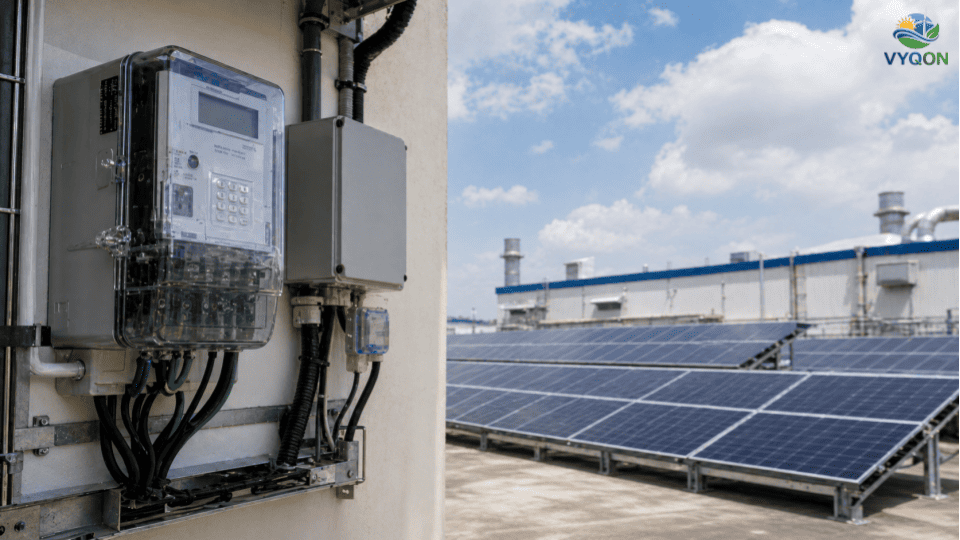
The Ministry of Power (MoP) notified the Electricity (Promoting Renewable Energy Through Green Energy Open Access) Rules in June 2022 to regulate the generation, purchase, and consumption of green energy. This framework applies to renewable energy (RE) developers, distribution licensees (DISCOMs), and Commercial & Industrial (C&I) consumers. To date, 27 states have notified their respective GEOA regulations. The central regulatory shift involves a mandate for a 15-day application processing window and the introduction of a “deemed approval” status to formalise the transition to renewable power.
The Deemed Approval Mechanism
Under these rules, applications for Green Energy Open Access (GEOA) are processed according to a “first-in, first-out” priority. The designated nodal agency is required to approve applications within 15 days of submission. If the agency fails to either approve or reject the application within this period, it is considered “deemed approved,” provided the applicant meets the technical requirements specified by the appropriate commission.
The regulations stipulate that any denial of an application must be issued as a “speaking order.” This mandates a detailed written explanation justifying the rejection. Furthermore, the nodal agency is prohibited from denying an application without providing the applicant with a formal opportunity to be heard in the matter.
Nodal Agency and DISCOM Obligations
The rules establish specific nodal agencies to manage the grant of open access. At the intrastate level, the State Load Despatch Centre (SLDC) serves as the nodal agency for short-term open access, while the State Transmission Utility (STU) is responsible for medium- and long-term access. For interstate entities, the Regional Load Despatch Centre (RLDC) handles registration. Short-term and medium-term open access are granted based on the availability of spare capacity in the transmission system, whereas long-term access may necessitate system augmentation.
DISCOMs are mandated to procure and supply green power to eligible consumers upon demand. Consumers may requisition green power from their distribution licensee, which must then procure and supply the requested quantity. Any requisition made to a DISCOM for green energy must be for a minimum period of one year. Agencies must update all approvals, rejections, and revisions on the centralized national portal.
Technical Context and Eligibility Criteria
The 2022 rules and subsequent clarifications prescribe several technical and financial eligibility requirements:
- Transaction Limits: The minimum Open Access Transaction limit is reduced from 1 MW to 100 kW.
- Load Aggregation: Consumers with multiple connections within the same electricity division can aggregate their load to meet the 100 kW threshold.
- Captive Consumers: No load limitations apply to captive consumers intending to avail green energy open access.
- Surcharge Caps: The increase in the Cross-Subsidy Surcharge (CSS) is capped at 50% of the surcharge determined for the year in which access was granted, applicable for 12 years.
- Additional Surcharge (AS): The AS is waived if the consumer pays fixed charges for their contracted demand.
- Banking Quantum (August 2024 Clarification): The MoP clarified that the 30% banking quantum limit is calculated based solely on energy directly procured from the distribution licensee. Electricity obtained through third-party or captive open access arrangements is excluded from this calculation.
The Centralized GOAR Portal Framework
The Green Energy Open Access Registry (GOAR) portal serves as a “single-window” system operated by the Central Nodal Agency, the Grid Controller of India Limited (formerly POSOCO). Applicants must obtain grid connectivity prior to registration. The RLDC processes new registrations for regional entities within 7 working days, while the SLDC processes and recommends intrastate entity applications within 5 working days. Once approved, registration remains valid for three years. The portal acts as the central registry for all management information system (MIS) data, ensuring transparency in the application process.
Leave a Comment