
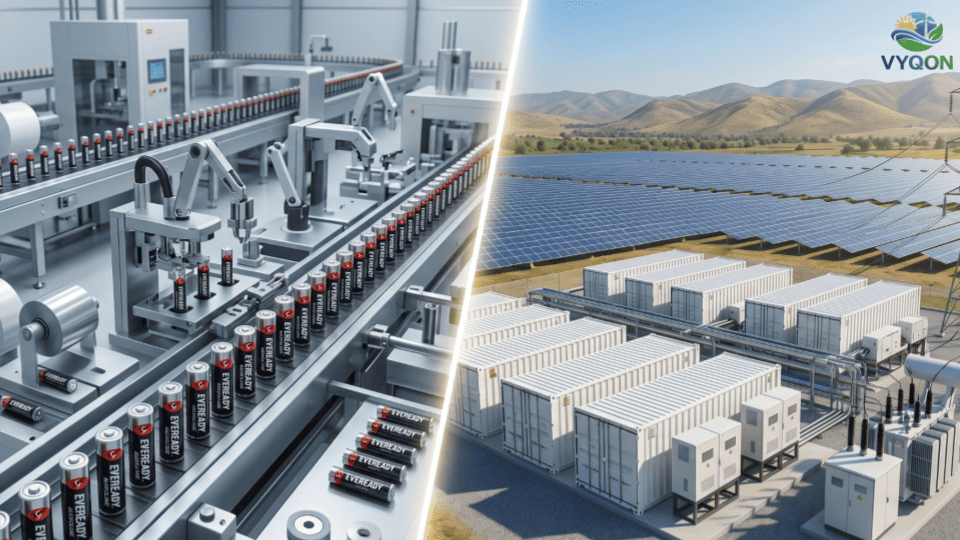
Eveready Industries India has officially commissioned its Greenfield alkaline battery manufacturing facility in Samba, Jammu, marking a strategic pivot toward domestic production of premium power solutions and a definitive reduction in regional import reliance. The facility was inaugurated on April 22, 2026, by Lieutenant Governor Manoj Sinha in the presence of Eveready promoter Mohit Burman. Representing an investment of ₹200 crore, the Samba plant is distinguished as the only operating alkaline battery manufacturing unit within the SAARC region, positioned to serve as a critical hub for both domestic supply and international export.
Technical Specifications and Production Capacity
The infrastructure of the Samba facility is engineered to support high-volume manufacturing of alkaline technology, which is increasingly essential as the Indian market transitions away from traditional carbon-zinc chemistries. The plant’s output extends beyond portable cells to include ancillary lighting products, integrated within a single industrial complex.
| Operational Metrics | Annual Capacity/Output |
| Battery Production | |
| Installed Capacity | 456 million units |
| Estimated Peak Output | 360 million units |
| Ancillary Lighting Products | |
| Flashlight Production | 7 million units |
| LED Light Production | 6 million units |
Operational Sustainability and Resource Management
The facility incorporates advanced resource management systems designed to align with environmental ESG (Environmental, Social, and Governance) standards while maintaining high industrial throughput.
Sustainability Specifications:
- Renewable Energy: Integration of a 1 MW rooftop solar installation to supplement the plant’s power requirements and reduce its carbon footprint.
- Water Conservation: Implementation of a 275 KLD (Kiloliters per Day) rainwater harvesting system, optimized for industrial-scale water resource management.
Strategic Context: Import Substitution and “Aatmanirbhar” Goals
The commissioning of the Samba facility represents a fundamental shift in the domestic battery market. India has historically remained one of the “last bastions” of the carbon-zinc battery, which maintains an 85% market share. However, while zinc growth remains flat, the alkaline segment is currently expanding at a rate of 20% annually. This plant serves as a technical hedge against the eventual obsolescence of zinc technology, moving toward the “premiumization” standards of developed economies where alkaline cells account for two-thirds of the market.
Eveready CEO Anirban Banerjee has described the facility as an “investment for the decade,” noting that local manufacturing will allow the company to realize a 10% increase in margins by eliminating import costs. Eveready currently commands a 52% share of the overall dry cell market and has successfully grown its alkaline segment share from 2% to approximately 15–16% following the 2023 relaunch of its Ultima brand.
Beyond its own branded play, the facility is strategically positioned to supply competitors who currently rely on imports, effectively becoming a private-label and white-label manufacturing partner for markets in the United States, Europe, and West Asia.
Situating Alkaline Production in the National Battery Ecosystem
The transition from primary cells like alkaline to more complex storage solutions is a key indicator of India’s advancing manufacturing maturity. This project aligns with the national goal of achieving 500 GW of renewable energy capacity by 2030, though the broader roadmap for Advanced Chemistry Cells (ACC) currently faces significant implementation headwinds.
While the Ministry of Heavy Industries’ ACC-PLI scheme targets the creation of 50 GWh of battery manufacturing capacity by 2026, the sector has seen a sharp gap between projections and outcomes; as of late 2025, only 1.4 GWh of that target has been commissioned. In this context, the Eveready plant provides a stable baseline for domestic production.
The Three Pillars of the Indian Battery Roadmap:
- Domestic Production: Establishing local units for primary and secondary cells to achieve “Aatmanirbhar” (self-reliant) status and replace imports from China.
- Grid-Scale Storage: Developing large-format systems (BESS) required to stabilize the grid as renewable energy penetration increases.
- Advanced Cell Chemistries: Focusing on lithium-ion and other high-energy-density technologies, despite current implementation challenges and raw material dependencies.
Economic Impact and Regional Industrial Growth
The Samba project represents a significant portion of the industrial revitalization of Jammu & Kashmir. The facility is expected to generate 500 direct and indirect employment opportunities. More broadly, the ₹200 crore investment accounts for nearly 3.4% of the region’s total projected industrial investment of ₹5,824 crore for the 2025-26 financial year. LG Manoj Sinha emphasized that the plant will catalyze the growth of local ancillary units while providing specialized vocational and employment opportunities for the region’s youth and women
The Samba facility serves as a pragmatic application of the Production Linked Incentive (PLI) framework, aimed at diminishing reliance on foreign battery components and stabilizing the domestic supply chain. By localizing the production of alkaline cells—a segment growing ten times faster than the traditional zinc market—Eveready is aligning with global supply chain realignments. This facility establishes a necessary foundation for manufacturing maturity, supporting India’s broader transition toward sophisticated energy storage and industrial self-sufficiency.
Leave a Comment