
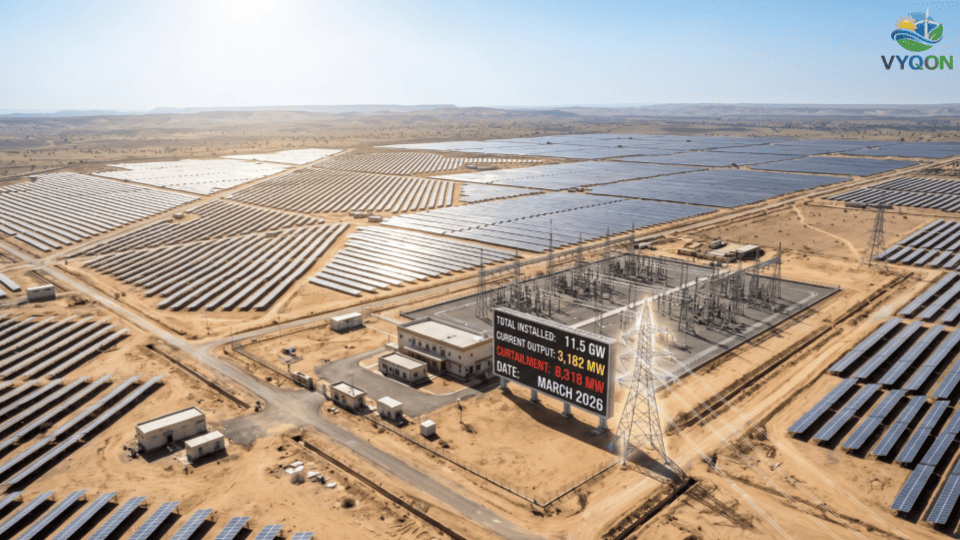
Since January 2026, renewable energy projects in Rajasthan have faced a cumulative generation curtailment of 11.5 GW. Despite the commissioning of major transmission assets in February 2025, including the Khetri–Narela 765 kV D/c line, significant output restrictions persist. Data indicates that approximately 4 GW of commissioned capacity remains restricted due to the non-availability of Transmission General Network Access (T-GNA) margins during peak solar hours. This systemic backing down of solar and wind assets has placed heavy financial pressure on developers, particularly as restrictions continue even with newer infrastructure online.
Data Breakdown: Cumulative and Monthly Figures
The scale of curtailment has escalated during the first quarter of 2026, impacting project revenue and regional grid integration. Specific data points include:
- Total Cumulative Curtailment: 11.5 GW recorded since January 2026.
- March 2026 Peak: A monthly figure of 8,318.2 MW was recorded by the State Load Despatch Centre (SLDC), operated by Rajasthan Rajya Vidyut Prasaran Nigam (RRVPNL).
- Production Cut Range: Individual substations reported production reductions ranging from 30% to 80%.
- Peak Generation Window: The majority of curtailments occur during high-generation hours between 10:30 AM and 14:30 PM.
Institutional Action: Rajasthan Solar Association (RSA) Intervention
The RSA has formally petitioned the State Energy Department regarding the operational and financial challenges posed by persistent generation cuts. The association’s intervention includes the following core statements and demands:
- Demand for Compensation Framework: The RSA is calling for a formal framework to compensate developers for curtailed energy. This demand highlights a specific legal vacuum, as current Power Purchase Agreements (PPAs) generally lack a grid compensation clause.
- Impact on Commercial Viability: The association stated that the current curtailment levels threaten the commercial viability of projects, making it difficult for developers—particularly small-scale entities—to meet debt-servicing obligations.
- Upcoming Seasonal Risks: RSA representatives warned that curtailment levels are anticipated to increase during the upcoming high-wind season.
Technical Context and Grid Constraints
Technical bodies, including the SLDC, the Central Electricity Authority (CEA), and Grid India, identify several operational factors necessitating backing-down instructions:
Generation/Demand Mismatch During periods of low demand, the grid faces a surplus of renewable generation. SLDC reports indicate that coal-fired thermal plants cannot be backed down below their “thermal minimum” operating limits—typically 55% to 70% of capacity—without risking total shutdown, necessitating the curtailment of solar and wind instead.
Transmission Infrastructure Bottlenecks Constraints persist due to the non-availability of T-GNA margins. Specific bottlenecks are cited on the Bhadla (RVPN)–Bikaner (RVPN) 400 kV D/c line and the 765 kV Bikaner–Khetri line, which limit the volume of power that can be exported to load centers.
Grid Stability Requirements Technical issues impacting grid security include voltage oscillations at pooling stations and a low Short Circuit Ratio (SCR) at various substations. These factors can compromise system stability if high injection levels are maintained.
Storage Deficits The state currently lacks sufficient commissioned battery energy storage systems (BESS). Without this infrastructure, there is no capacity to store surplus daytime generation for use during peak evening demand.
Regulatory Framework and “Must Run” Status
Under the Rajasthan Electricity Regulatory Commission (RERC) Regulations and the 2014 RE Tariff Regulations, renewable energy projects are granted “Must Run” status, which generally exempts them from merit order dispatch principles. However, the SLDC retains the authority to issue curtailment orders under Sections 32 and 33 of the Electricity Act if deemed necessary for grid security. Data indicates that industry developers have contested these instructions, arguing that curtailments are occasionally driven by commercial considerations—such as avoiding Unscheduled Interchange (UI) penalties—rather than purely technical exigencies.
Implementation and Forward Outlook
Technical bodies have identified several upcoming actions to mitigate these constraints. The CEA and Grid India are set to re-assess available transmission margins and explore network augmentation options. Planned mitigations include:
- Expediting the commissioning of the Bhadla II – Sikar II 765 kV D/c line (2nd circuit).
- Upgrading terminal bay equipment on the Bhadla–Bikaner 400 kV D/c line.
- Sharing Phasor Measurement Unit (PMU) data with developers to analyze and mitigate voltage oscillations at the plant level.
- Evaluating the implementation of “dynamic line rating” for identified transmission lines, with proposals to be placed before the next National Committee on Transmission (NCT) meeting.
Leave a Comment