
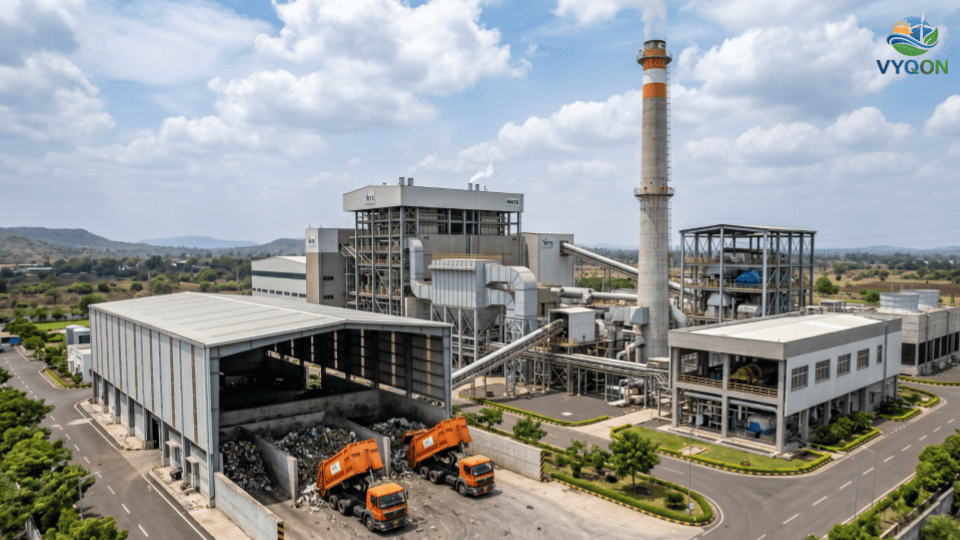
The Ministry of New and Renewable Energy (MNRE) has notified revised guidelines for the Waste-to-Energy (WtE) Programme under the National Bioenergy Programme. According to the Ministry, the revisions aim to “simplify” administrative procedures and “facilitate” the ease of doing business by aligning the release of Central Financial Assistance (CFA) with actual plant performance.
Eligibility Criteria
According to the guidelines, the following entities and project types are eligible for financial support:
- Project Types: Eligible outputs include Biogas, BioCNG (enriched biogas/compressed biogas), and Power generation.
- Technical Standards for Power: Projects utilizing steam turbines for power generation must maintain a minimum steam pressure of 42 bar.
- Waste Categories: The scheme applies to projects utilizing Urban, Industrial, and Agricultural wastes or residues—such as kitchen waste, poultry waste, and agro-processing effluents—as well as Municipal Solid Waste (MSW).
- Capacity Thresholds:
- MSW-to-Power: Projects must have a minimum installed capacity of 5 MW.
- Biogas Exclusions: Small-scale biogas plants based on agro-based industrial residues with a capacity below 2500 m³ are ineligible for this specific programme.
- Eligible Entities: Urban Local Bodies (ULBs), Municipal Corporations, registered private or public sector enterprises, MSMEs, and Energy Service Companies (ESCOs) may apply.
- Mandatory Loan Requirement: Private sector applicants must obtain a term loan from a bank or financial institution to qualify for CFA. This requirement is waived for local bodies or Public Sector Undertakings (PSUs) setting up projects using their own resources.
Feedstock Standards
The technical guidelines establish the following requirements for raw materials:
- MSW Compliance: MSW-to-Power projects must adhere to the Solid Waste Management Rules, 2016, and are permitted to utilize Refuse Derived Fuel (RDF).
- Mixing Limits: The Ministry permits the mixing of other renewable waste or biomass up to a limit of 25% for MSW-to-Power projects.
- Exclusions: The guidelines strictly forbid the use of fossil fuels, waste heat (flue gases), or distillery effluents for specific biogas generation CFA.
- Segregation Requirement: Projects utilizing biomethanation for MSW must use segregated or uniform biodegradable waste.
Tariff and Financial Applicability
The revised framework introduces a performance-linked system for the disbursement of Central Financial Assistance.
CFA Disbursement Stages
- Stage 1: 50% of the total CFA is released after the developer obtains the “Consent to Operate” (CTO). This stage requires the developer to provide a Bank Guarantee.
- Stage 2: The remaining 50% is released after successful performance testing. The output threshold for release is 80% of rated capacity for general WtE projects and 60% of rated capacity for MSW-to-Power and Biomass Gasifier projects.
Performance and Market Provisions
- Pro-rata Disbursement: If a plant fails to reach the required generation threshold during inspection, CFA may be disbursed on a pro-rata basis.
- Minimum Threshold: No CFA is granted if the Plant Load Factor (PLF) falls below 50%.
- Market Incentives: Developers of BioCNG projects may avail of a government “buy-back assurance” to support off-take security.
Financial Rates The Ministry has established the following CFA rates for eligible projects:
| Project Category | CFA Rate | Maximum Limit per Project |
| Biogas | Rs. 1.0 crore per 12,000 m³/day | Rs. 10 crore |
| BioCNG / Enriched Biogas | Rs. 4.0 crore per 4,800 kg/day (MWeq) | Rs. 10 crore |
| Power (Biogas – Gas Engine) | Rs. 3.0 crore / MW | Rs. 10 crore |
| Power (MSW / RDF) | Rs. 5.0 crore / MW | Rs. 50 crore |
| Power (Biomass/Waste – BTG) | Rs. 0.50 crore / MW | Rs. 10 crore |
Biomass Gasifier Rates
- Electrical (Dual Fuel): Rs. 2,500 per kWe.
- Electrical (100% Gas Engine): Rs. 15,000 per kWe (off-grid/distributed) or Rs. 10,000 per kWe (captive).
- Thermal Applications: Rs. 2 lakh per 300 kWth.
Operational Monitoring and Timeline
The guidelines specify the following administrative and operational benchmarks:
- In-Principle Approval: The Project Advisory Committee (PAC) evaluates proposals, and the Ministry aims to issue “In-Principle” approval within 45 days of the PAC recommendation.
- COD Timelines: The Commercial Operation Date (COD) must be achieved within 24 months for general WtE projects and 36 months for MSW-to-Power projects from the date of “In-Principle” approval.
- CFA Claims: Developers may claim CFA within 18 months of commissioning or from the date of In-Principle approval, whichever is later.
- Inspection Protocol: Joint inspections are led by the National Institute of Bio-Energy (SSS-NIBE) in coordination with State Nodal Agencies (SNAs) or other empaneled bodies.
- Performance Documentation: For CFA release, developers must submit 72 hours of continuous operation data and 3 months of performance records authenticated by the SNA.
- Long-term Mandate: Developers must provide an undertaking to keep the plant operational for a minimum period of 10 years.
Leave a Comment