
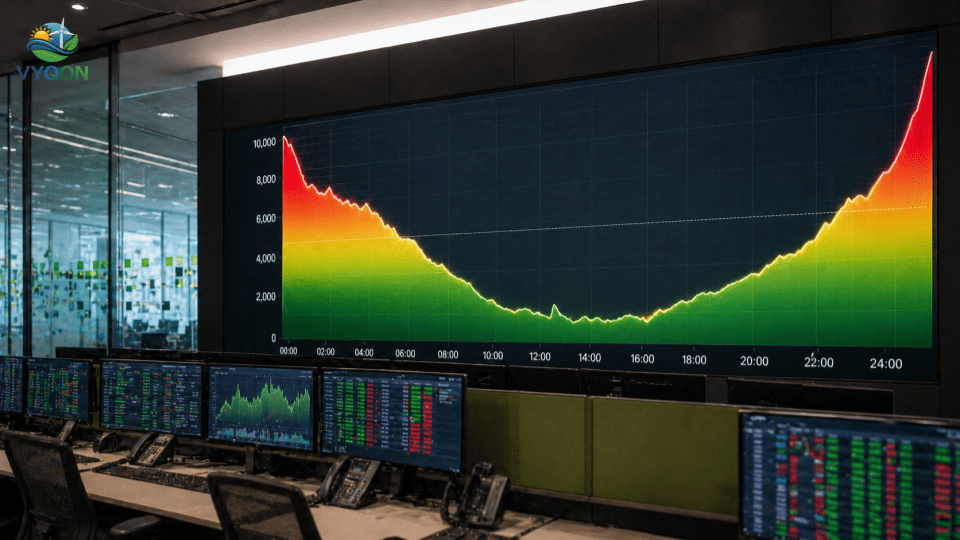
Market Activity Overview
On April 22, 2026, the Indian Energy Exchange (IEX) Green Day-Ahead Market (G-DAM) recorded unprecedented price volatility and high volumes during night-time hours, signaling extreme grid stress. Driven by an early-onset heatwave that pushed national peak power demand toward a historic 256 GW, the market struggled to maintain equilibrium after sunset. Despite the total absence of the nation’s 150 GW solar capacity during these hours, the G-DAM cleared significant volumes to address a widening supply-demand gap. The period was characterized by a steepest recorded shortfall of 5.4 GW, primarily triggered by a surge in forced and partial thermal plant outages totaling 21–26 GW, which left the grid increasingly dependent on exchange-traded green attributes and non-solar renewables.
Analysis of the Midnight Price Event
The trading day for April 22, 2026, opened with immediate price saturation as the Market Clearing Price (MCP) hit the maximum permissible limit. The specific metrics for the initial period are as follows:
- Market Clearing Price (MCP): ₹10,000/MWh (Regulatory Ceiling)
- Cleared Volume (Hour 1: 00:00 – 01:00): 10,785 MWh
- Intra-day Price Variance: The midnight MCP of ₹10/kWh stands in stark contrast to daytime lows of approximately ₹1.5/kWh (₹1,500/MWh) recorded during peak solar hours.
The persistent ceiling price of ₹10,000/MWh reflects a state of total market scarcity, where demand significantly outstripped available supply despite the high volume of green energy cleared at the start of the day.
Overnight Demand Trends in G-DAM
The April 2026 data confirms a deepening “Solar Paradox,” where peak electricity demand persists long after sunset (6 PM – 6 AM). While daytime requirements were met by the vast solar fleet, the grid faced a critical transition at dusk, falling back entirely on wind, hydro, nuclear, gas, and coal. The overnight demand surge in the G-DAM was exacerbated by “thermal stress”—high ambient temperatures that reduced the efficiency of generation equipment and led to nearly 26 GW of thermal capacity becoming unavailable. Consequently, the market relied on non-solar green attributes and limited stored energy to meet the 10,785 MWh cleared in the midnight block, illustrating a high-demand profile that no longer aligns with the solar production window.
The Deepening “Duck Curve”
The “duck curve” represents the timing imbalance between solar generation and the actual demand profile. This curve has deepened significantly as solar penetration has increased without a commensurate expansion in utility-scale storage. The clearing of 10,785 MWh at the regulatory ceiling highlights the severity of this imbalance.
Intra-day Market Imbalance Factors
| Market Condition | Data Indicator |
| Daytime Surplus (Solar Hours) | Market Clearing Price of ₹1.5/kWh; utilization of ~150 GW solar capacity |
| Evening/Midnight Scarcity | Market Clearing Price of ₹10/kWh (Regulatory Ceiling); 5.4 GW supply shortfall |
| Thermal Fleet Reliability | 21–26 GW of forced and partial outages due to high-temperature thermal stress |
The intra-day price differential of ₹8.5/kWh represents the current upper bound of the Levelized Cost of Storage (LCOS). This widening gap between the afternoon trough and the midnight peak price underscores the technical difficulty of balancing a grid where the primary renewable resource is unavailable during the period of maximum thermal stress.
Market Clearing Price (MCP) Trends
The volatility of the MCP serves as a factual metric for the grid’s current structural vulnerability. Prices frequently hit the regulatory ceiling at night while crashing during midday solar peaks, resulting in a diurnal range exceeding ₹7 per unit. This range is a direct consequence of a grid architecture that can manage solar-hour demand but lacks the reliability and storage buffer to handle post-sunset cooling loads. Factual observations from the April 2026 cycle indicate that early-season heatwaves are compressing planning windows and impacting grid reliability, as the thermal backup fleet faces increased failure rates exactly when solar contributions reach zero.
Leave a Comment