
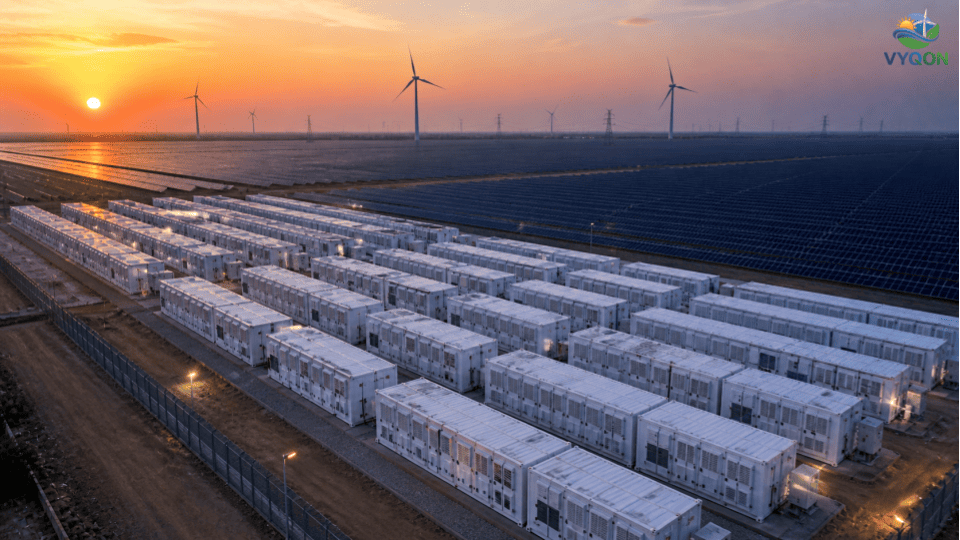
Adani Green Energy Limited (AGEL) has commissioned a 1,376 MWh Battery Energy Storage System (BESS) at its renewable energy site in Khavda, Gujarat. As the largest single-site BESS installation in India, this facility serves as the critical stabilization component for the 9,413 MW of operational capacity currently deployed at the site. The BESS infrastructure is a primary technical requirement for managing the solar-wind hybrid generation profiles within the world’s largest renewable energy park, ensuring grid integration and reliability for intermittent power sources.
Khavda Renewable Energy Park: Operational Profile
The Khavda development occupies 538 sq km of uninhabited, barren land in Gujarat. This location was selected through a “Resource as Value” approach, identifying high-potential zones for large-scale infrastructure. The project currently maintains an operational capacity of 9,413 MW, supported by a de-risked framework including long-term evacuation readiness and specialized site preparation.
The core project attributes and development readiness include:
- Site Suitability and Development: Utilization of vast, remote land parcels to minimize social and environmental impact.
- Resource Assessment: Completed solar resource assessments and the utilization of over 85 wind data locations.
- Geotechnical and Special Studies: Comprehensive geotechnical analysis and specialized engineering studies conducted by Adani Infra India Limited (AIIL).
- Infrastructure Readiness: Completion of dedicated evacuation infrastructure and detailed design planning, validated through plant-level simulations.
Technical Specifications and Grid Integration
The Khavda facility utilizes bifacial solar modules to maximize energy yield by capturing irradiance from both sides of the panels. Given the hybrid nature of the site, which combines solar and wind assets, the 1,376 MWh BESS acts as a value enhancer, allowing the variable renewable generation to function more effectively as a baseload-style provider.
Operations are managed through the Energy Network Operation Center (ENOC), a centralized cloud-based platform for real-time monitoring of AGEL’s national portfolio. This system integrates AI-based technology and analytics-driven Operations and Maintenance (O&M). To enhance data granularity, Adani Infrastructure Management Services Ltd (AIMSL) utilizes edge computing capability, with “Edge boxes” deployed at the plant level for deep data collection. These technological efficiencies have enabled AGEL to maintain a 92% EBITDA margin from power supply.
Strategic Growth and FY26 Development Trajectory
The commissioning of the BESS is a pivotal step in the transition from the 2.1 GW hybrid cluster milestone achieved in FY23 toward the FY26 interim growth targets. AGEL is currently executing a 2.3x locked-in growth strategy to bridge the gap between current operational capacity and its long-term objectives. The Khavda site is projected to reach 30 GW of capacity by 2029, contributing significantly to AGEL’s goal of a 45 GW global portfolio by 2030.
| Milestone Phase | Capacity Target | Strategic Context |
| Current Operational Status (Khavda) | 9,413 MW | Critical stabilization via 1,376 MWh BESS |
| FY26 Interim Milestone | Under Execution | Transitioning from 2.3x Locked-in Growth |
| 2029 Khavda Site Target | 30,000 MW (30 GW) | World’s largest single-location RE plant |
| 2030 Global Portfolio Target | 45,000 MW (45 GW) | Representing 10% of India’s RE target |
Infrastructure and Portfolio Synergies
The Khavda development leverages the “repeatable, robust, and proven transformative model” of the broader Adani Portfolio. Central to this model is AIIL, which provides project management and assurance through standardized engineering, design planning, and procurement processes. This ecosystem is supported by a strategic land bank of approximately 2,00,000 acres across Rajasthan and Gujarat.
From a regulatory and financial perspective, the project is underpinned by a “100% Must Run” status as mandated by the Electricity Act, 2003. This provides high cash-flow certainty, further reinforced by the fact that 95% of AGEL’s portfolio is tied to 25-year fixed-tariff Power Purchase Agreements (PPAs) with an average portfolio tariff of Rs. 2.97/unit. These long-term contracts, primarily with sovereign-equivalent counterparties, provide a de-risked framework for the massive capital expenditure required for the Khavda expansion.
Leave a Comment