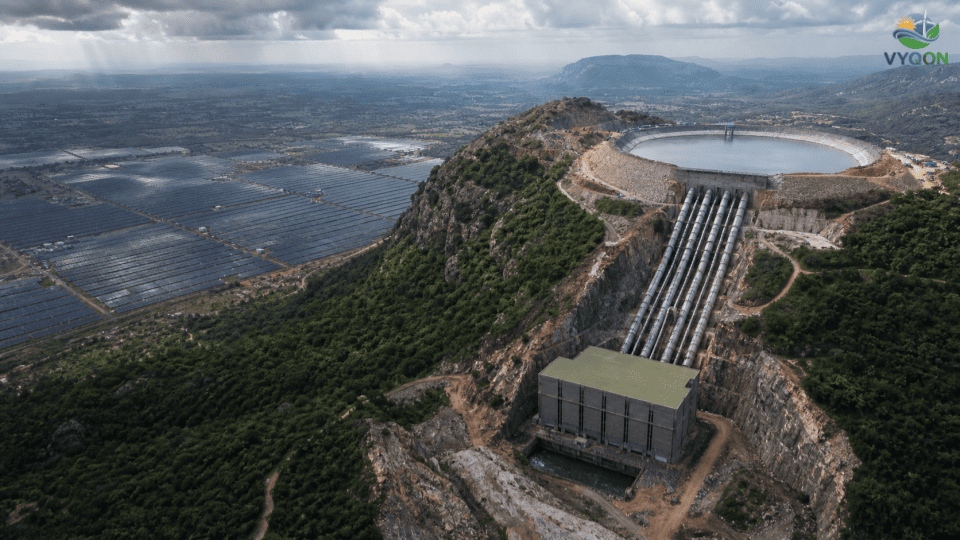
Greenko Group has achieved a pivotal technical milestone at the Pinnapuram Integrated Renewable Energy Storage Project (IRESP) with the successful wet commissioning of Unit 1 in pump mode. Located in the Kurnool District of Andhra Pradesh, this facility represents the world’s first and largest gigawatt-scale project to integrate Variable Renewable Energy (VRE) with large-scale storage. The milestone, highlighted during a site visit by Union Minister Shri Pralhad Joshi on April 18, 2025, confirms the operational readiness of the project’s hydraulic systems to provide Firm Dispatchable Renewable Energy (FDRE) to the national grid, supporting the decarbonization of hard-to-abate sectors like green steel and hydrogen.
Project Capacities and Infrastructure
The IRESP is a sophisticated multi-modal energy hub. While Phase I was initially granted Environmental Clearance for 1,200 MW, the facility has been reconfigured and recommended for an amendment to reach a cumulative capacity of 1,680 MW.
- Pumped Storage Project (PSP): 1,680 MW total capacity (comprising six units of 240 MW and two units of 120 MW).
- Solar Capacity (Phase I): 1,000 MW.
- Wind Capacity (Phase I): 550 MW.
- Reservoir Storage: Symmetrical live storage capacities of 1.346 TMC (upper reservoir) and 1.305 TMC (lower reservoir).
- Total Energy Storage: 11,250 MWh total capacity, delivering 10,080 MWh per day in a single cycle.
- Transmission: Integrated into the national grid via the 765/400 kV Interstate Transmission System (ISTS) substation at Orvakallu.
The Milestone: Wet Commissioning and Pump Mode
Wet commissioning at Pinnapuram involves the rigorous testing of the water conductor system, intake and outfall structures, and the hydraulic behavior of the reversible turbines under operational load. This milestone specifically validates “Pump Mode,” a critical function of the project’s Long-Duration Energy Storage (LDES) capability.
Unlike traditional hydro-electric plants, Pinnapuram is a closed-loop, off-stream system. This means it is not dependent on natural river flows but instead cycles a fixed volume of water between two man-made reservoirs. The system uses eight vertical-axis reversible Francis-type turbines. In pump mode, these turbines utilize surplus VRE to move water from the lower to the upper reservoir over a 7.7-hour duration, effectively “charging” the system. The engineering allows for a rapid transition to generating mode (discharging water for 6.7 hours) to meet peak demand or grid frequency requirements.
The IRESP Framework: Integrated Solutions for Intermittency
The IRESP addresses the core challenge of VRE—intermittency—by using the PSP as a stabilizing core. When solar and wind generation exceeds grid demand, the surplus electricity powers the pumping cycle. Conversely, when VRE generation wanes, the stored potential energy is released through the turbines to generate hydro power.
This synergy transforms variable wind and solar output into a firm, schedulable energy source. By providing a carbon-free alternative to fossil-fuel-based peaking plants, the project is projected to avoid 3.3 million tonnes of CO₂ emissions annually.
Project Context and Strategic Partnerships
The project is situated near Pinnapuram village in the Panyam Mandal and Nandyal Tehsil of Kurnool District, Andhra Pradesh. A cornerstone of the project’s commercial viability is the strategic partnership with ArcelorMittal (AM/NS India). ArcelorMittal has invested approximately $0.6 billion (Rs 4,500 crore) in solar and wind infrastructure to power the PSP, facilitating a 25-year off-take agreement for 250 MW of uninterrupted power for its Hazira steel plant in Gujarat.
Policy and Regulatory Environment
The IRESP operates within a robust framework of central and state incentives designed to catalyze the adoption of pumped storage technology:
| Policy Incentive | Duration / Detail |
| ISTS Charges Exemption | 25 years (for projects awarded before June 30, 2025; phased reintroduction thereafter). |
| Electricity Duty/Cess Waiver | 10 years on energy consumed for pumping operations. |
| Financial Assistance | Rs 10 million per MW for projects up to 200 MW; Rs 7.5 million per MW for capacity above 200 MW. |
| Water Cess | Explicitly not applicable to standalone Pumped Storage Projects. |
Stakeholder Perspectives
During his visit on April 18, 2025, Union Minister Shri Pralhad Joshi characterized the facility as a “shining example of India’s green energy potential,” noting that witnessing the world’s largest integrated storage project in action was a matter of national pride.
Anil Chalamalasetty, Group CEO & MD of Greenko, emphasized the strategic importance of the facility in the global energy landscape. He stated that the project “will make a vital contribution to global efforts to decarbonize hard-to-abate industries,” further noting that Greenko’s Intelligent RE Cloud Storage Platform is key to making renewable energy a mainstream, firm, and on-demand power source for the national grid.
Leave a Comment