
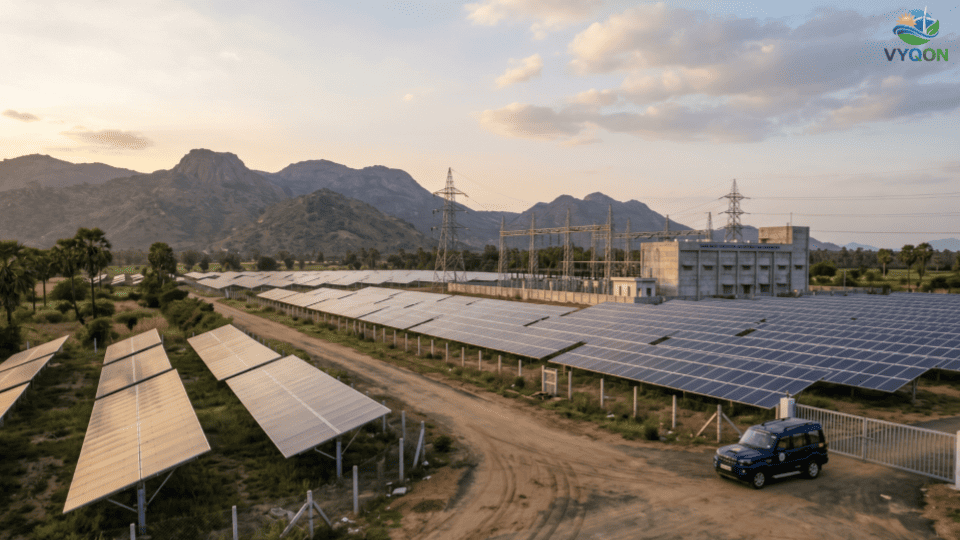
The Tamil Nadu Electricity Regulatory Commission (TNERC) has granted approval to the Tamil Nadu Green Energy Corporation Ltd (TNGECL) for the procurement of 420 megawatts (MW) of solar power. This initiative falls under Component-A of the Pradhan Mantri Kisan Urja Suraksha evam Utthaan Mahabhiyan (PM-KUSUM) scheme, targeting participation from farmers, village panchayats, and cooperative societies. The commission’s decision was contingent upon a formal undertaking from TNGECL to actively educate and invite the farming community to participate, ensuring broader awareness of the scheme’s financial benefits and decentralized generation opportunities.
Tariff Structures and Financial Determinations
Financial determinations by TNERC established a ceiling tariff of ₹3.10 per unit, finalized through a competitive reverse bidding process. This rate represents a significant reduction from an initial proposal of ₹3.28 per unit, which the commission previously rejected. In setting the ₹3.10 cap, TNERC accounted for Goods and Services Tax (GST) benefits and analyzed benchmarks from states such as Haryana, Madhya Pradesh, and Rajasthan, where procurement costs remained at or below ₹3.14 per unit. Successful developers will enter into Power Purchase Agreements (PPAs) with a 25-year duration from the commercial operation date.
Technical Mandates and Grid Compliance
To maintain grid stability and operational safety, the commission has mandated specific technical features, including remote metering and remote tripping capabilities. Developers will receive payments based on “net energy” injected into the grid, following the deduction of all line losses. Furthermore, the commission’s policy specifies that developers are ineligible for compensation regarding generation outages caused by routine feeder maintenance or substation shutdowns. All installations must preferably be located within a 5 km radius of existing 110/33/11kV or 33/11kV substations to optimize efficiency and minimize technical losses during transmission.
Scheme Implementation Status and Requirements
The approval comes at a critical juncture for PM-KUSUM in Tamil Nadu. Although the Ministry of New and Renewable Energy (MNRE) sanctioned 424 MW for the state, historical data indicates that only 2 MW had been commissioned by late 2025. TNERC noted that the state must strive to emulate Rajasthan’s success, which achieved 462.75 MW of installed capacity under the same scheme. Land requirements are set at approximately 3.704 acres per MW, utilizing barren, fallow, or marshy lands. Cultivable land usage is permitted via “stilt fashion” agrivoltaics, provided there is adequate spacing between panel rows to ensure that farming activities remain unhindered.
Understanding PM-KUSUM Component-A
Component-A of PM-KUSUM focuses on decentralized, grid-connected solar power plants ranging from 500 kW to 2 MW in capacity. These projects can be ground-mounted or elevated on stilts. The primary objective is to empower farmers to utilize unproductive land as a secondary income source while simultaneously assisting distribution companies (DISCOMs) in reducing transmission and distribution (T&D) losses by generating power closer to rural load centers.
l propose instalation of one mw solar power on my own land in arani taluk tiruvannamlai dt.
Dear Sir,
Kindly email your proposal at info@vyqon.in
Our team will take it from there.