
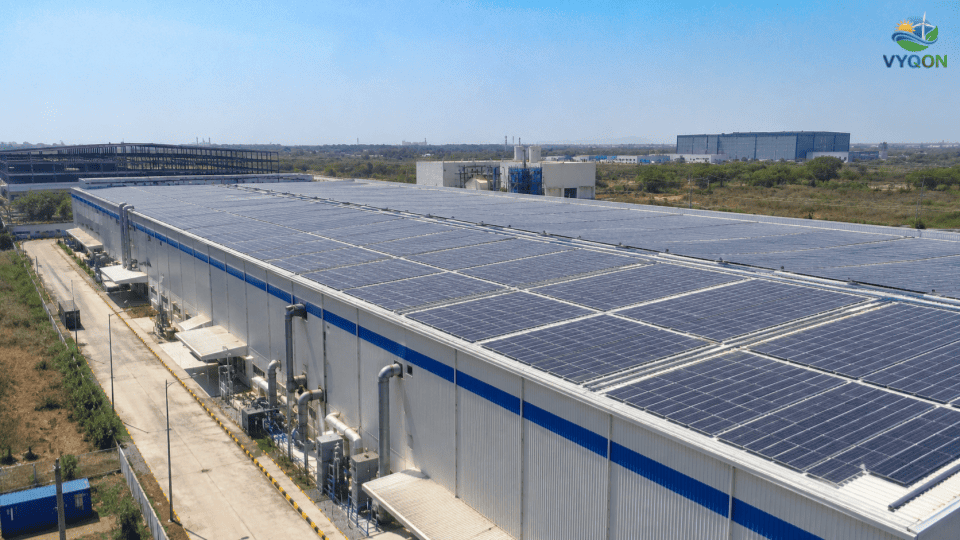
Executive Summary: The 9.75 MW Landmark PPA
A leading solar module manufacturer in Andhra Pradesh has solidified its long-term energy security by signing a landmark 9.75 MW rooftop solar Power Purchase Agreement (PPA). The strategic move is designed to slash the entity’s power costs by a staggering 83% relative to current grid tariffs. By pivoting to an on-site renewable model, the manufacturer effectively de-risks its balance sheet from the volatility of DISCOM rates while moving toward total energy self-sufficiency. This deal represents a significant milestone in the Indian Commercial and Industrial (C&I) sector, demonstrating how large-scale manufacturing can leverage the RESCO model to lock in price stability for decades.
Financial and Operational Benchmarks
The following data points distill the primary economic and technical specifications of the installation:
- Total Projected Savings: ₹2.21 billion (₹221 Crore) over a 20-year operational period.
- Cost Reduction Percentage: 83% decrease in power costs compared to prevailing grid tariffs.
- Installation Type: Industrial rooftop solar.
- Capacity: 9.75 MW.
PPA Mechanics and Project Structure
The project pivots on a RESCO (Renewable Energy Service Company) model, effectively de-risking the manufacturer’s balance sheet by eliminating high entry barriers. Under this OPEX-based arrangement, a third-party developer assumes 100% of the upfront costs for design, supply, and commissioning.
The “Buying Entity” purchases the solar energy at a pre-determined levelized tariff, providing an immediate “Zero Upfront Cost” advantage. Key technical features of the deal include:
- Metering and Delivery: Energy is recorded by a “Main Metering System” installed at a mutually agreed “Delivery Point.” The manufacturer pays only for the “Actual Monthly Production” delivered to their internal grid.
- Term Flexibility: While the ₹221 Crore savings are calculated over a 20-year window, the project aligns with the NREDCAP standard PPA framework, which typically allows for 25-year terms, offering the manufacturer long-term operational visibility.
Strategic Context: Andhra Pradesh as a Solar Manufacturing Hub
Andhra Pradesh is rapidly evolving into a premier solar manufacturing corridor, attracting massive capital inflows. The state is already anchoring major industrial facilities, such as Jupiter Renewables’ ₹2,700 crore plant in Anakapalle (targeting 4.8 GW of cell and 1.5 GW of module capacity). Premier Energies is further strengthening the local supply chain with a two-phase investment: ₹1,742 crore for 5 GW of wafers and ingots, and a subsequent ₹4,200 crore for 8 GW of solar cell production.
The regulatory environment has matured alongside these investments. The Andhra Pradesh Electricity Regulatory Commission (APERC) recently clarified intra-state connectivity transfer rules, specifically removing the 50 MW minimum capacity threshold. This technical shift provides vital flexibility for smaller-scale industrial projects to transfer connectivity directly to projects with active PPAs, facilitating smoother grid integration.
In a landscape where industrial tariffs are climbing—exemplified by Tamil Nadu’s hike to ₹7.5/unit and Uttar Pradesh’s proposed 15-18% increase—this PPA serves as a decisive hedge against the inflationary trends of traditional grid power.
Environmental Impact and Global Competitiveness
Beyond the financial harvest, the 9.75 MW project serves as a critical strategic asset against global carbon mandates. In the Indian industrial sector, every 1 MW of solar typically offsets between 1,400 and 1,600 tonnes of CO2 per year. This installation is estimated to purge approximately 13,650 to 15,600 tonnes of CO2 from the manufacturer’s annual footprint.
For a module manufacturer, these carbon savings are not merely an ESG metric but a necessity for long-term competitiveness under global mandates like the Carbon Border Adjustment Mechanism (CBAM). By lowering the carbon intensity of its production process, the manufacturer mitigates export-related risks and aligns with Andhra Pradesh’s ambitious renewable energy targets. This 20-year operational phase marks a definitive step toward decarbonized, high-margin industrial manufacturing in the region.
Leave a Comment