
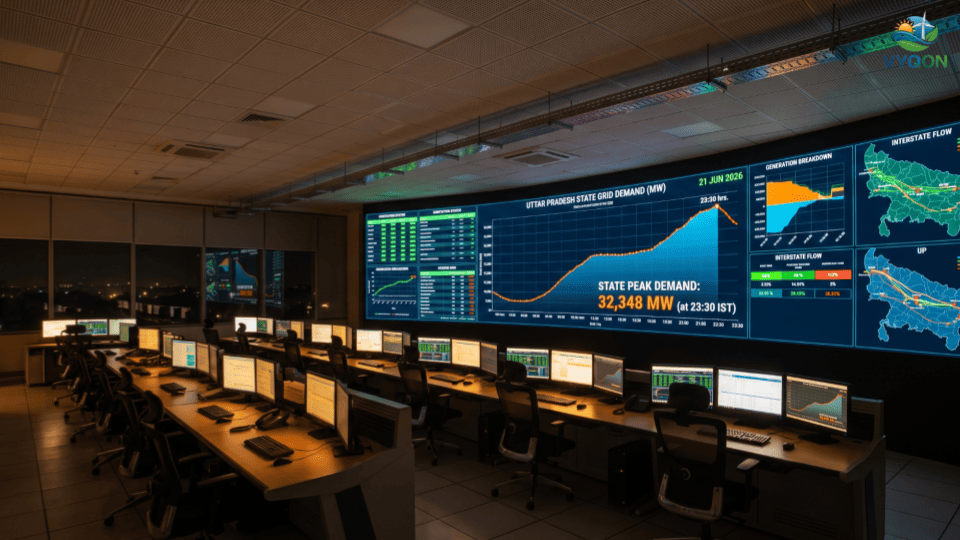
National Record Achievement
In a landmark event for the Indian energy sector, Uttar Pradesh (UP) successfully managed a record-breaking peak power demand of 32,348 MW at 10:48 PM on June 21, 2026. This figure establishes a new national benchmark for the highest instantaneous peak load ever handled by a single state in India, surpassing the previous record held by Maharashtra. However, this milestone was eclipsed just four days later; as intense heat intensified, the state grid recorded a further escalated peak of 32,634 MW at 9:54 PM on Thursday, June 25, 2026.
Comparison with National Benchmarks
The record set by Uttar Pradesh on June 21 edged past the previous national high established by Maharashtra in May 2026. The state’s electricity requirement saw a sustained upward trajectory throughout the month, crossing the 30,000 MW threshold on June 6 and exceeding 31,000 MW by June 7. By June 10, demand reached 31,894 MW, underscoring the mounting pressure on the regional power system.
| State | Peak Demand (MW) | Date Recorded |
| Uttar Pradesh | 32,348 | June 21, 2026 |
| Maharashtra | 32,317 | May 13, 2026 |
Primary Drivers of Record Demand
The unprecedented surge in power consumption was fueled by a combination of extreme weather and seasonal economic requirements:
- Severe Heatwave Conditions: The India Meteorological Department (IMD) issued forecasts for “heat wave to severe heat wave conditions” across East Uttar Pradesh during late June. With temperatures nearing 41 degrees Celsius and a delayed monsoon, cooling loads from residential and commercial sectors spiked significantly.
- Agricultural Consumption: Demand was further bolstered by seasonal irrigation. Agromet advisories for East UP specifically recommended “light irrigation” for vegetable crops and fruit orchards to mitigate heat stress, leading to a steady agricultural load.
- Industrial and Urban Growth: Continued urbanization, wider electricity access, and growing industrial activity have structurally increased the state’s base load.
- Sharp Daily Variation and Midnight Spikes: The system faced significant load balancing challenges, with demand ramping up from a daily minimum of 24,755 MW at 6:15 AM on June 21 to the late-night peak. Data from the State Load Dispatch Centre also noted unusual “mid-night demand” spikes, such as a 32,402 MW load recorded at 12:39 AM on June 25.
Official Statements and Grid Management
The management of this record load was overseen by the Uttar Pradesh State Load Dispatch Centre (UPSLDC), which maintained system stability despite the narrow margins. UP Energy Minister A.K. Sharma credited the achievement to the state’s modernized infrastructure, while UPPCL Chairman Dr. Ashish Kumar Goyal and Director (Distribution) Gyanendra Dhar Dwivedi emphasized that power was being supplied beyond roster levels.
However, the surge did not come without operational strain. Officials admitted that despite the record-breaking supply, a peak-time deficit of 2,000–3,000 MW persisted. This gap necessitated 6–7 hours of emergency load shedding in rural areas and contributed to intermittent outages caused by local faults and transformer earthing issues.
Regarding the achievement, the Uttar Pradesh Power Corporation Limited (UPPCL) released the following statement:
“This historic achievement is a result of the state government’s vision, modern power infrastructure, effective management and the dedication of thousands of officers and employees associated with power generation, transmission and distribution.”
Infrastructure Context
The state’s ability to sustain these demand levels was supported by critical capacity additions. The Ghatampur Thermal Power Station—a joint venture (NUPPL) between Neyveli Lignite Corporation (51%) and Uttar Pradesh Rajya Vidyut Utpadan Nigam (49%)—reached a maximum generation of 2008 MW on June 13, 2026. This peak coincided with the commencement of commercial operation (CoD) for its third 660 MW unit.
While the 1980 MW facility is a cornerstone of the state’s supply, it also operates under wider Power Purchase Agreements (PPAs). Approximately 75.12% of its generated power is dedicated to UPPCL, while the remaining 24.88% is allocated to Assam and other northern states, illustrating the plant’s role in broader regional grid stability.
Leave a Comment