
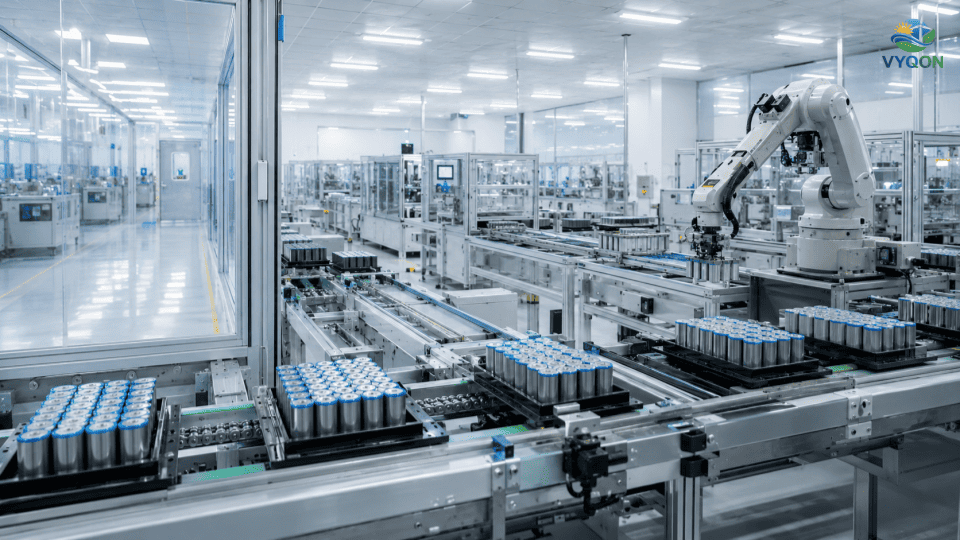
The 10 GWh Global Call for Grid Storage
The Ministry of Heavy Industries (MHI) has officially invited global bids for the final 10 GWh tranche of the ₹18,100-crore Production Linked Incentive (PLI) scheme for Advanced Chemistry Cell (ACC) battery storage. In a strategic pivot from the mobility-focused first half of the program, this final allocation is earmarked exclusively for Grid-Scale Stationary Storage (GSSS). By opening the bid to international players, the government seeks to shore up a national programme that has been marked by significant implementation delays and a widening gap between industrial policy and operational reality. Bids for this final portion of the 50 GWh cumulative target are due by October 13, 2026.
Tender Timeline and Operational Framework
The selection process utilizes a “Quality and Cost Based Selection” (QCBS) mechanism, conducted via the government’s Central Public Procurement (CPP) Portal.
| Milestone | Date |
| RFP Release Date | 15 July 2026 |
| Pre-bid Conference | 29 July 2026 |
| Bid Submission Deadline | 13 October 2026 |
| Technical Bid Opening | 14 October 2026 |
Strategic Shift: Revised Bidding Norms and Subsidies
This tender reflects a sophisticated recalibration of India’s storage ambitions, acknowledging both falling global manufacturing costs and the unique technical requirements of the power grid.
- Capacity Thresholds: To encourage a broader manufacturer base and mitigate the risk of project concentration, the MHI has reduced the capacity threshold to a 1–4 GWh range per bidder. This preserves the 1:4 minimum-to-maximum ratio of the original 5–20 GWh framework while lowering the entry barrier for specialized stationary storage players.
- Subsidy Reduction: The maximum subsidy has been slashed from ₹2,000 per kWh to ₹1,500 per kWh. According to the Ministry of New and Renewable Energy (MNRE), this reflects the sustained decline in global cell prices.
- Performance Metrics over Weight: Unlike EV batteries, where energy density is paramount for range, GSSS units are stationary installations where weight is irrelevant. Consequently, the evaluation metrics have pivoted to round-trip energy efficiency and cycle life. This shift favors chemistries like Lithium Iron Phosphate (LFP), which offer superior thermal safety and durability over high-density alternatives.
- Evaluation Weightage: Bids are weighted 80% Technical and 20% Financial. Crucially, 70% of the technical evaluation is based on the Domestic Value Addition (DVA) plan.
Contextualizing the National Programme: Policy vs. Implementation
While the PLI ACC scheme remains the cornerstone of India’s import-substitution strategy, its execution has been sluggish. Of the original 50 GWh target, 40 GWh has been awarded to four beneficiaries: ACC Energy Storage Pvt. Ltd. (5 GWh), Ola Cell Technologies (20 GWh), Reliance New Energy Battery Storage Ltd. (5 GWh), and Reliance New Energy Battery Ltd. (10 GWh).
The current 10 GWh tranche was made available after the government rescinded a 20 GWh award to Hyundai Global Motors following the discovery that the firm was not associated with the South Korean automaker. However, industrial analysts note that the path to 50 GWh is fraught with institutional risks:
- Financial Scrutiny: Rajesh Exports, initially a key player, is currently under the shadow of a SEBI investigation for allegedly overstating revenue by ₹15.15 trillion, casting doubt on its capacity to deliver.
- Zero Incentive Disbursement: As of late 2025, no incentives have been disbursed to any beneficiary. Despite a cumulative investment of ₹5,180 crore and the creation of 1,277 direct jobs, firms have struggled to meet the stringent DVA requirements necessary to claim subsidies.
- Commissioning Gaps: While Ola Cell Technologies has partially commissioned 1.4 GWh of capacity, the rest of the 40 GWh remains largely in the facility-setup phase.
Grid-Scale Stationary Storage (GSSS): The Path to 2030
The prioritization of GSSS is a direct response to India’s massive renewable energy (RE) deployment. Without storage, the grid cannot absorb the variable peak generation from solar and wind, leading to costly curtailment.
According to the National Electricity Plan (NEP) 2023, India requires 82.37 GWh of storage by 2026-27 (34.72 GWh from BESS) and a staggering 411.4 GWh by 2031-32 (236.22 GWh from BESS).
However, the “policy vs. reality” gap is most evident in the Domestic Value Addition (DVA) mandate. Reji Kumar Pillai, President of the India Smart Grid Forum (ISGF), has highlighted the critical tension: the government demands 70% DVA for technical qualification, yet India currently lacks domestic battery-grade mineral refining and upstream component manufacturing. Furthermore, on-the-ground operational hurdles—including visa delays for Chinese technical specialists required for equipment installation and a significant skilled manpower gap—continue to stifle the two-year commissioning timeline.
Industrial Goals and Sectoral Outlook
The MHI’s global tender for the final 10 GWh represents an effort to de-risk India’s energy transition by seeding a domestic supply chain for grid storage. While the programme has successfully catalyzed investment announcements, the actual manufacturing of battery cells remains nearly 100% dependent on imports. For this tender to succeed where previous tranches have lagged, the government must address the upstream bottlenecks in mineral refining and talent development. Until a mature ecosystem is established, India remains at least five to ten years behind global leaders, making the successful execution of this final 10 GWh tranche vital for national energy security.
- Official RFP Document (PDF): https://www.heavyindustries.gov.in/sites/default/files/2026-07/rfp.pdf
- MHI Tender Information Page: https://www.heavyindustries.gov.in/en/request-proposal-rfp-selection-manufacturers-setting-10-gwh-manufacturing-capacities-advanced
- Bidding Portal: The actual bidding process is conducted online through the Central Public Procurement (CPP) Portal.
Important Context for Readers:
- Tender Release Date: 15 July 2026.
- Bid Due Date: 13 October 2026.
- Technical Bid Opening: 14 October 2026.
- Selection Mechanism: Quality and Cost Based Selection (QCBS).
Official References & Citations
- Ministry of Heavy Industries (MHI): Request for Proposal (RFP) for Selection of Manufacturers for Setting Up 10 GWh Manufacturing Capacities for Advanced Chemistry Cell (ACC) for Grid Scale Stationary Storage Applications
- Press Information Bureau (PIB): Ministry of Heavy Industries Invites Bids through Global Tender for 10 GWh ACC Manufacturing Facilities (Release ID: 2284916)
- Ministry of New and Renewable Energy (MNRE): Energy Storage Systems (ESS) Overview and National Electricity Plan Projections
- Press Information Bureau (PIB): Status Update on PLI-ACC Scheme and Beneficiary Progress (Release ID: 2225877)
- Official Tender Document (PDF): Direct Link to RFP for 10 GWh Grid-Scale ACC Manufacturing
Leave a Comment