
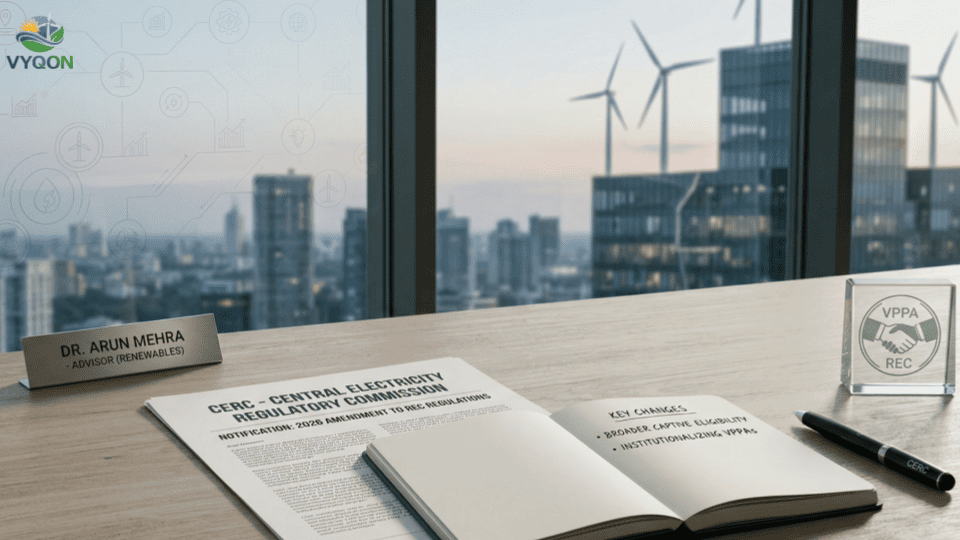
The Central Electricity Regulatory Commission (CERC) has officially notified the CERC (Terms and Conditions for Renewable Energy Certificates for Renewable Energy Generation) (First Amendment) Regulations, 2026. This amendment, which came into force on March 24, 2026, represents a significant overhaul of the REC framework to align with India’s evolving energy transition goals and the newly established Renewable Consumption Obligation (RCO).
Key Structural Changes:
- Expansion of Eligibility for Captive Plants: In a major relief for the C&I segment, the eligibility criteria under Regulation 4 have been widened. Captive generating stations that do not meet the specific “Captive” requirements under the Electricity Rules, 2005 (often due to shareholding complexities), but still consume self-generated renewable energy, are now eligible to participate in the REC mechanism. This allows these entities to monetize their green attributes through certificates.
- Institutionalization of Virtual PPAs (VPPAs): For the first time, a dedicated framework for VPPAs has been established under Regulation 14A. VPPAs are purely financial contracts where the physical electricity is not exchanged, but the “greenness” is. Under this new rule, RECs generated from VPPA projects will be automatically transferred to the consumer to meet their RPO or RCO.
- The New Multiplier Regime: To incentivize high-cost or emerging technologies, CERC has introduced a technology-specific multiplier:
- Solar & Onshore Wind: 1.0 multiplier.
- Renewable Hybrid Projects: 1.5 multiplier.
- Battery Energy Storage (BESS) & Pumped Hydro: 3.0 multiplier (reflecting their role in grid stability).
- Offshore Wind: 4.0 multiplier.
- Strict Issuance Timelines: Distribution licensees and Open Access consumers must now apply for REC issuance within three months of the State Commission’s certification of excess RE procurement. Failure to meet this window will result in the forfeiture of certificates for that period.
This amendment bridges the gap between the physical electricity markets and the Indian Carbon Market (ICM), ensuring that every unit of green power generated—whether physically consumed or financially contracted—can be accurately tracked and monetized.
Leave a Comment