
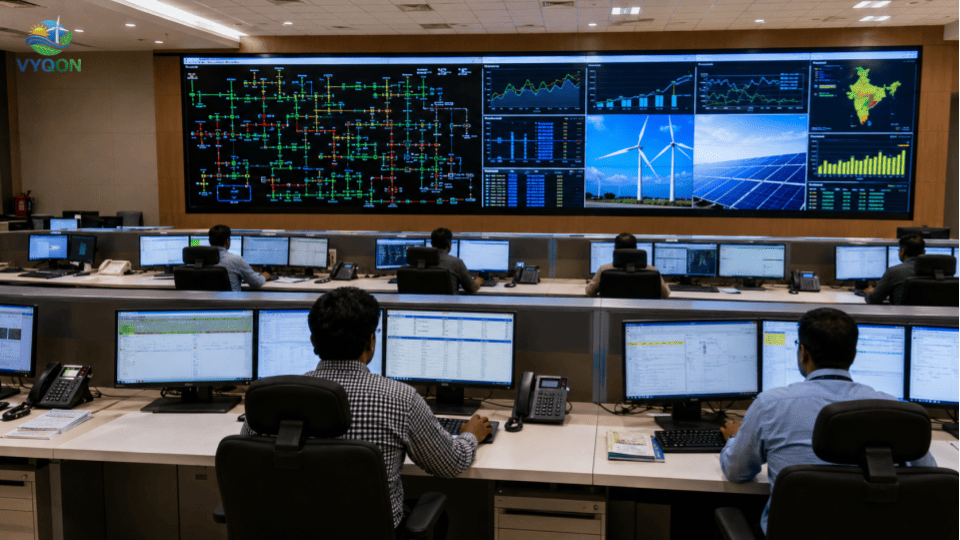
The Tamil Nadu Electricity Regulatory Commission (TNERC) has officially notified the “State Load Dispatch Center (SLDC) Functions and Accountability Regulations, 2026.” This framework establishes the operational mandates for the state’s grid controller, focusing on the maintenance of grid discipline, the formalization of technology-specific statuses, and enhanced accountability for system users. The regulations are designed to provide a structured environment for the state’s power sector as it integrates higher volumes of variable renewable energy and advanced storage technologies.
Must-Run Status for Renewable Energy
Under the 2026 Regulations and the aligned Tamil Nadu Electricity Grid Code 2026, the Commission has reinforced “must-run” protections for specific power generation technologies. This status ensures that designated facilities are not subject to merit order dispatch and are prioritized for power evacuation to minimize curtailment.
The technologies granted must-run status include:
- Solar and wind power stations
- Hybrid renewable energy systems
- Nuclear power stations
- Run-of-river hydro stations
The SLDC may only direct these stations to curtail output under strictly defined conditions, specifically for maintaining grid security or mitigating risks to personnel and equipment. To support system stability, renewable generators connected at extra-high voltage (EHV) levels are mandated to comply with reactive power management obligations and operate voltage control systems in accordance with Central Electricity Authority (CEA) technical standards.
Regulatory Treatment of Battery Energy Storage Systems (BESS)
The 2026 Regulations and recent TNERC directives clarify that “must-run” status does not extend to Battery Energy Storage Systems (BESS). Instead, BESS operations are subject to SLDC scheduling instructions for both charging and discharging cycles.
To prevent “gaming”—where developers might exploit a fixed composite tariff by supplying only solar power during BESS outages—TNERC has established rigorous technical and financial safeguards. A primary example is the 15 MW Solar / 45 MWh BESS project in Karur District, awarded to M/s. Evolve Green Energies Private Limited at a discovered composite tariff of Rs. 4.47/kWh.
Key mandates for integrated storage projects include:
- DC:AC Capacity Cap: To curb over-generation incentives, the total DC capacity of solar modules is capped at a DC:AC ratio of 1.3:1 relative to the inverter or contracted capacity.
- Outage Penalties: During BESS outages or battery replacement periods, the tariff is downgraded from the composite rate to the lower SECI discovered solar rate or the weighted average solar tariff for the period.
- Mandated Metering Architecture: Integrated facilities must maintain three separate energy accounting points:
- Gross solar energy generation from the photovoltaic plant.
- Energy charged into the BESS (exclusively from the co-located solar plant).
- Energy discharged from the BESS to the grid.
Digital Oversight and Compliance Monitoring
The regulations formalize a digital instruction module for integrated grid operations. The SLDC is responsible for high-accuracy frequency measurement (rated at 50 Hz) and is required to archive system data at 1-second intervals. This digital oversight ensures the state grid remains within the operating frequency range of 49.9–50.05 Hz, aligning jurisdictional operations with the Indian Electricity Grid Code (IEGC) 2023.
To strengthen compliance, the framework mandates the appointment of a Qualified Co-ordinating Agency (QCA) for renewable generators. The SLDC is empowered to levy escalating penalties for non-compliance, with deviation charges increasing to 150% for the first 30 days of non-appointment and 200% for the subsequent 30 days. Continued non-compliance beyond 120 days may result in grid disconnection.
Implementation Timeline and Financial Framework
The SLDC is now required to maintain separate books of accounts to ensure financial transparency and independence from the State Transmission Utility (TANTRANSCO). This includes a formal separation of assets and liabilities to establish a clear opening capital cost.
While the Functions and Accountability Regulations are now notified, related frameworks—including the Multi-Year Tariff (MYT) and SLDC Fee Regulations—remain in the draft phase for the five-year control period spanning FY 2027-28 to FY 2031-32. This control period will include a mandatory mid-term review in 2029. Under the proposed fee structure, the SLDC will recover its Aggregate Revenue Requirement (ARR) through a split mechanism: 70% via System Operation Charges (SOC) and 30% through Scheduling Charges (SCh).
Leave a Comment