
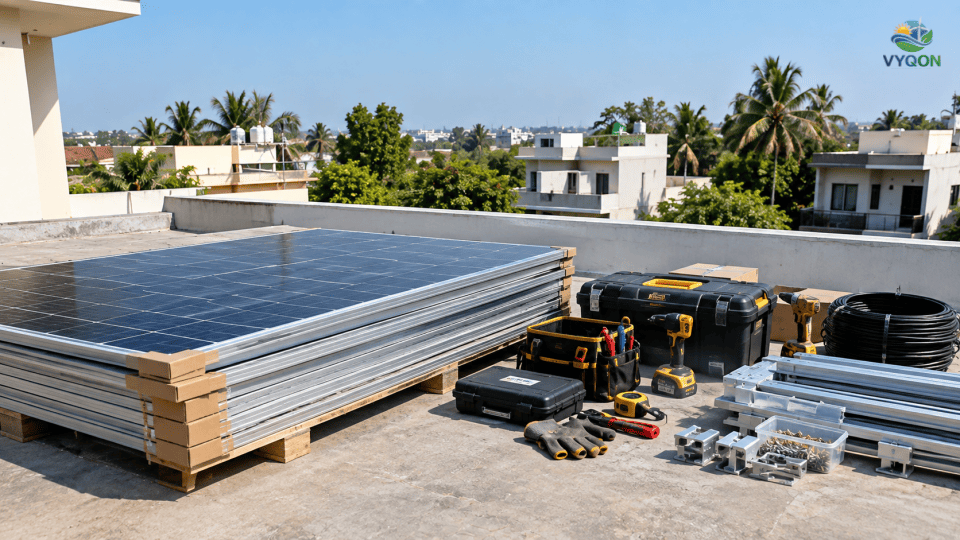
The Karnataka Electricity Regulatory Commission (KERC) has finalized the regulatory framework for grid-connected Distributed Solar Photovoltaic (DSPV) systems. This final order establishes the operational rules for installations across the service areas of BESCOM, HESCOM, GESCOM, CESC, MESCOM, and HRECS. The finalized regulations establish limits that differ from the June 2026 draft proposals, specifically by expanding the net metering capacity limit to 1 MW and removing the previously proposed mandatory battery storage requirement.
Expansion of Net Metering Eligibility to 1 MW
The finalized regulations establish a higher capacity threshold for net metering compared to earlier proposals. While the June 2026 draft regulations suggested capping net metering at 500 kW, the final order doubles this limit.
Regulatory Update: The maximum capacity for net metering for Distributed Solar PV systems is finalized at 1 MW.
This threshold allows commercial, industrial, and institutional consumers with higher demand to utilize net metering for systems up to the 1 MW limit, enabling the credit of surplus generation against grid consumption.
Removal of the Mandatory Storage Requirement
The KERC has reversed a provision from the June 2026 draft regarding Battery Energy Storage Systems (BESS). The initial proposal required integrated battery storage for all DSPV systems with a capacity exceeding 10 kW. In the finalized regulations, this requirement has been withdrawn.
| Draft Proposal (June 2026) | Finalized Regulation |
| Mandatory integrated BESS for systems >10 kW | Mandatory storage requirement removed; BESS is optional |
Implementation of Virtual and Group Net Metering (VNM & GNM)
The framework for Virtual Net Metering (VNM) and Group Net Metering (GNM) is governed by the Common Standard Operating Procedure (SOP) issued on May 12, 2026. These mechanisms require a minimum plant size of 5 kW and the installation of smart meters at both generation and consumption points.
Virtual Net Metering (VNM)
VNM allows energy generated from a single solar plant to be adjusted across multiple electricity service connections of the same category within a distribution licensee’s area.
- Mechanism: Total generated energy is exported to the grid and apportioned to participating consumers based on the ratio specified in the Power Purchase Agreement (PPA).
- Eligibility: Restricted to Domestic consumers, group housing societies, charitable institutions, government buildings, schools, and buildings belonging to local authorities.
Group Net Metering (GNM)
GNM allows a single consumer to adjust surplus energy from a solar installation at one location against other connections held in the same name and category.
- Mechanism: Surplus energy is adjusted against other connections in a priority order indicated in the PPA.
- Eligibility: Consumers of all categories are eligible for GNM.
- Operational Requirement: The service connection where the solar plant is located (source connection) must consume at least 20% of the total energy generated by the plant in a billing month.
- Lapsed Energy: The equivalent units of the mandatory 20% source-point generation that are not consumed at the source connection are considered lapsed energy and are not available for credit.
Standardized Billing and Technical Feasibility
A unified framework for billing and technical approval has been adopted across all state ESCOMs.
- Billing and ToD Compensation: All installations follow a monthly billing cycle with synchronized meter readings. For consumers under Time of Day (ToD) tariffs, electricity consumption in any specific time block (Peak or Off-Peak) is first compensated by solar generation from the corresponding time block within the same billing cycle.
- Treatment of Net Exported Energy: Surplus energy remaining after adjustments is credited at 75% of the generic tariff determined by KERC for the relevant control period.
- Technical Feasibility and Authority: A technical feasibility analysis is mandatory for all applications. While the Assistant Executive Engineer (AEEE) of the sub-division is responsible for the analysis in most scenarios, higher capacity or complex installations require escalated authority:
- Ground-mounted VNM plants: The AEEE must coordinate with the Executive Engineer (EE).
- Systems above 500 kWp: The Executive Engineer (EE) of the O&M Division is the authorized officer for coordination and synchronization.
- Open Access: Consumers are exempted from Open Access charges if generation and consumption occur within the same distribution transformer or 11kV feeder.
Key Facts Summary
- Finalized Net Metering Limit: 1 MW.
- Storage Status: Proposed 10 kW mandate removed; BESS is optional.
- VNM Eligibility: Domestic, institutional, government, and local authority categories.
- GNM Eligibility: Open to all consumer categories.
- GNM Source Requirement: Minimum 20% consumption at the source point; unconsumed portions of this 20% are considered lapsed energy.
- Export Tariff: 75% of the generic KERC solar tariff.
- ToD Logic: Compensation is applied within corresponding peak/off-peak time blocks.
- Feasibility Authority: AEEE for standard systems; EE coordination or authorization required for ground-mounted VNM or systems exceeding 500 kWp.
- Metering: Mandatory smart meters for all VNM and GNM participants.
Official References & Regulatory Sources
- KERC Grid-Interactive Distributed Solar PV Plants Regulations, 2026 – Issued by the Karnataka Electricity Regulatory Commission (KERC). This principal regulatory order expands net metering eligibility up to 1 MW (1,000 kW), establishes framework rules for net billing, gross metering, Group Net Metering (GNM), and Virtual Net Metering (VNM), and formalises the removal of mandatory energy storage requirements. Access to state regulatory archives can also be found at the KERC Official Regulations Portal.
- Common Standard Operating Procedure (SOP) for VNM & GNM Implementation – Joint operational circular issued by Bangalore Electricity Supply Company Limited (BESCOM) on behalf of all Karnataka state DISCOMs (BESCOM, HESCOM, GESCOM, CESC, MESCOM, and HRECS) under KERC approval. It outlines step-by-step technical feasibility checks, smart metering standards, procurement ratio declarations, and billing mechanisms for shared solar plants.
- KERC Solar & Distributed Solar PV Tariff Determination Paper – Official regulatory order and discussion paper by KERC establishing levelised solar tariffs across Karnataka, including non-subsidy residential rates (up to ₹3.89 per unit), PM Surya Ghar tariffs, and the 75% generic tariff rate applied to net exported energy under VNM and GNM arrangements.
- Ministry of New and Renewable Energy (MNRE) Policy & Compliance Framework – Central government portal providing official notifications for Approved List of Models and Manufacturers (ALMM) cell/module compliance, PM Surya Ghar Muft Bijli Yojana implementation, and mandatory inverter-level generation data storage standards.
Leave a Comment