
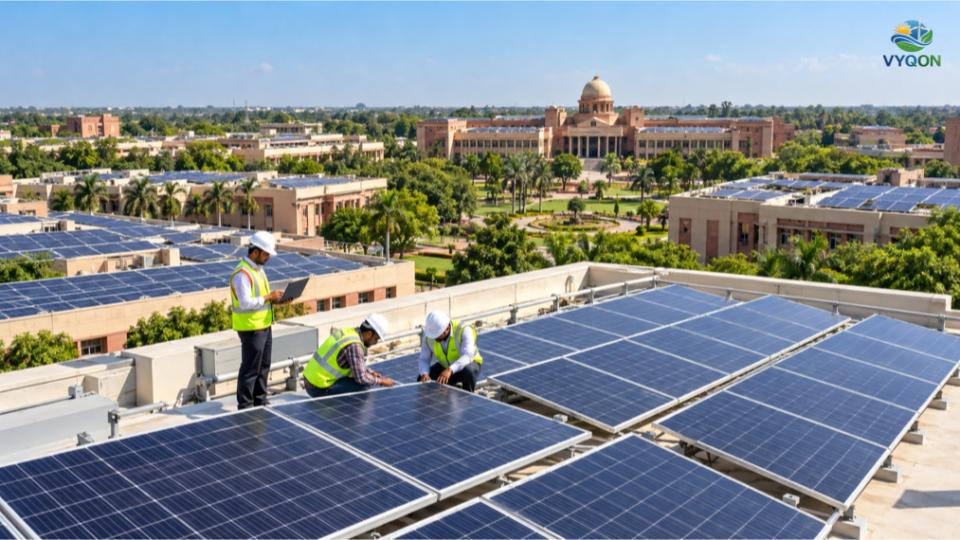
The ₹49.09 crore tender aims to install grid-connected rooftop solar systems at 76 agricultural research institutions across 24 states and Union Territories under the Government Building Solarization component of PM Surya Ghar: Muft Bijli Yojana.
REC Power Development and Consultancy Limited (RECPDCL) has invited bids for the installation of approximately 11.1 MW of grid-connected rooftop solar photovoltaic systems across 76 institutes operated by the Indian Council of Agricultural Research (ICAR).
The procurement, with an estimated value of ₹49.09 crore, covers engineering, procurement, construction (EPC), testing, commissioning and maintenance of solar installations under the Government Building Solarization (GBS) component of PM Surya Ghar: Muft Bijli Yojana.
Issued through the Government e-Marketplace (GeM) on 1 October 2026, the tender invites eligible agencies to submit bids by 22 October 2026.
The initiative forms part of an agreement signed between RECPDCL and ICAR in September 2026 to expand renewable electricity generation across India’s agricultural research infrastructure.
Project Covers 11.1 MW Across 76 ICAR Institutes
According to REC Limited’s official announcement dated 23 September 2026, the programme will cover 76 ICAR institutions located across 24 states and Union Territories.
The planned aggregate installation capacity is 11,109.87 kW (11.1 MW), with expected annual electricity generation of approximately 1.73 crore units (17.3 million kWh) once the systems become operational.
The project details are summarised below.
| Parameter | Project details |
|---|---|
| Implementing agency | RECPDCL |
| Beneficiary organisation | ICAR |
| Proposed solar capacity | 11.1 MW |
| Number of institutes | 76 |
| Geographic coverage | 24 states and UTs |
| Estimated tender value | ₹49.09 crore |
| Implementation model | ICAR-funded CAPEX |
| Expected annual generation | 1.73 crore units |
| Operation and maintenance | 5 years |
| GeM bid number | GEM/2026/B/8107512 |
| Bid submission deadline | 22 October 2026 |
The generation estimate represents projected electricity production rather than measured output from operating installations.
Actual annual generation will depend on local solar irradiation, system design, equipment performance and operating conditions.
ICAR-Funded CAPEX Model Supports Government Building Solarization
The project will follow a capital expenditure (CAPEX) model, with ICAR providing project funding and RECPDCL acting as the turnkey implementation partner.
Unlike a developer-financed Renewable Energy Service Company (RESCO) arrangement, the CAPEX approach involves capital investment by the beneficiary organisation rather than electricity purchases from a developer-owned installation under a long-term service tariff.
RECPDCL will coordinate project execution through empanelled EPC-cum-operation and maintenance agencies.
The procurement scope includes system design, engineering, equipment supply, installation, testing, commissioning and comprehensive maintenance for five years.
The objective is to increase renewable electricity generation at public research facilities while potentially reducing their dependence on conventional grid electricity.
The programme may also provide practical experience for implementing rooftop solar projects across other geographically dispersed government institutions.
Tender Details and Bidding Schedule
RECPDCL has issued the Request for Selection under GeM Bid Number GEM/2026/B/8107512.
The procurement seeks EPC-cum-O&M agencies from RECPDCL’s empanelled solar power developers.
According to published tender reporting, the estimated procurement value is ₹49.09 crore, including applicable taxes.
Key reported tender milestones include:
- Tender issue date: 1 October 2026
- Pre-bid meeting: 2 October 2026
- Bid submission deadline: 22 October 2026, 4:00 PM
- Scheduled bid opening: 23 October 2026, 4:00 PM
- Reported execution period: Four months and ten days
The tender is reportedly divided into five schedules, with competitive evaluation and reverse auction provisions.
However, prospective bidders should refer to the complete GeM documents and any subsequent amendments for binding financial, technical and contractual conditions.
The estimated tender value should not be interpreted as a final awarded contract price or expenditure already incurred.
Bifacial Solar Modules and Grid-Connected Technology
Published procurement reports indicate that the installations will use bifacial solar photovoltaic modules connected to the electricity grid without battery storage in the reported scope.
Bifacial modules can generate electricity from both their front and rear surfaces, potentially increasing energy yield when suitable installation conditions allow reflected sunlight to reach the rear side.
However, the additional generation depends on factors such as roof reflectivity, mounting height, module arrangement and shading.
Unlike ground-mounted installations with substantial clearance, rooftop systems may have limited rear-side irradiance, making site-specific design particularly important.
The proposed systems will operate through grid-connected inverters that convert DC electricity from solar modules into AC electricity suitable for institutional consumption.
Metering and electricity export arrangements will depend on the applicable state regulations and distribution utility requirements.
As no battery backup is included in the reported tender scope, the systems will primarily generate electricity during available sunlight hours.
Site-Specific Engineering Across Multiple Research Campuses
Installing rooftop solar systems across 76 institutions presents different challenges from constructing a single utility-scale solar plant.
Each location requires assessment of available rooftop area, structural strength, shading, electrical infrastructure and safe equipment access.
Engineering teams must consider roof loading capacity, waterproofing, wind resistance, drainage, module orientation and maintenance pathways.
These requirements are particularly important because the participating institutions are spread across different climatic regions.
Solar radiation, temperature, humidity and dust accumulation can vary significantly between sites, affecting generation performance and equipment maintenance requirements.
Electrical design must also account for earthing, surge protection, inverter anti-islanding protection, safe isolation and grid-interconnection compliance.
Effective coordination with institutional authorities will be essential to minimise disruption to laboratories, administrative buildings and research activities during installation.
Five-Year Maintenance to Support Long-Term Performance
The project includes five years of comprehensive operation and maintenance, making equipment reliability and monitoring important aspects of the procurement.
Solar PV systems require periodic inspection, cleaning, electrical testing and monitoring to maintain efficient operation.
For installations distributed across multiple states, centralised monitoring can help track electricity generation, identify inverter faults and compare performance across institutions.
However, remote monitoring must be supported by local maintenance teams capable of responding to equipment failures and carrying out preventive inspections.
Important operating indicators include specific energy yield, performance ratio, inverter availability, equipment failures and system losses.
Accurate monitoring will help determine whether the installations achieve their expected contribution of approximately 1.73 crore electricity units annually.
Reliable maintenance arrangements can also help protect the long-term value of ICAR’s capital investment.
Importance for India’s Public-Sector Solar Expansion
The ICAR rooftop solar programme demonstrates how government institutions can contribute to India’s renewable energy transition by using existing buildings for electricity generation.
Rooftop solar projects can reduce the need for additional land while producing electricity close to consumption points.
Research institutions often have significant daytime electricity requirements associated with laboratories, offices, cooling systems and other equipment.
Solar generation can help offset part of this demand, depending on individual site consumption profiles.
The programme also creates opportunities for domestic solar equipment suppliers, installation contractors, electrical engineers and maintenance service providers.
However, the project’s benefits will ultimately depend on successful execution, reliable grid connectivity and actual generation performance rather than planned capacity alone.
Conclusion
RECPDCL’s tender for approximately 11.1 MW of rooftop solar capacity across 76 ICAR institutes represents an initiative to expand renewable electricity generation within India’s public research infrastructure.
With an estimated procurement value of ₹49.09 crore, the project combines ICAR-funded capital investment, turnkey EPC implementation and five years of maintenance under the Government Building Solarization programme. Once operational, the installations are expected to generate approximately 1.73 crore units of electricity annually. The next milestones will include bid evaluation, contractor selection, site-specific engineering, installation and commissioning. Successful implementation could provide a useful model for scaling distributed solar power across public-sector institutions while supporting India’s broader clean energy objectives.
Sources:
REC Limited – Official ICAR Rooftop Solar Agreement-https://recindia.nic.in/recpdcl-signs-moa-with-icar-for-rooftop-solarisation-of-76-institutes-across-india
RECPDCL – Official Renewable Energy Tender Register-https://recpdcl.in/regenerationtenders
REC – CAPEX Rooftop Solar Procurement Listing-https://recindia.nic.in/tender_list.php?category=RECPDCL
SolarQuarter – Tender Value and Bid Details –https://solarquarter.com/2026/10/09/recpdcl-floats-inr-49-09-crore-tender-for-icar-rooftop-solar-projects-across-multiple-states/
Leave a Comment